
Magnite’s CTV Ambitions: Auction Model Transition, Margin Dynamics, and the Stakes of Platform Independence
Magnite’s evolution into a leading independent connected TV (CTV) advertising platform is anchored by its full-stack technology and strategic acquisitions. The company’s future hinges on the pace of industry adoption of biddable CTV auctions, its ability to scale operating leverage amid rising expenses, and the outcome of competitive and regulatory pressure on dominant incumbents.
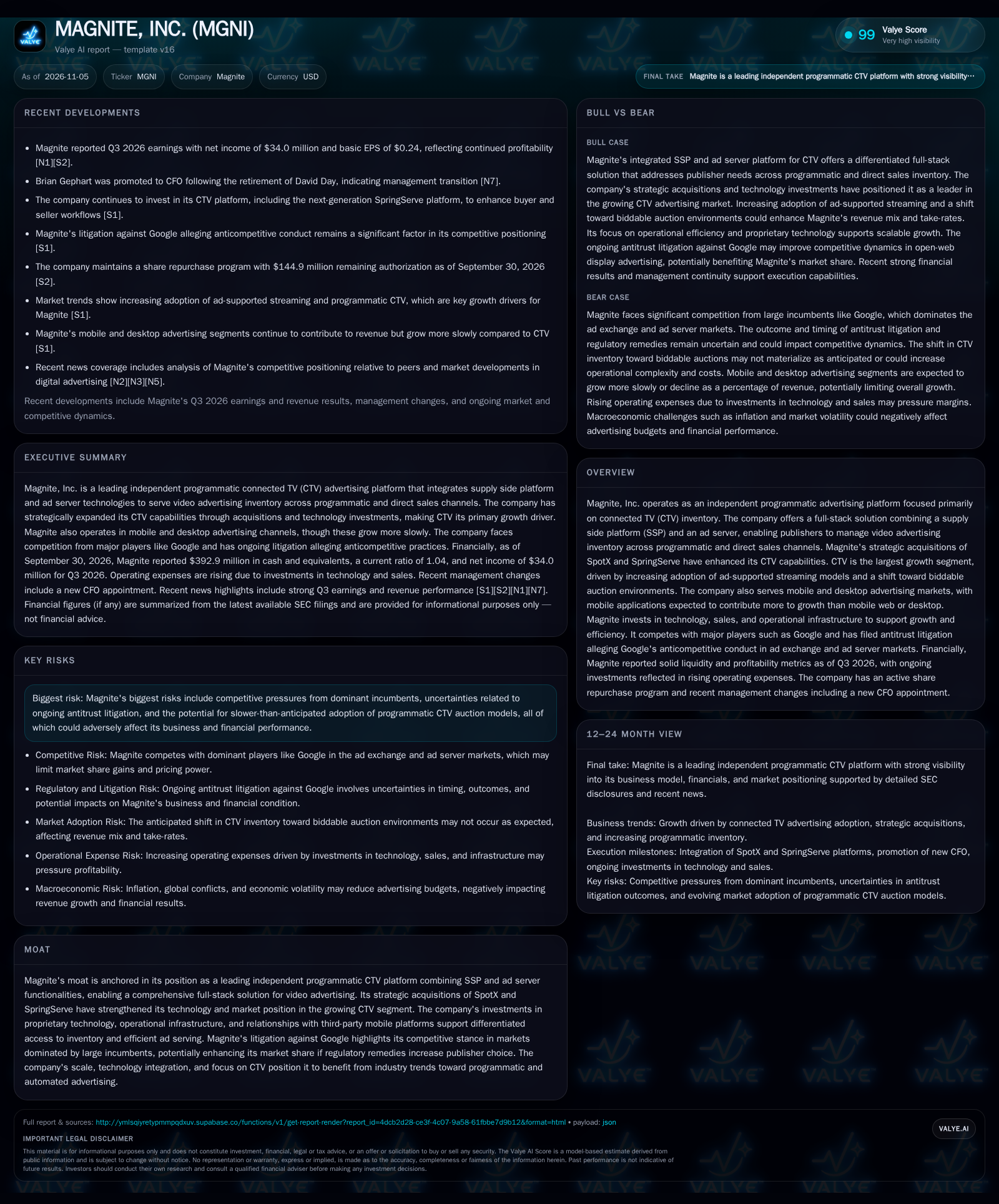
Magnite reported strong Q3 2026 results, with CTV driving revenue and margin growth, but faces rising expenses from ongoing investment and continued competition from entrenched players like Google. The company’s success depends on accelerating the industry shift to biddable CTV auctions, extracting operating leverage, and navigating regulatory and litigation headwinds. Monitoring CTV auction adoption, margin trends, and competitive developments will be critical for testing the thesis over the next 12-24 months. [S1] [S2] [N1]
Magnite’s position as a leading independent programmatic CTV platform is the result of targeted acquisitions, persistent investment in technology, and a strategic focus on the fastest-growing segment of video advertising. As CTV becomes increasingly central to the digital ad ecosystem, Magnite’s prospects hinge on the speed with which publishers and advertisers embrace auction-based buying, the company’s ability to scale its platform efficiently despite rising costs, and the evolving regulatory landscape. Success would mean not only capturing a larger share of CTV spend but also improving take rates and profitability in a market still dominated by entrenched giants. The next phase will reveal whether Magnite’s integrated stack and independent positioning can deliver durable economic advantages—or whether industry structure and execution challenges will limit its upside. [S1] [S2] [N1]
CTV Momentum and Investment Drive Magnite’s 2026 Operating Priorities
Magnite’s most recent quarter (Q3 2026) underscores the company’s deepening focus on connected TV (CTV). CTV revenue grew 9% year-over-year, while Contribution ex-TAC—an indicator of gross profit excluding traffic acquisition costs—rose 17%, highlighting both top-line momentum and improving margin profile in this segment. These results validate CTV as the company’s primary engine for growth, outpacing its mobile and desktop segments. [S1]
The company reported net income of $34.0 million for Q3 2026, with basic EPS of $0.24, and maintained cash and equivalents of $392.9 million at quarter end. However, operating expenses are rising due to ongoing investments in CTV technology (including the next-generation SpringServe platform), sales, and support. The company reported cash and liquidity metrics for the period; these figures do not by themselves establish operating runway, investment capacity, financial flexibility, or financing capacity. [S2]
Strategically, Magnite has a $200 million share repurchase authorization (with $144.9 million remaining), and has seen a CFO transition, potentially signaling evolving capital allocation and leadership priorities. Litigation against Google for alleged anticompetitive practices continues to shape Magnite’s competitive posture. [S2] [N7]
How Auction Adoption and Platform Scale Could Reshape Magnite’s Margin Structure
Magnite’s business model is built on acting as a supply side platform (SSP) and ad server for publishers, primarily in CTV, but also in mobile and desktop environments. Revenue is typically generated via a take rate on ad spend transacted through its platform. A key economic lever is the shift from reserve (single-buyer) to biddable (multi-buyer) CTV auctions: biddable environments generally command higher take rates, as competition among buyers drives up prices and increases platform value capture. If publishers broadly adopt biddable auctions, Magnite could see both revenue and margin expansion.
The company’s cost structure features a mix of fixed and variable elements. Technology investments—including on-prem data centers to support high-volume CTV transactions—represent significant fixed costs, but as transaction volume scales, Magnite could achieve operating leverage, improving margins over time. Rising operating expenses, however, are a near-term headwind, reflecting the arms race in CTV technology and the need to support integration of acquired platforms (SpotX, SpringServe).
Capital needs are not especially intensive outside of technology and infrastructure investment, but ongoing R&D and sales investments are critical to maintain competitive parity and support publisher relationships. [S1] [S2]
Independence Versus Scale: Navigating a Market Shaped by Giants and Ecosystem Lock-In
Magnite’s main competitive advantage is its independence: it is not vertically integrated with buy-side platforms or content owners, making it an attractive partner for publishers seeking neutrality in a market otherwise dominated by Google and, to a lesser extent, The Trade Desk and other full-stack players. Strategic acquisitions (SpotX, SpringServe) have consolidated Magnite’s position as the largest independent CTV SSP, particularly for premium video inventory.
However, the company faces powerful counterforces. Google’s dominance in mobile and desktop ad exchanges creates significant inertia and network effects, while its ability to bundle ad serving, analytics, and exchange functions can lock publishers into its ecosystem. Magnite’s litigation against Google for anticompetitive conduct is a direct response to these dynamics, but the outcome and timing of regulatory intervention are highly uncertain. [S1]
Substitution risk also exists: publishers could build or license their own technology, or shift to alternative monetization models (such as direct deals or private marketplaces) that bypass SSPs. The pace of adoption for biddable CTV auctions is another wild card—if industry transition stalls, Magnite’s margin thesis weakens.
If Biddable Auctions Scale and Regulatory Tailwinds Arrive, Margin Expansion Could Accelerate
The most favorable scenario for Magnite involves rapid industry-wide adoption of biddable CTV auctions, with publishers migrating away from reserve models and embracing programmatic competition. This would likely drive higher take rates, expand the company’s share of CTV ad spend, and enable significant operating leverage as fixed technology costs are spread over growing transaction volume.
A positive resolution to antitrust litigation—whether through regulatory action or market-driven change—could loosen Google’s grip on the ad tech stack, increasing Magnite’s addressable market and improving its negotiating power with publishers. Continued execution on technology integration and operational efficiency would further support margin gains.
Confirmation would come from accelerating CTV revenue and Contribution ex-TAC growth, rising take rates in CTV, and signs of share gains from Google or other large incumbents. Announcements of major publishers adopting Magnite’s biddable auction platform would also be strong evidence.
Steady CTV Growth, but Margin Gains Offset by Rising Investment and Industry Friction
The most plausible path is one in which Magnite continues to deliver mid-single-digit to low double-digit CTV revenue growth, but margin expansion is limited by ongoing technology investment and only gradual adoption of biddable auction models. Mobile and desktop segments remain stable or decline as a share of total revenue, with CTV accounting for the majority of growth.
Litigation and regulatory processes against Google remain unresolved in the medium term, providing no immediate boost to Magnite’s competitive position. Operating expenses continue to rise as the company invests to keep pace with evolving CTV requirements and publisher expectations.
Evidence consistent with this scenario would be moderate CTV revenue and Contribution ex-TAC growth (similar to current trends), stable or slightly increasing operating expenses, and no major shifts in publisher auction model adoption or regulatory outcomes.
If Auction Adoption Stalls and Costs Outpace Growth, Profitability Could Erode
Magnite’s risks crystallize if publishers are slow to embrace biddable CTV auctions, dampening take rate and margin expansion. If entrenched competitors like Google maintain their dominance—either through technical lock-in or regulatory inertia—Magnite may struggle to grow market share or improve its economics.
Rising operating expenses could further pressure profitability, especially if technology investments fail to yield the expected growth or efficiency gains. Macro headwinds—such as a downturn in ad spending—would amplify these pressures, particularly given the company’s relatively reported liquidity position cushion and the fixed nature of many technology costs.
Downside evidence would include flat or declining CTV revenue, stagnating Contribution ex-TAC, sustained increases in operating expenses without corresponding revenue growth, or signs that publishers are reverting to direct or private market deals rather than programmatic auctions.
Milestones and Metrics That Will Determine Whether Magnite’s Platform Strategy Delivers
The quarterly growth rate of CTV revenue and Contribution ex-TAC; acceleration would support the upside scenario, while deceleration could signal adoption or competitive issues. [S1] [S2]
Publisher adoption rates for biddable CTV auctions (if disclosed); a useful metric would be the percentage of CTV inventory transacted via biddable auctions versus reserve models.
Trends in take rate for CTV transactions; rising take rates would indicate improved platform value capture.
Operating expense growth relative to revenue growth; persistent cost escalation without margin improvement would be a warning sign.
Progress and updates in the ongoing Google antitrust litigation, especially any regulatory or market developments that could alter competitive dynamics.
Integration milestones for the next-generation SpringServe platform and evidence of operational efficiency gains.
Changes in the company’s liquidity position, particularly if operating cash flow deteriorates or significant new investments are required.
Disclaimer: This is research-only, informational analysis and not investment advice. It may include AI-generated interpretation and general industry context. Always verify important details using primary sources.

Comments