
Innoviva’s Earnings Outperformance and Liquidity Strength: Can Strategic Partnerships Offset Profitability Pressures?
Innoviva, Inc. shows reported liquidity position and a pattern of earnings and revenue outperformance in 2026, but persistent negative EPS raises questions about the durability of its underlying business economics.
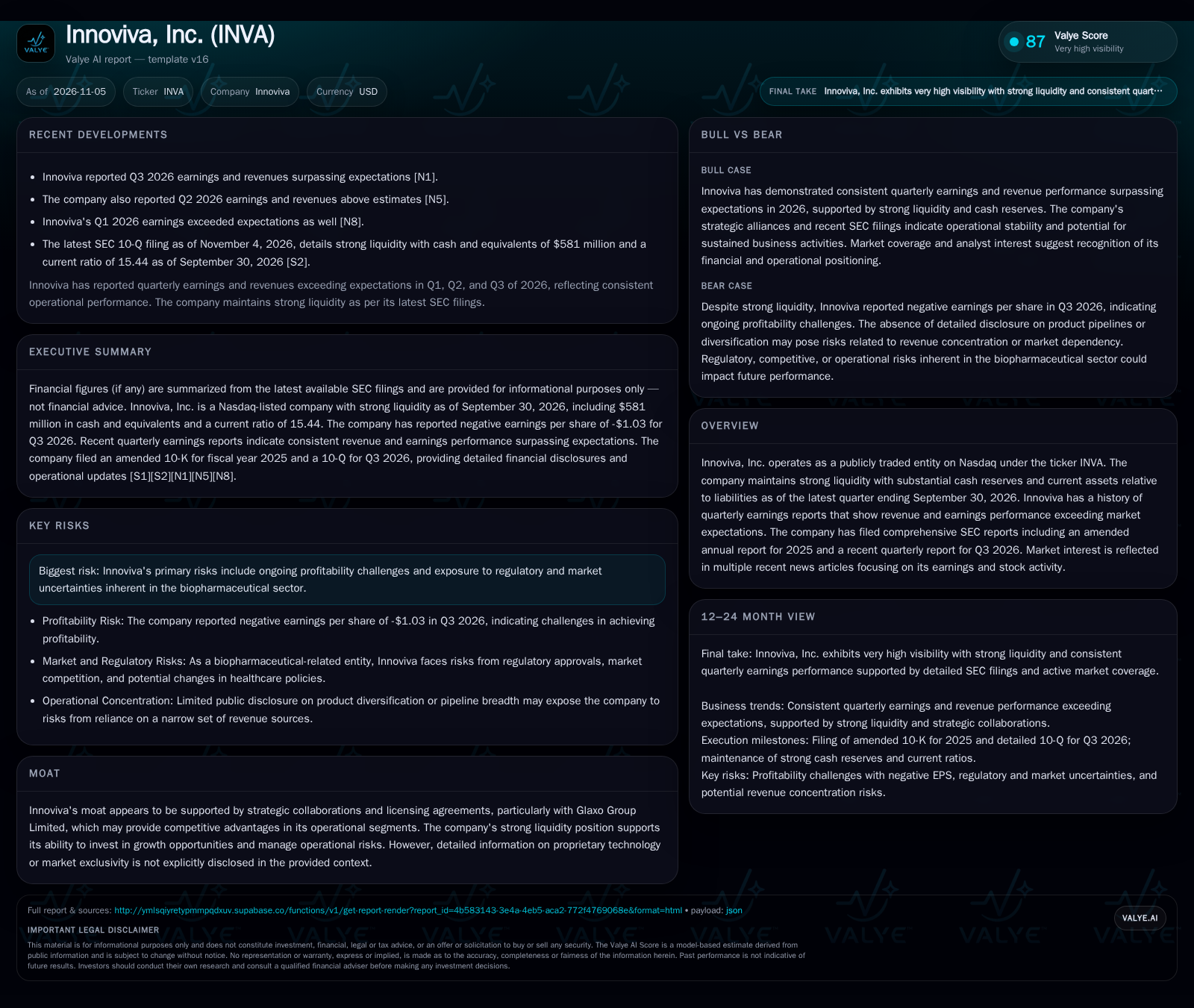
Innoviva, Inc.(Nasdaq: INVA) reported liquidity position as of September 30, 2026, with $581.4 million in cash and a reported current ratio, and has delivered three consecutive quarters of earnings and revenue above expectations. Yet, the company posted a Q3 2026 loss per share of -$1.03, highlighting ongoing profitability challenges. Strategic collaborations, notably with Glaxo Group Limited, underpin its competitive positioning, but the durability of its earnings power and revenue diversification remain open questions. [S2] [N1] [N5] [N8]
Innoviva, Inc. stands out for its rare combination of reported liquidity position and consistent quarterly earnings outperformance in 2026, with cash reserves far exceeding current liabilities and repeated positive surprises on both revenue and earnings. However, the company’s negative earnings per share in its latest quarter signals a deeper challenge: the ability to translate operational momentum and strategic partnerships into durable profitability. The tension between robust potential financial flexibility and ongoing losses will likely define Innoviva’s next chapter, as investors weigh the sustainability of its business model against the risks of concentration and sector volatility.
Earnings Outperformance Meets Persistent Losses: Where Innoviva Stands Now
As of September 30, 2026, Innoviva reported $581.4 million in cash and cash equivalents, current assets of $772.3 million, and current liabilities of just $50.0 million, resulting in a striking current ratio of 15.44 and a cash ratio of 11.63. Despite this, the company posted a basic and diluted EPS of -$1.03 for Q3 2026, confirming that profitability remains elusive. Notably, Innoviva has delivered quarterly earnings and revenue that exceeded analyst expectations for three consecutive quarters in 2026, drawing active market attention and analyst coverage. The strategic relationship with Glaxo Group Limited remains a foundational component of its business model. [S2] [N1] [N5] [N8]
How Innoviva’s Business Model Translates Revenue into Cash—And Where the Gaps Lie
Innoviva’s core economics appear rooted in royalty revenues and strategic collaborations, particularly with major pharmaceutical partners. The company’s historical model has emphasized collecting royalties or milestone payments from out-licensed assets, rather than direct product sales. This structure generally offers high gross margins and low fixed costs, as operational execution and R&D risk are often borne by partners. However, the absence of product diversification or a broader late-stage pipeline can make the company’s revenue base vulnerable to fluctuations in partner performance or patent expirations.
While the company’s reported cash position and minimal current liabilities suggest limited capital intensity, the negative reported EPS hints at either high non-operating charges, R&D expenses, or limited recurring revenue base relative to overhead. Innoviva may be in a phase where it is reinvesting or acquiring assets to diversify and sustain long-term growth, but without clear disclosure on new drivers, its ability to generate consistent, growing cash flows remains uncertain. The central economic question is whether its royalty streams and collaboration income can outpace costs and potential declines from maturing assets.
A critical factor in assessing Innoviva’s business economics is the sustainability and predictability of its royalty revenue streams. Given that royalties are often contingent on partner sales performance, the company’s revenue visibility depends heavily on the commercial success and lifecycle stage of partnered products. If partners face market share erosion or regulatory challenges, Innoviva’s income could be disproportionately impacted. Furthermore, the timing and magnitude of milestone payments can introduce episodic revenue spikes that complicate forecasting. Therefore, the company’s ability to smooth earnings volatility hinges on either broadening its royalty portfolio or securing agreements with more predictable revenue profiles.
Another economic consideration involves Innoviva’s cost structure relative to its revenue base. While royalty models typically incur lower direct costs, ongoing investments in business development, legal, and administrative functions can create a fixed cost floor that pressures profitability during revenue downturns. If Innoviva is actively pursuing asset acquisitions or in-licensing deals, associated due diligence and integration expenses may further weigh on earnings.
Strategic Alliances and Royalty Streams: Innoviva’s Moat and Its Limits
Innoviva’s competitive position is anchored by its strategic agreements, most notably with Glaxo Group Limited. Such relationships can confer durable advantages, including preferential access to proven products or revenue streams, and insulation from some commercialization risks. In the royalty aggregation model, scale and quality of partners are key differentiators: a robust alliance with a global pharmaceutical leader can provide both stability and enhanced deal flow opportunities.
However, this model also faces significant counterforces. Royalty income is typically finite, tied to the lifecycle of underlying products, and exposed to generic competition or regulatory shifts. Without a pipeline of new assets or diversification into either new therapeutic areas or business models, Innoviva risks becoming overly dependent on a shrinking pool of royalty-generating products. In the current landscape, peer companies include royalty aggregators, specialty pharmaceutical firms, and healthcare investment entities, all of which compete for the same class of assets and partnerships.
What It Would Take for Innoviva to Unlock Sustainable Profitability
The most favorable scenario for Innoviva involves leveraging its strong cash reserves to acquire or in-license new royalty streams or commercial-stage assets, thereby diversifying and extending its revenue base. If the company’s strategic partnerships—especially with Glaxo Group Limited—yield additional milestones, expanded indications, or new product launches, Innoviva could see a step-change in royalty income and improved operating leverage.
Confirmation would come from disclosures of new asset acquisitions, expanded collaboration agreements, or evidence of a broadening revenue base in future filings—particularly if accompanied by a return to positive EPS. Conversely, if quarterly results continue to show outperformance on the top line and a narrowing of losses, it would suggest that recent investments or cost controls are beginning to bear fruit.
Stability Through Partnerships, But Growth Hinges on Asset Pipeline
The most plausible near-term path for Innoviva is continued reliance on its existing royalty streams and partnership income, with periodic outperformance relative to consensus as partner products perform well or cost controls are implemented. However, without clear evidence of new growth drivers or material asset diversification, earnings may remain volatile and negative, especially as legacy royalty streams mature.
The base scenario would be confirmed if Innoviva maintains its pattern of beating quarterly expectations but struggles to achieve sustained profitability, with EPS fluctuating around breakeven or moderately negative. Falsification would come from a marked deterioration in royalty income, increased operating losses, or evidence of asset write-downs or failed acquisitions.
Concentration Risk and Eroding Royalties: How Innoviva Could Lose Its Cushion
The primary risk for Innoviva is that its main revenue streams—particularly those tied to Glaxo Group Limited or other key partners—begin to decline due to patent expirations, generic competition, or partner underperformance.
Confirmation of this downside would come from disclosures of royalty declines, asset impairments, or guidance cuts related to partner product sales.
Benchmarks for Testing Innoviva’s Ability to Turn Liquidity into Durable Earnings Power
Quarterly disclosure of royalty and collaboration income by product and partner, to gauge revenue concentration and resilience.
Updates on new asset acquisitions, in-licensing deals, or expanded collaboration agreements, which would indicate efforts to diversify and grow future income streams.
Trends in operating expenses and R&D outlays, to assess whether cost controls are improving profitability or merely deferring losses.
EPS trajectory in the next two to four quarters—especially whether losses are narrowing or flipping to positive territory.
Cash flow from operations, if disclosed, to distinguish between accounting losses and underlying cash generation.
Any regulatory or legal developments impacting core royalty streams or partnership agreements.
Management commentary or guidance on the outlook for existing and potential new revenue sources.
Disclaimer: This is research-only, informational analysis and not investment advice. It may include AI-generated interpretation and general industry context. Always verify important details using primary sources.

Comments