
American Bitcoin Corp.: Scaling Mining and Treasury Ambitions in a Volatile Crypto Cycle
The strategic bet: outlast and outscale rivals as halving and capital scarcity reshape the mining landscape.
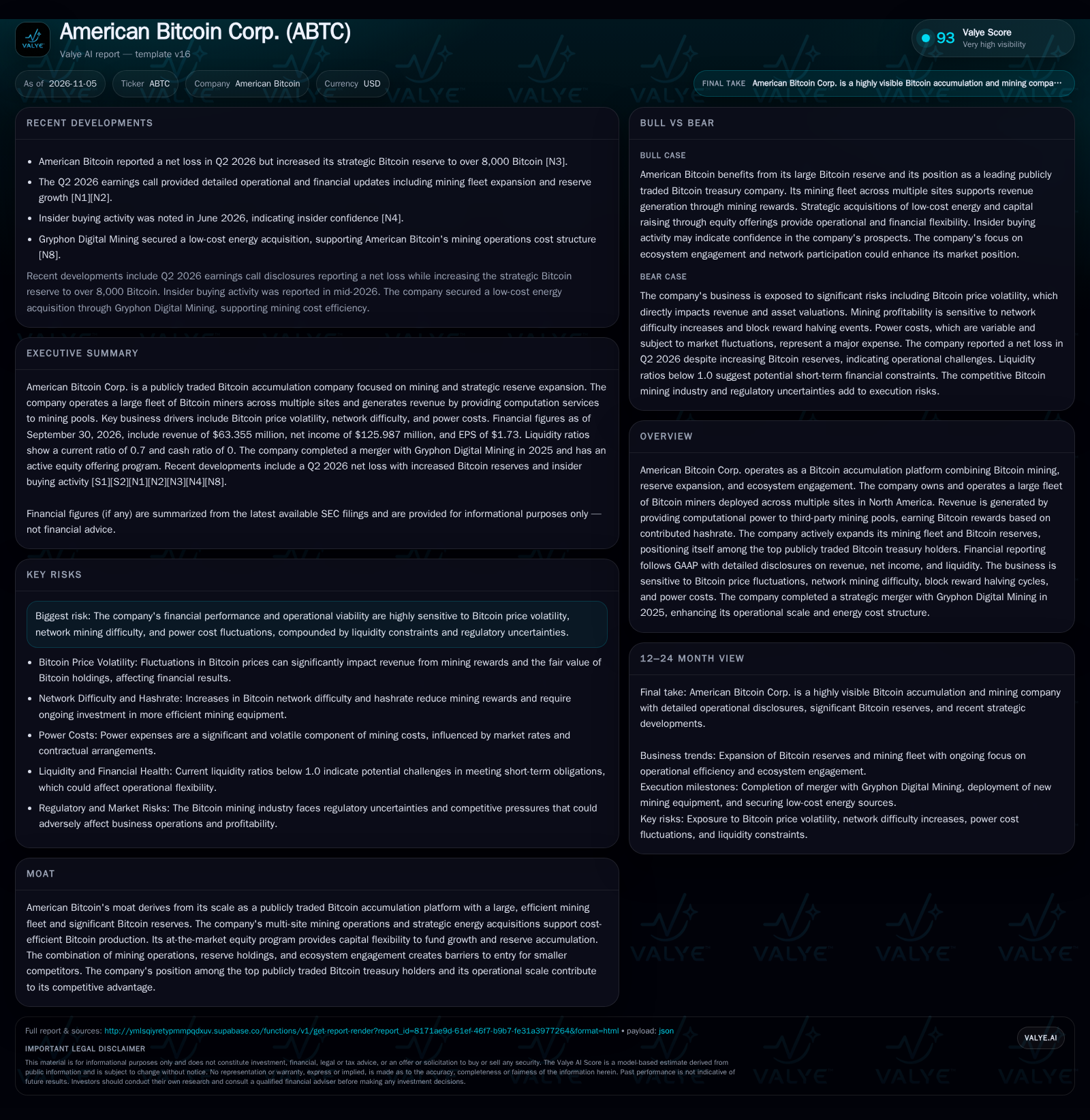
American Bitcoin Corp. is one of the largest publicly traded Bitcoin accumulation platforms, operating a major mining fleet and holding nearly 7,000 Bitcoin in reserve as of March 2026. Revenues are generated from providing computational power to mining pools, but recent results show a Q2 net loss despite increasing reserves to over 8,000 Bitcoin. With a current ratio of 0.7 and minimal cash, the business is highly sensitive to Bitcoin price, network dynamics, and power costs. [S1] [S2] [N1] [N2] [N3] [N4]
American Bitcoin Corp. sits at the intersection of industrial-scale Bitcoin mining and public-market treasury accumulation, aiming to achieve durable scale in an industry characterized by extreme cyclicality and technological arms races. With nearly 7,000 Bitcoin held as of March 2026—and reserves subsequently surpassing 8,000 by Q2—the company ranks among the largest public holders globally. But as the business expands its mining fleet to almost 90,000 units and faces a post-halving landscape, it must contend with sharp Bitcoin price swings, rising network difficulty, and persistently thin liquidity. These dynamics set the stage for an aggressive, but high-stakes, bid to consolidate share in a capital-starved sector where only the most efficient and well-capitalized players are likely to endure.
Fleet Expansion and Treasury Accumulation Amid Financial Strain
American Bitcoin Corp. reported revenue of $63.4 million and net income of $126 million for the September 2026 quarter, yet posted a net loss in Q2 2026 even as it increased its strategic Bitcoin reserve to over 8,000 coins. As of March 2026, the company held 6,963 Bitcoin, ranking among the top 16 public treasury holders. The mining fleet continues to expand, with 89,000 miners owned (28.1 EH/s) and 59,000 operational (25.0 EH/s). However, liquidity remains tight: the current ratio stands at 0.7, with only $678,000 in cash and minimal short-term investments. An at-the-market equity program authorizes up to $2.1 billion in share issuance, reflecting the need for continual capital. The company reported cash and liquidity metrics for the period; these figures do not by themselves establish operating runway, investment capacity, financial flexibility, or financing capacity. [S1] [S2] [N3] [N4]
Mining Economics and the Leverage of Bitcoin Price Cycles
American Bitcoin’s core business model is to accumulate Bitcoin by operating a large-scale, energy-intensive mining fleet and participating in third-party mining pools, receiving Bitcoin rewards proportional to contributed hashrate. Revenue is a direct function of the Bitcoin price, network block rewards, and the company’s share of total network hashrate. In periods of high Bitcoin prices and manageable network difficulty, gross margins can be substantial—especially for operators with low-cost power and efficient hardware.
However, the economics are inherently volatile. The block reward halving (which occurs roughly every four years) instantly cuts mining revenue per unit of hashrate in half, while network difficulty tends to rise as more miners compete for fewer rewards. Power costs are the largest variable expense, and their volatility can quickly erode margins during bear markets. Fixed costs—primarily depreciation and site overhead—create operating leverage: if mining margins compress, losses can mount rapidly.
The company’s at-the-market equity program is a critical capital lever, enabling ongoing fleet expansion and reserve accumulation without relying on debt. But frequent share issuance can dilute existing shareholders, especially if done at depressed valuations. [S1] [S2]
Scale, Energy Sourcing, and Treasury Strategy Shape Competitive Edge
American Bitcoin’s competitive positioning hinges on three intertwined factors: mining fleet scale, access to low-cost power, and the ability to accumulate and hold large Bitcoin reserves. The company’s nearly 90,000 owned miners and multi-site North American footprint provide industrial-scale network participation, which may yield procurement advantages for hardware and energy. Its status as one of the largest public Bitcoin treasuries could attract institutional interest and ecosystem partnerships.
Yet, these advantages are not unassailable. The global mining industry is fragmented, with formidable competitors in North America, Asia, and elsewhere—many with their own scale, energy deals, or vertically integrated structures. Barriers to entry are high mainly due to capital intensity and power access, but the sector remains exposed to rapid technological obsolescence (as new ASICs outpace old hardware), regulatory shocks, and unpredictable government policy (such as mining bans or tariffs).
Energy sourcing is a double-edged sword: while strategic deals can provide cost stability, any disruption or spike in power prices can quickly undermine cost leadership. The company’s heavy reliance on external capital also makes it vulnerable to market sentiment, especially if equity markets turn risk-averse or if sector multiples compress. The ability to weather prolonged bear markets and capitalize on distressed asset sales will be a key test of durable advantage.
Capitalizing on Bitcoin Bull Cycles and Sector Shakeout
In a favorable scenario, the price of Bitcoin rallies—driven by institutional adoption, macroeconomic instability, or new ETF inflows—boosting both the value of American Bitcoin’s reserves and the profitability of its mining operations. With a large, efficient fleet and multiple power sites, the company could achieve industry-leading margins and accelerate reserve accumulation, reinforcing its status as a top public Bitcoin treasury.
A sector-wide shakeout (perhaps triggered by halving or rising power costs) could force higher-cost or undercapitalized miners to exit, reducing network difficulty and allowing survivors like American Bitcoin to capture greater share and temporarily higher margins. If the company is able to raise equity at attractive valuations, it could further scale operations, acquire distressed assets, or lock in long-term power contracts.
Evidence confirming this scenario would include sustained or surging Bitcoin prices, declining network difficulty relative to the company’s hashrate, margin expansion in quarterly results, successful equity raises with limited dilution, and continued reserve growth. Announcements of ecosystem partnerships or new institutional treasury clients would further bolster the case.
Navigating Cyclical Volatility with Marginal Profitability
The most plausible outcome is that American Bitcoin continues to operate at the edge of profitability, with results fluctuating quarter-to-quarter depending on Bitcoin price, network difficulty, and power costs. Mining revenue and margins may remain compressed post-halving, but the company leverages its at-the-market equity program to fund ongoing operations and modest reserve growth.
Shareholder dilution could increase if equity is issued at lower prices, but the company maintains enough scale and operational flexibility to avoid insolvency. The company’s reserve accumulation continues, but at a slower pace, and the stock trades largely as a levered play on Bitcoin price cycles.
Evidence supporting this scenario would be quarterly reports showing modest revenue growth or stabilization, small net profits or losses, regular but not transformative equity issuance, and a relatively stable operational fleet size. Any significant deviation in liquidity, reserve drawdown, or mining fleet shrinkage could falsify this baseline.
Liquidity Crunch and Sector Compression Risk
If Bitcoin prices decline significantly or remain stagnant while network difficulty continues to rise, American Bitcoin could face persistent negative mining margins, forcing it to sell reserves to meet operating expenses or service obligations.
Should equity markets sour—reducing the appetite for dilutive share issuance—the company could find itself unable to fund fleet maintenance, power contracts, or expansion, leading to operational retrenchment or even forced asset sales. Regulatory actions targeting mining operations or power use could further exacerbate cost pressures or restrict site operations.
Evidence confirming a downside scenario would include a rapid drawdown of Bitcoin reserves, shrinking operational fleet size, missed or delayed payments on contracts, or public disclosures of financing shortfalls. Announcements of regulatory investigations, major power cost spikes, or sector-wide bankruptcies would also signal acute risk.
Milestones That Will Shape American Bitcoin’s Relative Strength
Quarterly changes in Bitcoin reserve holdings—both absolute and as a percentage of total assets—would help test whether the company is accumulating or liquidating under pressure.
Operational fleet size and efficiency metrics (such as EH/s per miner and total power consumption), if disclosed, would clarify the company’s cost position versus peers.
Gross margin trends and mining revenue per EH/s in future filings will indicate the impact of Bitcoin price, network difficulty, and power cost volatility.
Details on power contracts, energy sourcing, and site-level cost structure—especially any new long-term agreements or exposure to spot market rates.
Frequency, size, and pricing of at-the-market equity issuances will reveal the company’s ongoing access to capital and the degree of shareholder dilution.
Liquidity disclosures beyond simple ratios—such as working capital trends and any debt covenant information—would provide a clearer view of financial runway.
Regulatory developments in the company’s major jurisdictions (e.g., North America) regarding mining, energy use, or crypto asset treatment.
Insider trading activity and management commentary on strategic priorities could signal internal confidence or emerging concerns.
Disclaimer: This is research-only, informational analysis and not investment advice. It may include AI-generated interpretation and general industry context. Always verify important details using primary sources.

Comments