
Dave Inc.: Growth in Short-Term Credit, Margin Pressures, and the Stakes of AI-Driven Underwriting
Dave Inc. has accelerated service-based and subscription revenue growth through increased ExtraCash origination and member engagement, but rising credit losses and operating expenses highlight the challenge of scaling short-term fintech lending.
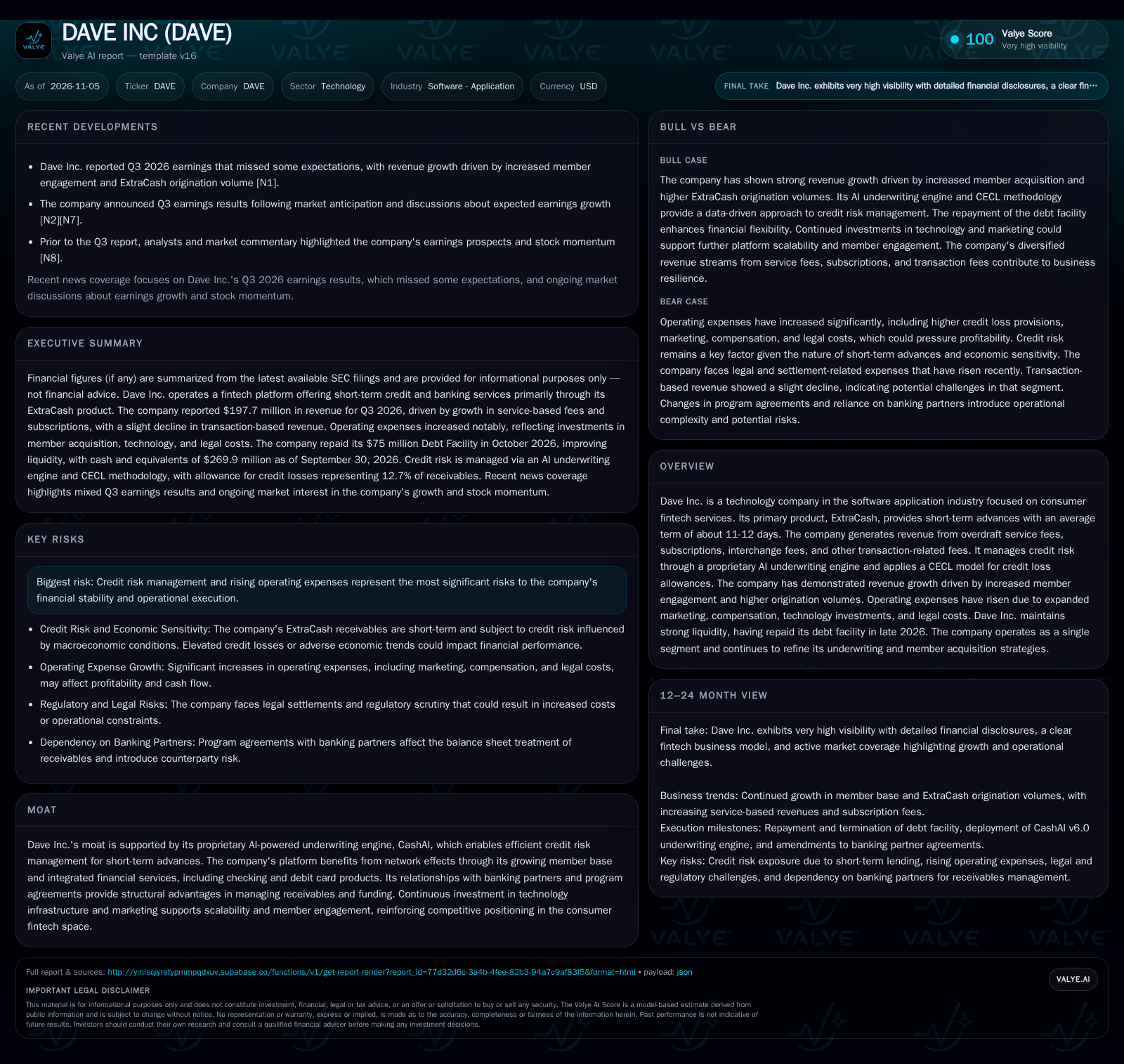
Dave Inc.’s Q3 2026 results show robust top-line growth from its ExtraCash short-term advance product and expanded subscriptions, supported by proprietary AI underwriting and a growing member base. However, significant increases in credit loss provisions and operating expenses underscore the cost and risk of scaling consumer fintech lending. [S2] [N1]
Dave Inc. is scaling its consumer fintech platform by leveraging proprietary AI underwriting and expanding short-term credit access through its flagship ExtraCash product. The company’s Q3 2026 results highlight impressive service and subscription revenue gains, fueled by increased member engagement and origination volume. Yet, as Dave’s operating expenses and credit loss provisions climb sharply, questions emerge about the sustainability of its growth model, the resilience of its risk management, and the long-term economics of short-duration lending. [S2] [N1]
Recent Financial Performance and Portfolio Shifts Shape the Current Debate
Dave Inc. reported Q3 2026 operating revenue of $197.7 million, up 31% year-over-year, driven by growth in ExtraCash origination volume (from ~$2.0 billion to ~$2.5 billion) and an 18% increase in average monthly transacting Members. Service-based and subscription revenues were the primary growth engines, with subscription revenue up 74% due to more paying members and higher fees. However, provision for credit losses rose 22% to $36.5 million, reflecting both portfolio expansion and a modest uptick in loss rates. Operating expenses climbed 43% to $149.7 million, outpacing revenue growth and compressing margins. Dave repaid and terminated a $75 million debt facility in October 2026, reporting $269.9 million in cash and a current ratio of 4.22 at quarter-end. Notably, legal and settlement-related costs have increased, and transaction-based revenue declined slightly, highlighting new headwinds for the platform. [S2] [N1]
Short-Term Lending Economics: Fee Revenue, Credit Risk, and Operating Leverage
Dave Inc. monetizes its platform through a mix of service-based fees (overdraft and subscription) and transaction-based fees (interchange and ATM). The ExtraCash product, featuring short-term advances of 11-12 days, generates revenue through a combination of direct service fees and subscription upgrades. The business model is capital-light compared to traditional lenders, as Dave leverages banking partnerships and offloads some receivables, but it remains highly sensitive to credit risk and member behavior.
The company’s proprietary AI underwriting engine, CashAI, is designed to optimize risk selection and limit credit losses. Still, as the portfolio grows, provision for credit losses and the allowance for credit losses (at 12.7% of receivables) remain significant drains on profitability. Operating leverage is possible as technology and network costs are spread across a larger member base, but recent results show that fixed and variable expenses—including processing, network costs, advertising, compensation, and legal—are rising rapidly. Sustained margin expansion depends on whether incremental revenue per member can consistently outpace marginal credit and operating costs, especially as Dave pushes for broader adoption and deeper engagement.
AI Underwriting and Member Engagement: Differentiators or Commodity Pressures?
Dave’s competitive story hinges on its proprietary CashAI underwriting, ability to scale member acquisition, and integrated banking features. Theoretically, advanced AI-driven risk assessment can lower loss ratios and enable profitable lending at scale—a potential moat in a crowded fintech landscape. The company’s network effects may be reinforced by a larger, engaged member base that uses multiple services, boosting retention and fee yield.
However, the short-term lending and neobank space is intensely competitive, with numerous fintechs and traditional banks offering overlapping products. Many rivals also deploy machine learning for underwriting, and regulatory scrutiny of overdraft and advance fees remains a threat. Switching costs for digital banking apps are generally low, and customer loyalty is often driven by price, convenience, or app experience rather than deep platform lock-in. Dave’s challenge is to maintain underwriting edge and member engagement while defending fee structures and managing legal/regulatory risks.
If AI Underwriting Delivers Superior Loss Control, Margin Expansion Could Accelerate
The bullish scenario rests on Dave’s ability to translate AI-driven credit selection into structurally lower loss rates and higher per-member economics. If CashAI v6.0 enables better risk segmentation, the company could expand originations without proportional increases in credit losses, unlocking operating leverage as revenue outpaces expense growth. Sustained growth in paying members and successful upselling of subscriptions would boost recurring revenue and reduce reliance on transaction fees.
Evidence supporting this scenario would include a declining loss ratio (provision for credit losses as a percentage of originations), stable or improving operating margins despite higher origination volumes, and growing average revenue per member. Additional signals would be continued growth in subscription penetration, successful cross-selling of new financial services, and further reductions in member acquisition cost (if disclosed). Falsification would come from persistently rising loss rates, stagnant or falling margins, or regulatory changes that cap or restrict service fees.
Sustained Growth, but Margin Gains Remain Elusive as Expenses Track Revenue
The most plausible path is continued growth in ExtraCash origination and monthly transacting members, with service and subscription revenues expanding at a steady clip. However, operating expenses—especially credit loss provisions, technology, marketing, and legal—are likely to remain elevated as Dave invests for scale and navigates ongoing legal and regulatory challenges. Margin expansion may prove difficult if incremental revenue per member is offset by higher credit risk and costs, especially as the company targets less-prime borrowers or faces competitive pricing pressure.
This scenario would be confirmed by ongoing double-digit revenue growth alongside similar increases in operating expenses and credit loss provisions, with flat or only modestly improving profitability. Watchpoints include the stability of allowance for credit losses as a percentage of receivables, the ability to maintain or grow subscription revenue, and the trend in legal/settlement costs. A break from this path—either via a sharp inflection in margins or a stall in top-line growth—would signal a transition to an upside or downside scenario.
Rising Credit Losses and Legal Costs Erode Profitability Despite Top-Line Growth
The primary risk is that rapid origination growth leads to adverse credit selection, with loss rates rising faster than AI models can adapt. If macroeconomic stress or regulatory changes hit key member cohorts, Dave could experience a spike in charge-offs, forcing higher credit loss provisions and shrinking net income. Simultaneously, continued escalation in legal, compliance, and technology costs could overwhelm any revenue gains, especially if transaction-based revenues stagnate or decline.
Confirmation of this scenario would include a material increase in the allowance for credit losses as a percentage of receivables, sequential deterioration in net income or return on equity, and mounting legal/settlement expenses. If member growth slows or churn increases—perhaps due to competitive offers or negative publicity—the top-line could stall, further exposing fixed cost leverage and pressuring cash flow. A reversal of recent liquidity gains or renewed reliance on external debt would also be a negative signal.
What Will Determine the Durability of Dave’s Fintech Model?
Quarterly trend in provision for credit losses versus origination volume—does the loss ratio improve, stabilize, or deteriorate as the portfolio grows?
Average revenue per transacting Member and growth in subscription penetration—are monetization efforts keeping pace with member acquisition costs?
Operating margin and net income progression relative to expense growth—can Dave achieve sustainable margin expansion as it scales?
Allowance for credit losses and off-balance-sheet liability as a percentage of receivables—are reserve levels adequate, and do they signal emerging portfolio stress?
Legal and settlement-related expenses—do these costs stabilize, or do they continue to absorb a growing share of operating expense?
Member churn and retention rates—a useful metric would be monthly active user retention, to test platform stickiness and cohort quality.
Impact of regulatory or partner bank changes—any new restrictions on fee structures or program agreements could materially affect revenue and operating flexibility.
Cash flow from operations and any future changes in debt or liquidity position—does Dave maintain its current financial cushion as it grows?
Disclaimer: This is research-only, informational analysis and not investment advice. It may include AI-generated interpretation and general industry context. Always verify important details using primary sources.

Comments