
Flowco Holdings: Acquisition-Driven Expansion and the Strategic Stakes in Oilfield Production Optimization
Flowco Holdings leverages targeted acquisitions and a broadening artificial lift portfolio to capture durable demand in oilfield production optimization, while navigating the cyclical pressures and integration risks inherent to oilfield services. Recent financial outperformance and capital deployment signal a company at an inflection point—where scale, technology, and operational discipline may determine its margin and resilience through industry cycles.
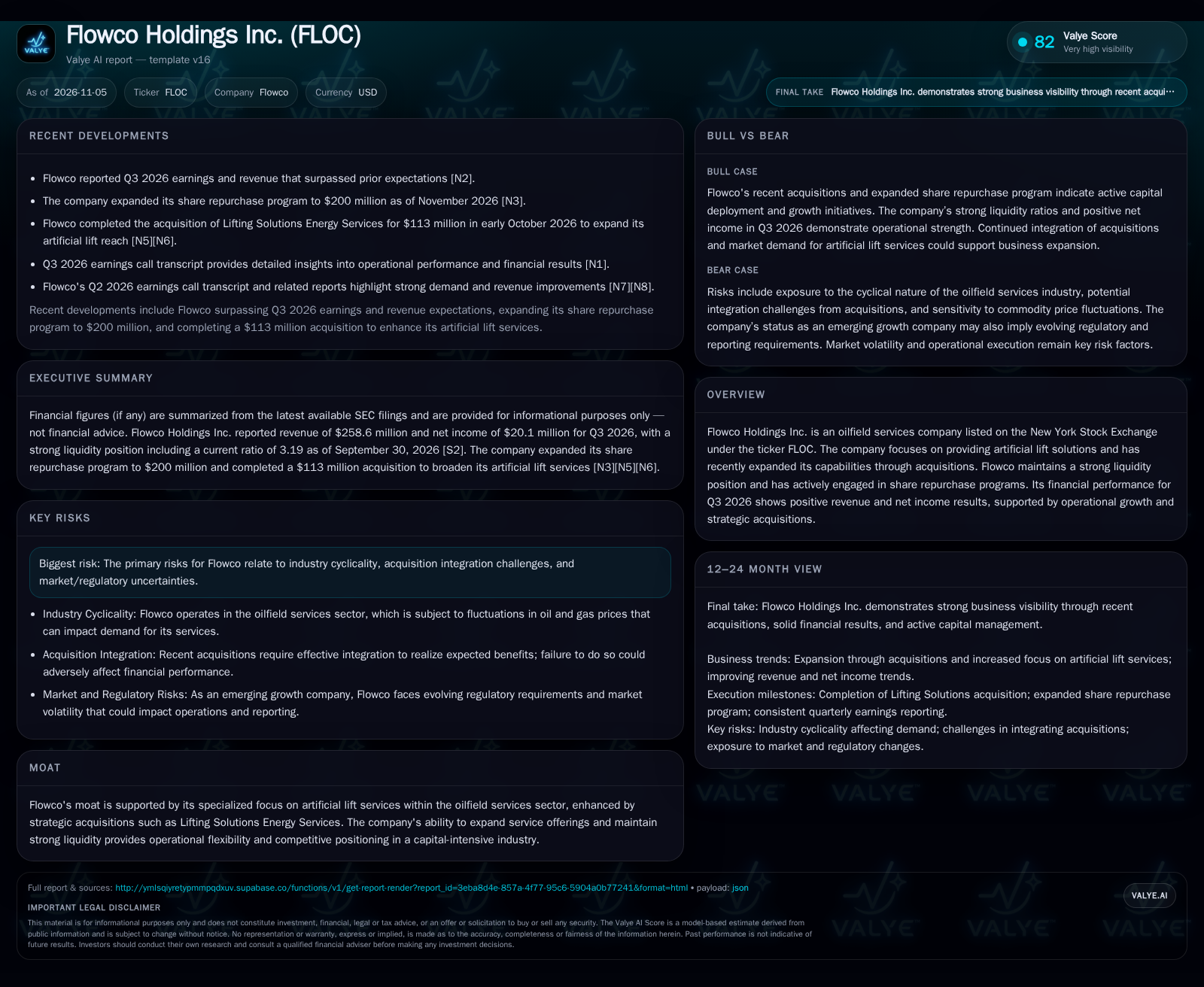
Flowco Holdings has reported stronger-than-expected Q3 2026 results, advanced its artificial lift capabilities through the acquisition of Lifting Solutions Energy Services, and expanded its share repurchase program. These moves position Flowco to consolidate its role in production optimization within oilfield services, but the company must prove it can integrate acquisitions effectively and manage through oil price volatility. The next phase will test whether Flowco’s capital allocation and technology breadth can deliver sustained margin improvement and through-cycle stability. [S2] [N2] [N5] [N6]
Flowco Holdings Inc. is at a strategic crossroads as it seeks to become a leading force in oilfield production optimization. The company’s recent acquisition of Lifting Solutions Energy Services for $113 million and the expansion of its share repurchase program to $200 million signal a commitment to both growth and shareholder returns. With Q3 2026 revenue and earnings outpacing expectations, Flowco’s ability to integrate new assets and scale its artificial lift and emissions management portfolio will be critical to its long-term margin profile and resilience. The real test lies ahead: can Flowco’s operating leverage and technological differentiation offset the volatility of the oilfield services cycle and deliver sustainable, through-cycle value? [S2] [N2] [N5] [N6]
Recent Financial Outperformance and Strategic Acquisitions Shape Flowco’s Trajectory
In Q3 2026, Flowco Holdings reported revenue of $258.6 million and net income of $20.1 million, with both top- and bottom-line results beating prior expectations [S2] [N2]. This financial outperformance has been accompanied by a surge in capital deployment: the company completed the $113 million acquisition of Lifting Solutions Energy Services in October 2026, expanding its artificial lift capabilities and geographic footprint [N5] [N6]. At the same time, Flowco increased its share repurchase authorization to $200 million, signaling confidence in its valuation and future cash flows [N3]. The company reported cash and liquidity metrics for the period; these figures do not by themselves establish operating runway, investment capacity, financial flexibility, or financing capacity. [S2] These moves collectively suggest a company intent on scaling up and capturing greater share of production optimization spend, but they also raise the stakes for effective integration and disciplined capital allocation.
Artificial Lift, Emissions Management, and the Economics of Production Optimization
Flowco’s core business is rooted in oilfield services—specifically, production optimization and artificial lift solutions that extend the economic lifespan of oil and gas wells. The company’s technologies, including high pressure gas lift, electric submersible pumps, and vapor recovery units, are essential for maintaining production as wells mature and natural decline sets in. These offerings, especially when coupled with proprietary digital tools for remote monitoring and optimization, are often less discretionary for operators, embedding Flowco’s products and services deeper into customer workflows.
Revenue streams may include equipment sales, installation, ongoing monitoring, and recurring maintenance or service contracts—though the exact mix is not disclosed. The potential for high-margin, recurring service revenue is significant if Flowco can convert more customers to ongoing digital monitoring and emissions management, especially as regulatory pressure on methane emissions intensifies. Fixed costs in manufacturing and technology development create operating leverage, meaning incremental revenue growth—if achieved with disciplined cost control—could drive disproportionate gains in operating profit.
Where Flowco Stands Amid Specialist and Integrated Oilfield Service Rivals
Flowco’s competitive positioning benefits from its specialized focus on artificial lift and emissions management, segments that are increasingly critical for maximizing well economics and regulatory compliance. The recent acquisition of Lifting Solutions Energy Services not only broadens Flowco’s technology portfolio but may also enhance its ability to serve a wider array of geographies and well types [N5] [N6]. This specialization allows Flowco to compete against both diversified oilfield service giants and niche technology providers.
The company’s proprietary digital tools for remote monitoring and optimization could provide a switching-cost advantage if customers integrate these platforms deeply into their operations. However, many competitors also offer digitalized, integrated service models, and barriers to switching may be lower if interoperability and open standards prevail. The emergence of alternative production optimization technologies or shifts in regulatory requirements could alter the competitive landscape. Ultimately, Flowco’s ability to retain customers and defend margins will depend on its technology differentiation, service reliability, and the success of its post-acquisition integration efforts.
Integration Success and Regulatory Tailwinds Could Unlock Durable Margin Expansion
In a favorable scenario, Flowco successfully integrates Lifting Solutions, realizing both cost and revenue synergies that expand margins and accelerate growth. Cross-selling opportunities—such as offering emissions management technologies to Lifting Solutions’ customer base—could drive higher wallet share and recurring service revenue. If environmental regulations around methane emissions tighten further, demand for vapor recovery units and related technologies could outpace underlying oilfield activity, providing a countercyclical growth engine.
Confirmation of this scenario would come from sustained above-peer revenue growth, improving EBITDA margins, and increased attachment rates for digital and emissions management services. Further evidence would include new multi-year contracts, customer retention rates above industry averages, and public disclosures of successful integration milestones. If Flowco can demonstrate that its technology and service model are becoming indispensable to operators, it could command a premium valuation and greater through-cycle resilience.
Sustained Growth with Periodic Volatility as Oilfield Activity Cycles Persist
The most plausible near-term outcome is that Flowco delivers steady, acquisition-driven growth but remains exposed to periodic swings in oilfield capital spending. Revenue and profitability may trend upward as the artificial lift and emissions management portfolios expand and the company realizes some integration benefits, but margin gains could be offset by cyclical slowdowns or integration costs.
In this scenario, Flowco’s financials would show moderate revenue growth, stable or slightly improving margins, and continued investment in technology and service capacity. Confirmation would come from consistent quarterly earnings, incremental growth in recurring revenue streams (if disclosed), and manageable integration expenses. Signs of execution risk—such as customer attrition, delayed integration milestones, or margin compression—would challenge this scenario.
Integration Hurdles and Oil Price Weakness Could Pressure Earnings and Capital Allocation
A negative scenario could emerge if Flowco faces significant challenges integrating Lifting Solutions, resulting in elevated costs, operational disruptions, or customer losses. If oil prices decline sharply, customers may defer production optimization spending, leading to revenue contraction and margin pressure. Overextension on acquisitions or share repurchases could further constrain liquidity if cash flows weaken.
Evidence of this scenario would include missed earnings targets, rising integration expenses, negative operating cash flow, or reductions in the share repurchase program. Customer churn, project delays, or public disclosure of integration setbacks would reinforce the downside case. The company’s ability to maintain discipline in capital allocation and cost management would be tested in such an environment.
Milestones That Will Clarify Flowco’s Ability to Deliver Sustainable Value
Progress on integration of Lifting Solutions, including cost synergies, cross-selling initiatives, and retention of key personnel or customers—public updates or quantified milestones would help clarify the trajectory.
Recurring revenue as a percentage of total revenue, if disclosed, would offer insight into the durability and predictability of Flowco’s earnings base.
EBITDA margin trends, especially post-acquisition, will signal whether scale and operating leverage are being realized or whether integration costs are eroding profitability.
Customer retention rates and contract renewal activity—particularly for digital and emissions management services—would test the strength of Flowco’s competitive moat.
Quarterly operating cash flow and capital expenditure trends, to assess the company’s ability to fund growth and capital returns without straining liquidity.
New regulatory developments impacting methane abatement or artificial lift requirements in major markets, as these could shift demand dynamics and competitive positioning.
Evidence of further acquisitions, divestitures, or capital allocation changes—such as adjustments to the share repurchase program—in response to market or operational developments.
Disclaimer: This is research-only, informational analysis and not investment advice. It may include AI-generated interpretation and general industry context. Always verify important details using primary sources.

Comments