
Acadia Healthcare’s Growth Ambitions: Scale, Integration, and the Stakes of Behavioral Health Expansion
Acadia Healthcare’s position as a leading pure-play behavioral health provider is underpinned by robust facility growth, recent outperformance, and a multi-pronged expansion strategy. The challenge now is whether its operational scale can balance regulatory, staffing, and integration risks while supporting sustainable profitability.
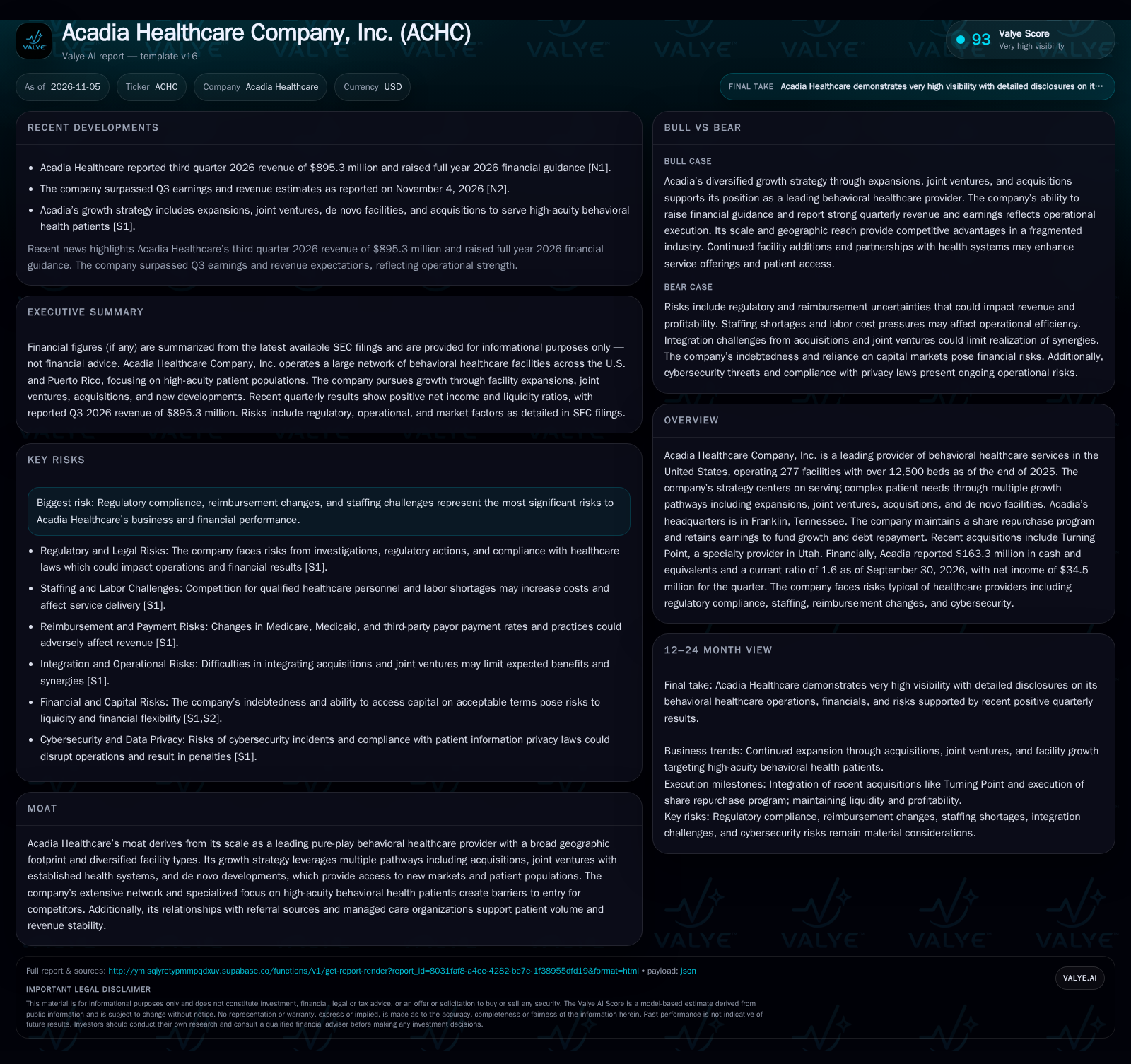
Acadia Healthcare has reported strong Q3 2026 results, raised its full-year guidance, and continues to expand its network of behavioral health facilities through acquisitions and partnerships. The company’s scale provides clear advantages in a fragmented sector, but integration, regulatory, and reimbursement challenges remain pivotal to its future trajectory. Watch for execution on new facility ramp-up and evidence of margin stability as key tests of long-term value creation.
Acadia Healthcare’s latest quarter underscores its emergence as a dominant force in behavioral health, with revenue and earnings outpacing expectations and full-year guidance moving higher. The company’s multi-pronged strategy—encompassing acquisitions, joint ventures, and organic facility growth—has rapidly scaled its national footprint. Yet, as Acadia pushes deeper into complex, high-acuity care, its ability to integrate new assets, manage labor pressures, and adapt to shifting reimbursement landscapes will determine how much of its recent momentum is sustainable. The next phase hinges on execution and resilience, not just expansion.
Recent Performance and Expansion Set the Stage for the Next Phase
Acadia Healthcare reported third quarter 2026 revenue of $895.3 million and raised its full-year financial guidance, marking a period of outperformance relative to consensus expectations [N1] [N2]. Net income for Q3 2026 was $34.5 million, with basic and diluted EPS of $0.38 per share [S2]. As of December 31, 2025, the company operated 277 behavioral healthcare facilities with over 12,500 beds across 40 states and Puerto Rico, making it one of the largest pure-play behavioral health providers in the country [S1]. The acquisition of Turning Point, a 76-bed specialty provider in Utah, in February 2024, signals continued active portfolio expansion [S1]. These developments matter because they reinforce Acadia’s capacity for growth, its operational scale, and its willingness to deploy capital for network expansion—all of which influence its competitive position and risk profile.
How Acadia’s Business Model Converts Scale into Profitability
Acadia’s revenue model is built around the provision of inpatient and outpatient behavioral health services, with reimbursement flows sourced primarily from government (Medicare/Medicaid) and commercial payors. Pricing is largely dictated by negotiated rates and regulatory frameworks, which anchor revenue per bed but limit pricing flexibility. Volume growth depends on facility capacity, occupancy rates, and patient acuity mix. The company’s multi-pronged growth model—expansions, joint ventures, de novo facilities, and acquisitions—enables rapid scaling but also introduces complexity in integration, standardization, and cost management.
On the cost side, labor is the largest expense, and staffing shortages can drive wage inflation or capacity constraints. Fixed costs (facility leases, administrative overhead) are significant, but operating leverage can be achieved as occupancy rises and new beds are filled. Acadia’s capital needs remain high: ongoing investments are required for facility development, regulatory compliance, and technology. The $300 million share repurchase program ($250 million remaining as of year-end 2025) highlights optionality in capital allocation but also signals confidence in future cash flows [S1]. The company’s stated intent to retain earnings for growth and debt repayment suggests a preference for reinvestment over shareholder payouts [S1].
A critical dimension of Acadia's profitability hinges on the effective deployment of capital in facility development and acquisitions relative to the incremental revenue generated. The timing of capital expenditures versus revenue ramp-up can create temporary earnings pressure, especially if new facilities require extended periods to reach stabilized occupancy. Therefore, a useful metric to assess would be the payback period on incremental capital invested per bed or facility. Additionally, the company's ability to negotiate favorable reimbursement contracts that reflect the complexity and acuity of its patient population can materially influence revenue per bed. If reimbursement rates fail to keep pace with rising labor and operational costs, margin compression could ensue despite volume growth.
Scale, Specialization, and the Fragmented Behavioral Health Landscape
Acadia’s competitive edge stems from its scale, breadth of services, and geographic reach in a highly fragmented industry. Most U.S. behavioral health providers are regional, single-site, or subspecialty operators, making Acadia’s national network a differentiator for payors and referral sources. Its focus on high-acuity, complex needs populations and its ability to partner with health systems via joint ventures further insulate it from low-cost, commoditized competition. However, regulatory barriers to entry are high for new facilities, but existing players face persistent threats from reimbursement rate pressure, evolving telehealth models, and nontraditional entrants (e.g., digital mental health platforms). The question is whether Acadia’s integration capabilities and network effects will translate into higher occupancy, stable margins, and stronger referral relationships—or whether rising labor costs and the challenge of merging disparate operations will erode those advantages.
Acadia’s scale also enables potential advantages in data analytics and care coordination, which can improve clinical outcomes and operational efficiency. By aggregating patient data across its network, the company could identify best practices, optimize staffing models, and tailor services to regional demand patterns. However, realizing these benefits depends on the successful integration of disparate IT systems and clinical protocols, which often present significant challenges in healthcare consolidation. Moreover, the company’s ability to leverage its scale for negotiating with payors and suppliers may be constrained by regulatory scrutiny or market dynamics, particularly as behavioral health reimbursement models evolve toward value-based care and bundled payments.
The fragmented nature of behavioral health also means that local market dynamics play a substantial role in facility performance. Acadia’s national footprint provides diversification benefits, but it must still navigate regional variations in patient demographics, regulatory environments, and labor markets. For example, some states may have more favorable Medicaid reimbursement policies or less stringent licensing requirements, which could facilitate higher margins or faster facility ramp-up. Conversely, areas with acute staffing shortages or regulatory complexity might limit operational flexibility and increase costs. Thus, the company’s regional management capabilities and strategic site selection become critical factors in sustaining competitive advantage.
If Integration and Expansion Deliver: What a Win Looks Like
The bull case for Acadia is that its facility expansion and acquisition strategy continue to drive above-industry volume growth, while synergies from integration and scale lead to margin improvement. A favorable reimbursement environment, successful ramp-up of new and acquired facilities (such as Turning Point), and effective management of staffing constraints could result in sustained double-digit revenue growth and expanding EPS. Confirmation would come from ongoing outperformance of guidance, rising occupancy rates, evidence of successful integration (cost synergies, clinical quality metrics), and continued positive net income trends. Additional validation would include new joint venture announcements with major health systems and high utilization rates in new de novo facilities.
Sustained Growth Meets Operational Friction: What’s Most Likely
The most plausible outcome is that Acadia continues to grow its network and revenue base at a moderate pace, but margin expansion is tempered by persistent labor cost inflation and the operational drag of integrating new assets. Regulatory and reimbursement headwinds are likely to fluctuate, creating occasional earnings volatility. Facility utilization may improve incrementally, but staffing shortages and regional wage variation could offset some of the benefits of scale. Evidence to support this scenario would include steady, but not accelerating, EPS growth, periodic guidance updates rather than sustained beats, and muted improvement in key cost ratios. Falsification would be a sustained period of flat or declining occupancy or a material increase in integration-related costs.
When Growth Strains the System: Risks to Watch
A negative scenario could unfold if regulatory changes or reimbursement cuts sharply reduce revenue per bed, or if labor shortages and wage pressures escalate beyond management’s ability to offset with productivity or pricing. Integration missteps—such as failure to realize expected patient volumes, cost overruns, or cultural clashes in acquired facilities—could erode profitability. Cybersecurity or compliance failures could trigger litigation or operational disruptions. Evidence would include a downward revision of guidance, shrinking margins, rising turnover or contract labor usage, or regulatory actions affecting facility licenses or reimbursement eligibility.
Tests of Acadia’s Model: What Will Reveal Durable Value Creation
Occupancy trends and average daily census by facility type, if disclosed, would provide direct insight into demand and operational leverage.
Labor cost as a percentage of revenue and staff turnover rates, if available, would help gauge the impact of staffing pressures and wage inflation.
Integration milestones for recent acquisitions (e.g., Turning Point), including cost synergies and patient volume ramp-up, would test the success of the expansion strategy.
Guidance updates—both frequency and direction—will indicate management’s view on underlying business visibility and risk.
New joint ventures or de novo facility openings, and their initial utilization rates, would signal ongoing growth momentum and execution.
Any announced regulatory investigations, payor audits, or reimbursement rate changes could materially affect the risk profile.
Capital allocation shifts—such as acceleration or slowdown in share repurchases, debt repayment, or facility investment—would reflect management’s evolving risk appetite and cash flow outlook.
Cybersecurity incidents or privacy compliance disclosures, while hopefully rare, would be critical to monitor given the risk profile.
Disclaimer: This is research-only, informational analysis and not investment advice. It may include AI-generated interpretation and general industry context. Always verify important details using primary sources.

Comments