
Veeco Instruments: Semiconductor Equipment Scale, AI-Driven Demand, and the Strategic Stakes of the Axcelis Merger
Veeco’s advanced process equipment portfolio, robust backlog, and exposure to AI-fueled semiconductor investment underpin its near-term momentum. Yet, cyclical end-markets, customer concentration, and the pending Axcelis merger introduce both upside and integration risks. The company’s ability to leverage technology leadership and navigate industry volatility will determine its long-term value capture.
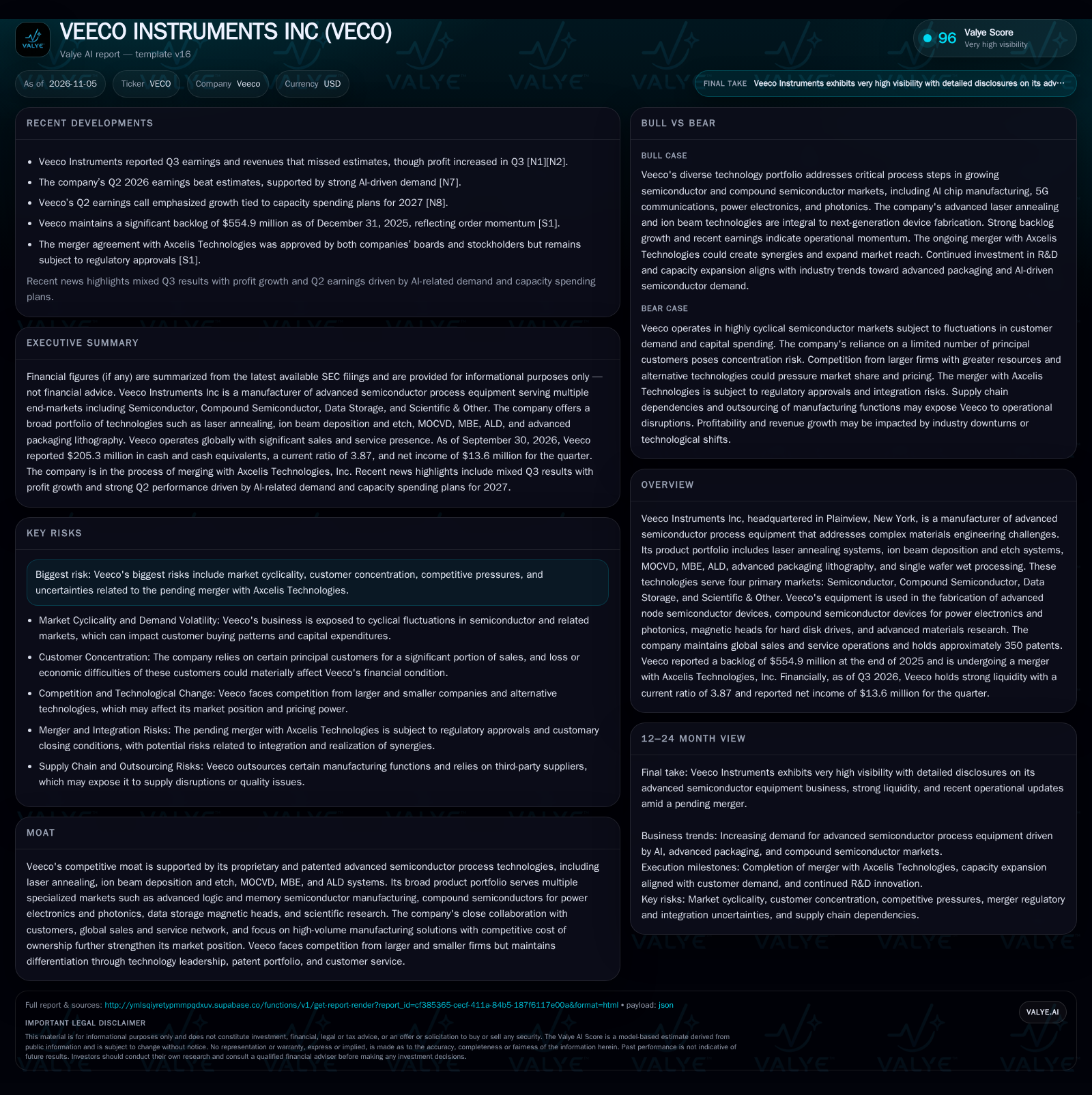
Veeco Instruments is a global supplier of advanced semiconductor process equipment, reporting a $554.9 million backlog at the end of 2025 and highlighting strong AI-related demand in 2026. As the company awaits regulatory closure of its merger with Axcelis Technologies, it faces both the promise of expanded scale and the challenges of cyclical demand, customer concentration, and competitive intensity in capital equipment markets. Its diversified product suite and patent portfolio give it a platform for growth, but execution and market volatility remain critical variables. [S1] [S2] [N7] [N8]
Veeco Instruments sits at a strategic crossroads as a supplier of advanced semiconductor process equipment. Its broad technology portfolio addresses critical steps in chip and compound semiconductor fabrication, positioning the company to benefit from rising AI infrastructure investment and advanced packaging trends. However, as it moves toward a merger with Axcelis Technologies, Veeco’s future will hinge on its ability to realize operational synergies, sustain order momentum, and navigate the cyclical and concentrated nature of the semiconductor capital equipment market. The interplay of technology leadership, backlog conversion, and customer dynamics will determine whether Veeco can translate its current visibility into durable, above-cycle value.
Backlog, AI Demand, and the Axcelis Merger: What’s Shaping Veeco Now
Veeco reported a backlog of $554.9 million at the end of 2025, up from $409.6 million the previous year, illustrating significant order momentum and providing visibility into future revenue streams. This backlog expansion is especially notable in the context of strong AI-related demand, as highlighted by Q2 2026 results where Veeco beat earnings estimates, driven by capacity spending in semiconductor markets supporting AI infrastructure. In contrast, Q3 2026 saw earnings and revenues miss consensus, though profits continued to rise, reflecting both ongoing demand and the volatility inherent in capital equipment cycles. The pending merger with Axcelis Technologies, expected to close by the end of Q1 2027 subject to regulatory approval, represents a potentially transformative event for Veeco’s market scope and operational scale. [S1] [S2] [N1] [N2] [N7] [N8]
Revenue Streams, Cost Structure, and the Levers of Semiconductor Equipment Profitability
Veeco’s economics are shaped by a mix of high-value capital equipment sales and a recurring aftermarket business. Roughly 25% of 2025 net sales came from parts, upgrades, service, and support, providing a degree of revenue stability amid the cyclicality of new equipment orders. The capital equipment side is characterized by long sales cycles, large-ticket orders, and significant margin leverage when utilization rates are high. Gross margins in the industry are influenced by product mix—leading-edge tools and proprietary technologies typically command higher margins, while price competition and commoditization pressure lower-end offerings.
Fixed costs are substantial, given the need for ongoing R&D, global service infrastructure, and manufacturing capacity. Variable costs scale with order volume and service activity. Veeco’s ability to realize operating leverage depends on backlog conversion, efficient manufacturing, and the share of high-margin proprietary systems in its sales mix. The company reported cash and liquidity metrics for the period; these figures do not by themselves establish operating runway, investment capacity, financial flexibility, or financing capacity. [S2]
The merger with Axcelis, if completed, could unlock additional scale economies, potentially improving procurement, R&D efficiency, and global support costs. However, integration costs and the risk of operational disruption during the transition could offset these benefits if not well managed.
Technology Depth and Patent Moat: Veeco’s Strategic Position Versus Rivals
Veeco’s competitive position rests on its portfolio of advanced process technologies—including laser annealing, ion beam deposition and etch, MOCVD, MBE, ALD, and advanced packaging lithography—supported by approximately 350 patents. This technological breadth enables Veeco to address a diverse set of applications across logic and memory chips, compound semiconductors for power electronics and photonics, and data storage devices.
Competition is intense and varies by product line. In MOCVD and compound semiconductor equipment, Veeco faces firms like Aixtron. In broader wafer fab equipment (WFE), it competes with much larger players such as Applied Materials and Canon, which benefit from scale, deep customer relationships, and the ability to bundle solutions. The durability of Veeco’s moat depends on its ability to maintain technology differentiation, secure design wins in next-generation manufacturing nodes, and deepen its installed base to drive recurring service revenue.
Switching costs can be significant for customers due to qualification requirements, process integration, and equipment reliability concerns. However, rapid technological change and customer efforts to diversify supply chains can erode these frictions over time, especially if competitors close the innovation gap or offer superior cost-of-ownership.
How AI and Advanced Packaging Could Drive Above-Cycle Growth
In a favorable scenario, secular growth in AI, high-performance computing, and advanced packaging drives sustained WFE investment, benefitting Veeco’s core product lines. If the company successfully converts its robust backlog into revenue, maintains high utilization across manufacturing, and leverages its aftermarket business, operating leverage could deliver outsized earnings growth.
The Axcelis merger could amplify these effects by broadening the customer base, enabling cross-selling of complementary technologies, and realizing cost synergies in R&D and support. Expansion into new geographies or end-markets—such as quantum computing or advanced photonics—could further diversify revenue streams.
Confirming this scenario would require evidence of continued backlog growth through 2027, increasing share of high-margin systems in sales mix, successful regulatory closure and integration of the Axcelis merger, and above-industry growth in service revenues. A sustained upcycle in semiconductor capital spending, particularly by leading-edge and AI-focused fabs, would also reinforce the thesis.
Navigating Cycles: What a Realistic Outcome Looks Like for Veeco
The most plausible scenario is that Veeco continues to ride industry cycles, with periods of strong demand linked to AI, advanced packaging, and compound semiconductor investments, followed by inevitable slowdowns as customers digest capacity additions. Backlog conversion supports near-term revenue visibility into 2027, but order volatility and customer concentration will remain persistent features.
The aftermarket business (parts, upgrades, service) acts as a partial buffer, but is not immune to broader industry downturns. Integration of the Axcelis merger, if completed, delivers incremental scale but also introduces the risk of operational distraction or customer attrition if not executed carefully.
Evidence supporting this scenario would include stable but fluctuating quarterly bookings, moderate growth in recurring service revenues, incremental margin improvement from operational efficiencies, and a merger process that closes on time without major disruption. Downside would be signaled by merger delays, backlog erosion, or margin compression due to competitive pricing.
Disruption Triggers: What Could Derail Veeco’s Momentum
In an adverse scenario, a cyclical downturn in semiconductor capital spending—potentially triggered by overcapacity, macroeconomic shocks, or technology transitions—leads to order cancellations, backlog shrinkage, and underutilization of manufacturing capacity. Customer concentration amplifies the risk: the loss or pullback of one or more key accounts could materially impact revenue and margins.
Competitive pressure from larger players or disruptive technologies could erode Veeco’s share in critical segments, especially if customers seek lower-cost alternatives or consolidate spending with full-line suppliers. Failure to close or integrate the Axcelis merger could result in lost synergies, stranded costs, and organizational distraction.
Downside confirmation would come from a sharp drop in new orders, backlog contraction, margin compression, or a material increase in customer churn. Regulatory or operational delays with the Axcelis transaction, or evidence of integration difficulties, would further pressure the equity thesis.
Testing Veeco’s Value Capture: Metrics and Milestones That Matter Most
Quarterly order intake and backlog progression: Sustained growth here would support the durability of demand and future revenue visibility. [S1] [S2]
Revenue mix by segment (equipment vs. service/aftermarket): A rising share of recurring service revenue would reduce cyclicality and improve margin stability. A useful metric would be detailed segment disclosure if provided.
Gross and operating margin trends: Expansion, particularly from higher-margin proprietary tools or post-merger synergies, would signal successful execution.
Merger closure timeline and regulatory status: Timely completion of the Axcelis deal, with minimal disruption, is crucial for realizing the strategic upside. [S2]
Integration milestones post-merger: Tracking retention of key customers, cost synergies, and operational alignment will be critical after the deal closes.
Customer concentration metrics: Any reduction in reliance on principal customers would reduce risk and signal successful diversification. If disclosed, customer revenue breakdowns would help test the thesis.
R&D investment and new product introduction cadence: Continued innovation is necessary to defend share and maintain technology leadership.
End-market demand signals: Capex plans from major semiconductor and compound semiconductor manufacturers, especially those tied to AI and advanced packaging, will remain leading indicators for Veeco’s order pipeline.
Disclaimer: This is research-only, informational analysis and not investment advice. It may include AI-generated interpretation and general industry context. Always verify important details using primary sources.

Comments