
Martin Marietta Materials: Asset Swaps, Specialty Expansion, and the Strategic Stakes of Scale in Heavy Construction
Martin Marietta’s record revenue, recent asset exchange with QUIKRETE, and expanded specialty minerals footprint highlight both the power and complexity of scale in heavy building materials. As integration risks rise alongside cyclic and weather-driven demand, the company’s ability to turn geographic breadth and product diversity into sustainable margin resilience is the central question for the next phase.
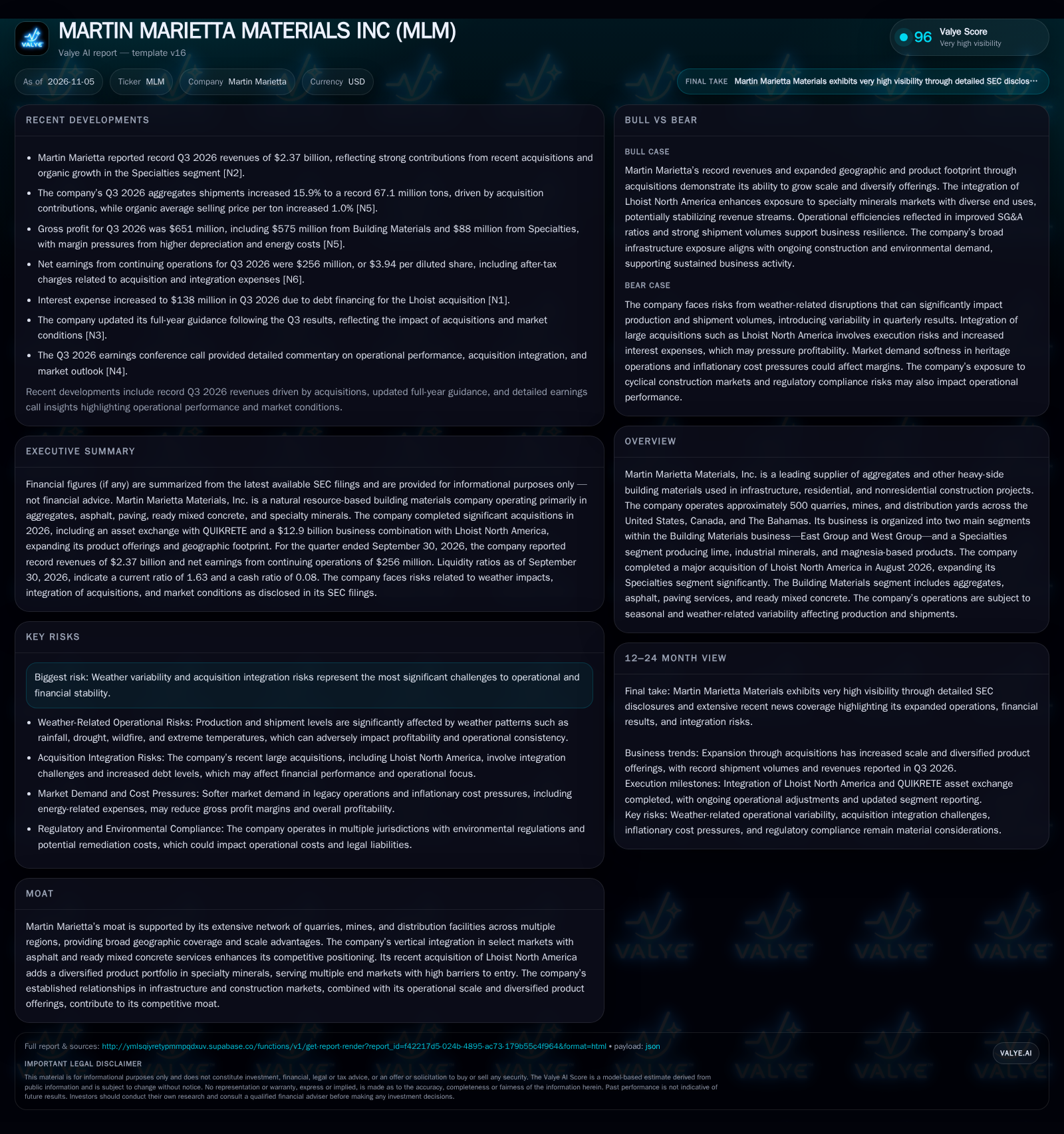
Martin Marietta set record Q3 2026 revenues, driven by both acquisitions and organic growth in specialty minerals. The QUIKRETE asset exchange increased annual aggregates capacity by 20 million tons and broadened its geographic reach, while divesting a cement plant. With a current ratio of 1.63 and ongoing integration efforts, the company’s future hinges on translating scale and diversity into margin stability amid weather and construction market volatility. [N2] [S2]
Martin Marietta Materials, a heavyweight in U.S. aggregates and heavy-side building products, has used 2026’s asset swaps and specialty expansion to deepen its presence across North America’s infrastructure supply chain. Record Q3 2026 revenues underscore the immediate impact of its QUIKRETE deal and specialty minerals growth, but the company now faces a more complex portfolio with increased integration demands and persistent cyclicality. The next phase will test whether Martin Marietta can turn scale, geographic reach, and product breadth into structural margin advantages, or whether integration, weather, and demand volatility will erode the benefits of its recent expansion. [N2] [S2]
Asset Exchange and Specialty Growth Redefine the Operating Map
Martin Marietta reported record Q3 2026 revenues of $2.37 billion, with $2.007 billion from Building Materials and $362 million from Specialties. This performance reflects both organic growth and the immediate impact of recent acquisitions. Most notably, in February 2026, the company completed an asset exchange with QUIKRETE Holdings, acquiring operations producing approximately 20 million tons of aggregates annually across Virginia, Missouri, Kansas, and Vancouver, plus an asphalt and paving business and $450 million in cash, while divesting its Midlothian cement plant and related assets. As of September 30, 2026, Martin Marietta operated about 500 quarries, mines, and distribution yards in 29 states, Canada, and The Bahamas. Liquidity at quarter-end included $140 million in cash, a current ratio of 1.63, and a cash ratio of 0.08. [S2] [N2]
How Scale and Mix Drive Margin Potential in Aggregates and Specialties
Martin Marietta’s core economics are shaped by high fixed costs (notably quarry operation, equipment, and plant maintenance) and significant operating leverage—meaning incremental volumes, when market demand is strong, can translate rapidly into higher margins. Aggregates pricing is typically local, reflecting transportation costs and local supply/demand balances, so geographic diversity can buffer regional downturns but also dilutes pricing power if acquired assets are in more competitive or lower-growth markets.
The addition of 20 million tons of annual aggregates capacity through the QUIKRETE exchange materially increases Martin Marietta’s volume base, potentially amplifying fixed-cost absorption if demand holds up. The divestiture of the cement plant may signal a portfolio rationalization away from more cyclical or capital-intensive verticals. Asphalt and paving operations, now expanded, introduce a more service-oriented revenue stream but often at lower margins and higher weather sensitivity.
The Specialties segment, which includes high-calcium lime, dolomitic lime, and magnesia-based products, generally enjoys higher margins and more stable end-market demand (e.g., steel, glass, environmental remediation) than traditional construction aggregates. Expansion here could smooth cyclicality, but integration costs and execution risks remain. Capital needs are ongoing, both to maintain and expand quarry infrastructure and to support bolt-on acquisitions.
Geographic Breadth, Vertical Integration, and the Limits of Regional Advantage
Martin Marietta’s competitive position rests on its vast footprint and vertically integrated operations in select markets, allowing for control over supply, logistics, and, in some regions, downstream value capture through asphalt and ready-mix. This network creates local scale advantages—reduced transportation costs, customer proximity, and logistical flexibility—particularly in regions with limited alternative supply.
However, the construction aggregates industry remains fundamentally local, and pricing power is constrained by regional supply/demand balances and the presence of other large, similarly scaled players (such as Vulcan Materials and regional independents). The expanded specialty minerals segment may offer some insulation from regional construction cycles, but faces its own set of industrial competitors and regulatory pressures.
Switching costs for customers are modest in most markets—buyers can shift to alternative quarries if supply, price, or quality changes—so Martin Marietta’s moat is derived more from physical barriers (proximity, transport costs, permitting) and the ability to serve large multi-project customers than from contractual lock-in or proprietary technology.
If Integration Succeeds, Scale and Mix Could Yield Structural Margin Gains
The bull case centers on Martin Marietta successfully integrating the QUIKRETE and specialty assets, realizing cost and logistical synergies, and leveraging its expanded footprint to capture incremental share in key growth markets. If the company can drive higher utilization across newly acquired sites while maintaining pricing discipline, operating leverage could deliver outsized margin expansion.
Continued infrastructure spending (federal, state, and local) and stable demand in specialty end-markets would support volume growth and pricing. Diversification into specialties may dampen volatility and improve blended margins. Confirmation would come from sustained improvement in segment operating margins, evidence of cost synergies in SG&A and logistics, and continued outperformance in revenue and EBITDA versus peers. Falsification would be signaled by persistent integration costs, stagnant margins, or loss of key customers post-acquisition.
Diversification Offsets Cyclicality, but Integration and Market Volatility Restrain Expansion
The most plausible outlook is that Martin Marietta’s expanded portfolio delivers modest incremental growth and margin stability, but the benefits are partially offset by integration challenges, cost pressures, and ongoing weather-related volatility. Aggregates volumes and pricing may remain healthy in core infrastructure markets, but softness in nonresidential or residential construction could limit upside.
Synergies from the QUIKRETE exchange and specialty expansion are realized gradually, with the company investing in operational integration and customer retention. The specialty segment helps smooth overall results but does not fully offset heavy-side cyclicality. Evidence supporting this scenario would include steady (but not accelerating) revenue and margin trends, manageable integration expenses, and continued geographic and product diversification in segment reporting.
Integration Missteps, Weather Shocks, and Demand Weakness Could Erode Recent Gains
The bear case unfolds if Martin Marietta faces major integration setbacks—such as operational disruptions, higher-than-expected costs, or customer attrition—following the QUIKRETE asset exchange and specialty expansion. Adverse weather could compound these issues, reducing volumes and stranding fixed costs, while a construction market downturn (particularly in key growth regions) could pressure both pricing and utilization.
In this scenario, the company would see margin compression, increased working capital needs, and potentially negative operating leverage. Confirmation would include rising SG&A as a percentage of sales, declining segment margins, and negative volume trends in both aggregates and specialties. Early warning signs might include management guidance cuts or evidence of project delays and cancellations in key regions.
Testing the Thesis: What Will Distinguish Durable Scale from Overreach at Martin Marietta?
Sustained segment operating margin improvement across both Building Materials and Specialties would support the thesis that scale and diversification are delivering real economic benefits.
Evidence of realized cost and logistics synergies from the QUIKRETE asset exchange and specialty expansion, such as reduced SG&A or improved supply chain efficiency, would help confirm successful integration.
Trends in aggregates and specialty product volumes, by region if disclosed, would clarify whether geographic diversification is buffering or amplifying cyclicality.
Pricing power in core markets—such as average realized price per ton for aggregates—would indicate whether local scale is translating into sustainable margin resilience.
Integration expense disclosures and updates on operational milestones (e.g., site rationalizations, asset performance) would reveal whether recent acquisitions are delivering or draining value.
Weather-related volume swings and management commentary on shipment disruptions would help test the company’s ability to manage operational volatility.
Shifts in end-market mix, such as construction versus industrial or environmental specialties, would indicate progress on smoothing cyclicality.
If disclosed, customer retention rates or new contract wins in newly acquired regions would provide further evidence of integration success or challenges.
Disclaimer: This is research-only, informational analysis and not investment advice. It may include AI-generated interpretation and general industry context. Always verify important details using primary sources.

Comments