
Eagle Materials: Margin Pressures, Infrastructure Tailwinds, and the Strategic Stakes in U.S. Construction Cyclicality
Eagle Materials posts record revenues amid profit pressure, leveraging a low-cost footprint and recent acquisitions as federal infrastructure spending buoys heavy materials demand. The company's exposure to housing headwinds, cost inflation, and regulatory risks highlights the balance between cyclical vulnerability and operational resilience.
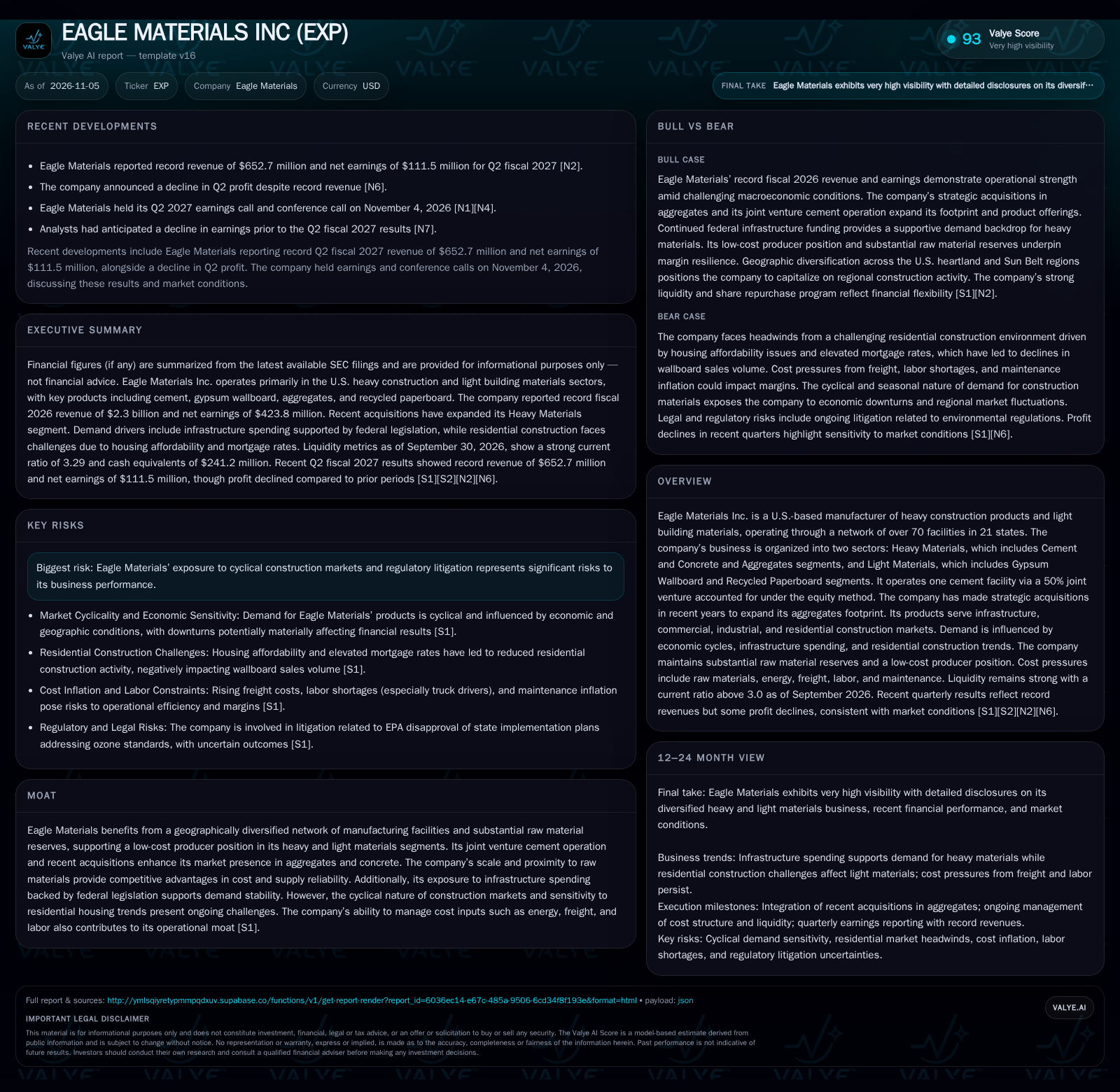
Eagle Materials reported record revenue of $652.7 million and net earnings of $111.5 million for Q2 fiscal 2027, though profits declined year-over-year. Infrastructure funding is supporting heavy materials demand, but residential construction weakness is weighing on wallboard volumes. Recent acquisitions expand the aggregates footprint, while cost inflation and labor shortages remain key margin risks. The company maintains a reported liquidity position, but cyclical exposure and regulatory litigation are ongoing concerns. [S1] [S2] [N2] [N6]
Eagle Materials stands at a crossroads typical for U.S. building materials suppliers: record revenues and strategic expansion through acquisitions, but profit margins pressured by cost inflation and persistent housing market headwinds. The company’s diversified footprint across heavy and light materials, coupled with low-cost production advantages, positions it to benefit from sustained infrastructure investment. Yet, the cyclical nature of construction demand, rising costs, and regulatory uncertainties underscore the risks to near-term earnings stability. Whether Eagle can translate its volume growth and expanded footprint into durable profit gains depends on its ability to manage cost pressures and capture upside from U.S. infrastructure outlays.
Profitability Under Pressure Despite Record Top-Line Performance
Eagle Materials reported record quarterly revenue of $652.7 million in Q2 fiscal 2027, with net earnings of $111.5 million, but profits declined compared to the prior year [N2] [N6]. This divergence between revenue growth and net income signals intensifying margin pressure, driven by rising freight, labor, and energy costs. The company’s heavy materials business is buoyed by federal infrastructure spending—including funding flows from the Infrastructure Investment and Jobs Act—while its light materials segment is challenged by a 7% decline in wallboard volumes tied to weak residential construction [S1]. Recent acquisitions in Northern Kentucky ($24.9 million) and Western Pennsylvania ($150 million) are expanding the company’s aggregates presence in the Heavy Materials segment [S1]. The company reported cash and liquidity metrics for the period; these figures do not by themselves establish operating runway, investment capacity, financial flexibility, or financing capacity. [S2]
How Eagle Materials Converts Volume and Footprint into Earnings
Eagle Materials’ economic model hinges on scale, proximity to raw materials, and the ability to flex mix between heavy (cement, concrete, aggregates) and light (wallboard, paperboard) materials. Revenue is driven by both volume—largely determined by construction activity and public spending—and pricing, which is sensitive to regional competition and input costs. The company’s low-cost producer status stems from substantial raw material reserves adjacent to its manufacturing base, which reduces inbound logistics and enables more competitive delivered pricing, especially in cement and aggregates.
Variable costs—raw materials, energy, freight, and labor—are significant, and recent inflation in fuel and labor has squeezed margins. Freight is especially impactful in cement, where high weight-to-value ratios make local sourcing and delivery a structural advantage. Maintenance and plant utilization rates also affect unit costs and operating leverage. Fixed cost absorption improves with higher throughput, but the seasonal and cyclical nature of construction creates volatility in plant utilization.
Recent acquisitions, if integrated efficiently, may deliver incremental fixed-cost leverage and local market share, but integration costs and regional demand fluctuations could dilute near-term returns. The company’s capital needs are moderate relative to free cash flow, with investments focused on plant upgrades, environmental compliance, and tuck-in acquisitions. Share repurchases provide optionality for capital deployment, but do not fundamentally alter the operating economics.
Assessing the Moat: Geographic Reach, Cost Structure, and Substitution Risk
Eagle Materials’ competitive position is anchored in its geographic footprint—over 70 facilities across 21 states, notably in the U.S. heartland and Sun Belt—and its access to raw material reserves. These factors underpin a cost advantage in core markets, particularly where transportation costs are prohibitive for distant competitors. The joint venture in Texas further entrenches its cement presence in a key growth region.
In heavy materials, competition comes from national and regional cement and aggregates producers, with barriers to entry created by the capital intensity of cement plants, permitting hurdles, and the need for proximate raw materials. Light materials, especially wallboard, face more direct price competition and substitution risks from alternative materials in commercial construction.
Substitution risk is relatively low in cement and aggregates, but wallboard demand is more vulnerable to shifts in construction methods or regulatory changes. Eagle’s ability to maintain cost leadership depends on energy efficiency, vertical integration of raw materials, and disciplined capacity additions. Recent acquisitions may enhance local market power but could face integration and market-cycle risks.
Infrastructure-Led Demand Surge Amplifies Operating Leverage
A favorable scenario unfolds if federal and state infrastructure spending accelerates, driving sustained demand for cement, aggregates, and concrete. In this environment, Eagle could see higher plant utilization, improved pricing power, and increased absorption of fixed costs—especially if recent acquisitions deliver synergies and local market share gains. Wallboard volumes could stabilize or rebound if housing affordability improves, leading to a recovery in residential construction.
Evidence confirming this scenario would include sequential improvement in heavy materials volumes and pricing, margin expansion despite cost inflation, and stabilization or growth in wallboard shipments. Successful integration of recent acquisitions—demonstrated by margin accretion and market share gains in Kentucky and Pennsylvania—would further validate the upside. Watch for upward revisions to capital spending plans, signaling management’s confidence in sustained demand.
Sustained Infrastructure Support Offsets Housing Drag, but Margins Remain Tight
The most plausible outlook is one in which infrastructure spending continues to support heavy materials volumes, while residential construction remains subdued due to persistent affordability and rate pressures. In this scenario, Eagle’s cement and aggregates businesses maintain or slightly grow revenues, but wallboard volumes stay below prior peaks. Cost inflation—particularly for freight and labor—continues to pressure margins, largely offsetting any gains from revenue growth.
Confirmation would come from quarterly results showing stable or slightly growing heavy materials sales, ongoing wallboard volume declines or stagnation, and gross margin compression. Management commentary emphasizing cost control, selective capital spending, and gradual integration of acquisitions would support this view. Falsification would come from a notable recovery in residential volumes or a sharp reversal in cost inflation.
Economic Downturn or Regulatory Shock Triggers Multi-Segment Weakness
The adverse case would see a broad economic slowdown or sharp pullback in public infrastructure funding, leading to declines in both heavy and light materials demand. Simultaneously, persistent or escalating cost inflation—especially in energy and labor—would further compress margins. Regulatory risks, such as adverse outcomes in environmental litigation or new emissions standards, could force unplanned capital expenditures or restrict plant operations.
Confirmation of this scenario would include sequential revenue declines across both segments, deteriorating gross and operating margins, and negative free cash flow. Management might respond with cost-cutting, reduced investment, or asset sales. Watch for legal disclosures indicating material liabilities or plant shutdowns, and for guidance revisions citing demand or regulatory headwinds.
Milestones and Variables That Could Reshape Eagle Materials’ Earnings Power
Quarterly cement and aggregates volumes and realized pricing, as these will indicate whether infrastructure demand is translating into profitable growth.
Wallboard shipment trends and pricing—if disclosed—to gauge the trajectory of residential construction exposure and any signs of volume stabilization or rebound.
Gross and operating margin evolution, particularly in the face of persistent freight, energy, and labor cost inflation.
Integration progress and financial contribution from the Kentucky and Pennsylvania acquisitions, including any disclosed synergy realization or accretion metrics.
Management commentary or disclosures on regulatory and legal risks, especially regarding environmental litigation or new compliance requirements.
Capital expenditure guidance and allocation between organic plant upgrades, environmental compliance, and acquisitions.
Share repurchase activity and any shift in capital allocation policy that might signal management’s confidence or concerns about near-term cash generation.
Disclaimer: This is research-only, informational analysis and not investment advice. It may include AI-generated interpretation and general industry context. Always verify important details using primary sources.

Comments