
Mayville Engineering’s Strategic Expansion: Acquisition Integration and Segment Diversity as Growth Levers
Mayville Engineering Company’s recent expansion into data and power markets via the Accu-Fab acquisition marks a strategic shift beyond its traditional industrial segments.
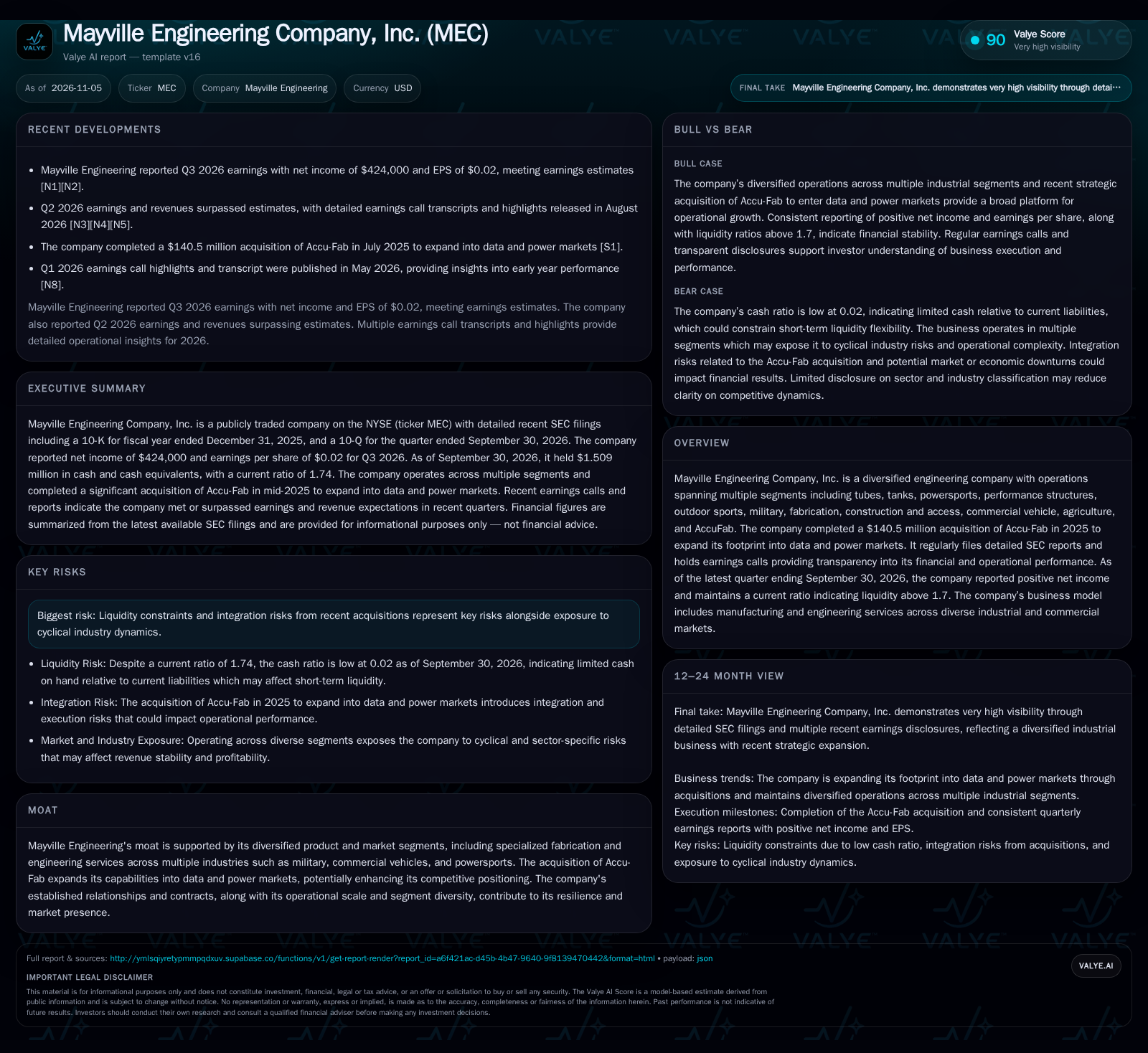
Mayville Engineering (MEC) reported modest positive net income in Q3 2026 and reported liquidity-ratio trends above 1.7, despite a reported cash ratio. The $140.5M Accu-Fab acquisition expands its reach into data and power markets, but introduces integration and capital structure risks. Execution on synergies, customer diversification, and the ability to manage liquidity pressures will shape the company’s prospects in a competitive, cyclical landscape. [S2]
Mayville Engineering Company, Inc. (MEC) is navigating a transitional period defined by its $140.5 million Accu-Fab acquisition and ongoing efforts to broaden its industrial portfolio. With a positive but slim profit in Q3 2026, a robust current ratio, and a cash position that remains tight, the company’s near-term thesis revolves around translating its expanded market reach into sustained earnings growth while managing the complexities of integration and maintaining liquidity discipline. Execution on these fronts will determine whether MEC’s diversification strategy can deliver durable shareholder value.
Latest Performance, Acquisition Effects, and Liquidity Position
Mayville Engineering reported net income of $424,000 for Q3 2026, translating to basic and diluted EPS of $0.02, with current assets of $174.6 million and current liabilities of $100.3 million, resulting in a current ratio of 1.74. However, cash and cash equivalents were just $1.5 million, yielding a cash ratio of 0.02 as of September 30, 2026 [S2]. This signals that while the company has adequate short-term assets to cover liabilities, its immediate liquidity position is limited. The $140.5 million Accu-Fab acquisition, completed in July 2025, represents a significant strategic move into the data and power sectors, layering additional integration and capital structure complexity onto the business [S1]. With 25 operational facilities and a customer base spanning OEMs in commercial vehicles, agriculture, military, construction, and powersports, the company’s operational scale is sizable, but execution risks remain heightened given the breadth of its segment exposure.
Revenue Composition and Cost Dynamics Driving Financial Results
Mayville Engineering generates revenue primarily through manufacturing and engineering services, producing complex metal components for a wide array of OEM customers in commercial vehicles, construction, agriculture, military, and, following the Accu-Fab acquisition, data and power infrastructure. The company’s economics are shaped by a mix of customized project work and volume production, with pricing power typically constrained by the competitive and cyclical nature of its end markets. Gross margins in such diversified contract manufacturing environments are often sensitive to raw material costs (steel, aluminum), labor efficiency, and utilization rates across facilities.
Fixed costs are substantial given the company’s 25 operational sites and capital-intensive production assets, making operating leverage a key swing factor. When volumes are strong, incremental revenue can drive significant margin expansion; in downturns, underutilization can quickly erode profitability. The Accu-Fab acquisition likely brings both new revenue streams and additional fixed costs, amplifying the importance of integration and synergy capture.
Capital allocation decisions—especially post-acquisition—must balance funding integration initiatives, maintaining plant competitiveness, and preserving liquidity. The company’s ability to extract higher-value engineering fees, secure longer-term customer relationships, or move up the value chain (e.g., assemblies vs. simple components) would be important levers for margin resilience. However, specific commercial mechanics such as contract durations, average transaction values, or customer concentration are not disclosed in the available filings and should be considered as conditional factors rather than established facts.
Broad Segment Exposure and the Quest for Competitive Advantage
Mayville Engineering competes against a fragmented set of contract manufacturers, metal fabricators, and engineering service providers, ranging from regional specialists to large Tier I suppliers. The company’s principal advantage lies in its breadth—serving diverse end markets and offering a range of fabrication, assembly, and engineering solutions. This diversification can buffer demand volatility in any single segment but also dilutes focus and may limit the ability to establish deep competitive moats in individual verticals.
The Accu-Fab acquisition extends MEC’s reach into data center and critical power markets, which are generally less cyclical and may offer higher growth and margin potential compared to traditional sectors like agriculture or powersports. However, entering these markets exposes MEC to new competitors with specialized domain expertise and entrenched customer relationships. The company’s scale, engineering know-how, and established OEM relationships provide some switching cost and stickiness, particularly where integration into customer production processes is complex. Still, price competition, customer consolidation, and the risk of insourcing by large OEMs are persistent threats.
Sustained differentiation will likely depend on MEC’s ability to deliver value-added design, advanced manufacturing capabilities, and reliability at scale—along with successful integration and cross-selling of Accu-Fab’s offerings to existing and new customers. Without specific disclosure on contract structures or customer retention rates, the durability of these advantages remains subject to execution and market conditions.
Realizing Synergies Through Successful Integration and Market Expansion
In a favorable scenario, Mayville Engineering successfully integrates Accu-Fab, realizing cost and revenue synergies through cross-selling, operational streamlining, and broader customer solutions. The expansion into data and power markets provides access to faster-growing, potentially higher-margin projects, partially insulating the company from cyclical swings in legacy end markets. If MEC can leverage its engineering expertise to secure longer-term customer relationships or preferred supplier status in these new verticals, it could achieve higher asset utilization and operating leverage.
This scenario would be confirmed by a measurable improvement in consolidated EBITDA margins, evidence of new customer wins or expanded wallet share in the data/power segments, and a stable or improving working capital profile despite growth. Additional evidence would include public disclosures of integration milestones, customer contract announcements in new segments, and a reduction in net leverage as cash flow from the expanded platform is used to pay down acquisition debt. However, absent specific commercial mechanics in public filings, these outcomes remain conditional on execution.
Diversification Progress Under Cyclical Market Conditions
The most plausible outlook is that Mayville Engineering continues to operate profitably, with modest earnings growth driven by incremental gains from the Accu-Fab integration and ongoing cost discipline. The diversified portfolio helps cushion revenue against downturns in any single segment, but the company remains exposed to broader industrial cycles and input cost volatility. Integration benefits from Accu-Fab are realized gradually, offsetting but not fully transforming the margin profile.
Evidence for this scenario would include continued low but positive net income, stable or slightly improving current ratios, and periodic mention of new data/power market wins, but no dramatic margin or revenue inflection. Working capital management remains a recurring challenge, with periodic pressures on liquidity mitigated by receivables management or credit line usage. The absence of major operational disruptions or customer losses would further support this steady-state thesis.
Risks from Integration Challenges, Liquidity Strains, and Industrial Slowdowns
The adverse scenario involves execution missteps in integrating Accu-Fab, resulting in higher-than-expected costs, operational inefficiencies, or customer attrition. If end-market demand weakens—particularly in commercial vehicles, construction, or agriculture—MEC could face underutilization of its expanded asset base, amplifying fixed cost absorption issues.
This downside would be confirmed by declining or negative net income, worsening current and cash ratios, management commentary on integration setbacks, and/or the need to raise additional capital or amend credit agreements. Watch for missed synergy milestones, delays in new market penetration, or public disclosure of restructuring charges or asset impairments. Without specific backlog or contract duration disclosures, demand visibility is limited to general industry and management commentary.
Key Developments Influencing the Outcomes of Mayville Engineering’s Diversification Strategy
Disclosure of integration milestones and synergy capture from the Accu-Fab acquisition—such as cost savings, cross-selling achievements, or operational consolidation progress.
Trends in consolidated gross and EBITDA margins, particularly any sustained improvement attributable to the data and power segment expansion.
Net leverage and interest coverage ratios, which would indicate how well the company is managing its capital structure post-acquisition (if disclosed).
Quarterly working capital and cash flow from operations, with a focus on whether liquidity pressures persist or ease as integration proceeds.
Customer concentration data, especially any reduction in reliance on top customers or meaningful wins in new verticals (if disclosed).
Facility utilization rates and any commentary on capacity additions, closures, or major investment in automation or process upgrades.
New contract announcements or awards in the data and power sectors, confirming successful market entry and expansion.
Management commentary on macroeconomic or end-market trends, particularly as they relate to demand visibility, order book strength, and input cost headwinds.
Disclaimer: This is research-only, informational analysis and not investment advice. It may include AI-generated interpretation and general industry context. Always verify important details using primary sources.

Comments