
Euronet Worldwide: Diversified Payments Engine Faces Margin Pressures and Integration Stakes
Euronet Worldwide’s global payments platform spans ATM, prepaid, and money transfer networks, driving scale and recurring revenue across geographies. Yet, recent results reveal margin headwinds and execution risk as digital adoption and regulatory complexity reshape the economics of cross-border payments.
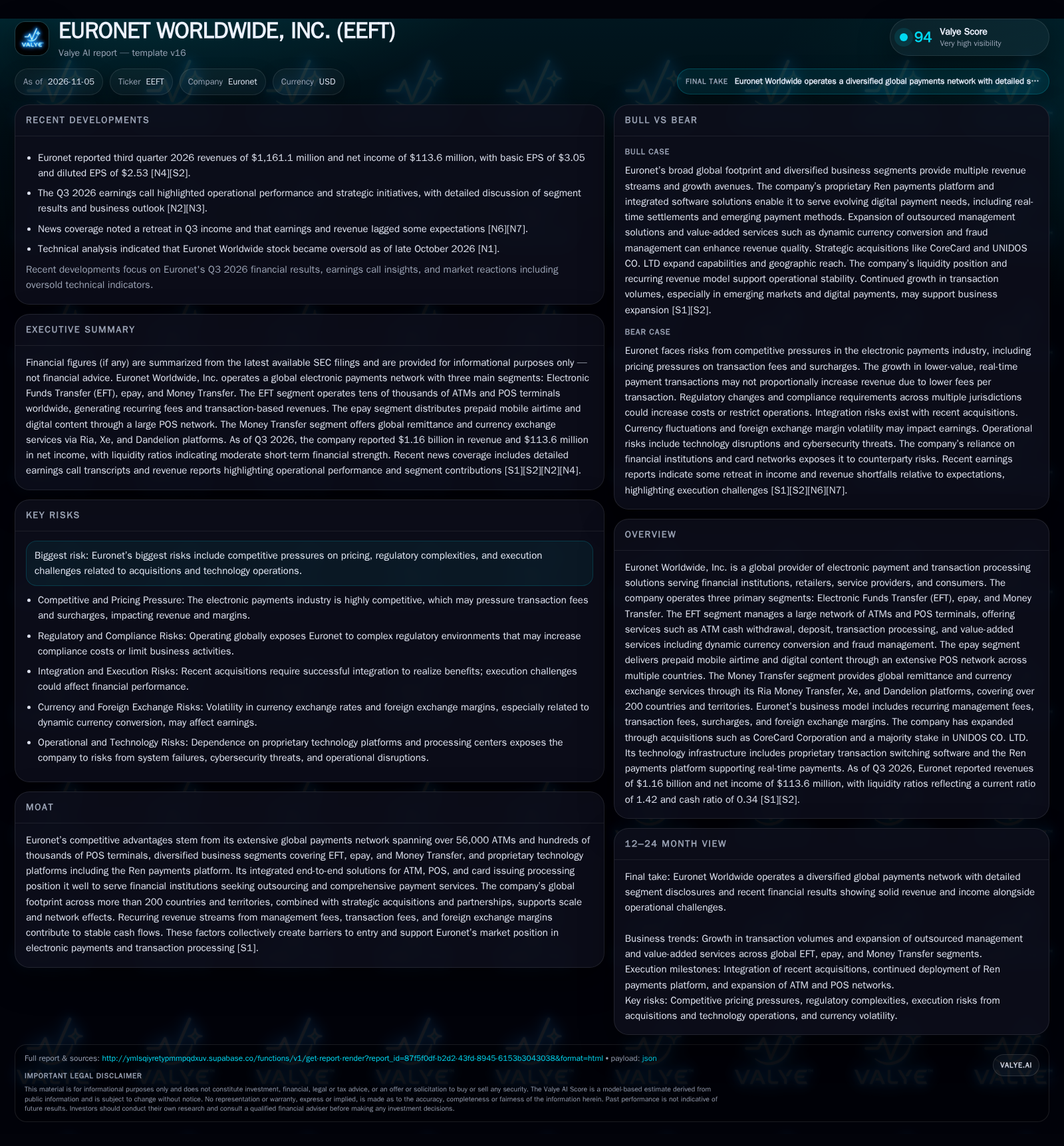
Euronet Worldwide operates three major payments segments—EFT, epay, and Money Transfer—each with global reach and recurring fee structures. Q3 2026 saw $1.16 billion in revenue and $113.6 million in net income, but income retreated and results lagged some expectations. Recent acquisitions expand capabilities but introduce integration and execution risk. The company’s competitive moat relies on network breadth, proprietary tech, and multi-segment scale, yet faces pricing, regulatory, and margin pressures, especially as the industry shifts toward lower-fee digital transactions. Monitoring integration progress, value-added service adoption, and regulatory impacts will be critical to assessing Euronet’s long-term earnings power and strategic flexibility. [S1] [S2] [N4] [N6] [N7]
Euronet Worldwide stands as a global payment infrastructure provider, operating at the intersection of cash, digital value, and cross-border transactions. Its three-segment engine—ATM/POS (EFT), prepaid/digital content (epay), and money transfer—offers a unique blend of recurring fees, scale, and service diversity. But the company’s Q3 2026 results exposed the vulnerability of this model to margin compression and shifting industry dynamics: income retreated and revenue fell short of some expectations, even as the business added new geographies and capabilities through acquisition. As digital adoption accelerates and regulatory scrutiny intensifies, Euronet’s ability to integrate new assets, expand value-added services, and defend pricing will determine whether its network scale translates into sustainable earnings power or simply exposes it to the churn of the payments cycle.
Recent Performance Highlights Margin Compression and Expansion Imperatives
Euronet reported Q3 2026 revenue of $1,161.1 million and net income of $113.6 million, with basic EPS of $3.05 and diluted EPS of $2.53 [S2] [N4]. However, both revenue and income lagged some analyst expectations, and income retreated versus prior periods [N6] [N7]. This suggests that while the company’s multi-segment engine continues to generate significant top-line scale, margin pressures—potentially from pricing, mix, or cost factors—are weighing on profitability.
The company’s Money Transfer segment now accounts for 42% of consolidated revenue, overtaking traditional EFT and epay segments [S1]. This shift highlights the growing importance of cross-border payments and remittances within Euronet’s portfolio, but also exposes the firm to regulatory, pricing, and competitive risks unique to the global remittance market.
Euronet’s liquidity ratios as of September 2026—a current ratio of 1.42 and cash ratio of 0.34—reflect moderate short-term liquidity, with $955.4 million in cash and equivalents [S2].
How Euronet’s Multi-Segment Model Converts Scale Into Revenue—and Where Profitability Leaks
Euronet’s revenue engine is built on a blend of recurring management fees, transaction fees, surcharges, and foreign exchange (FX) margins, distributed across three segments: EFT (ATM/POS), epay (prepaid/digital content), and Money Transfer. The EFT segment drives volume through a network of nearly 57,000 ATMs and over 600,000 POS terminals, generating fees from both financial institutions (outsourced management, processing) and direct consumer transactions (withdrawals, DCC, surcharges) [S1]. The epay segment monetizes prepaid airtime and digital content distribution via a vast POS network, while Money Transfer leverages Ria, Xe, and Dandelion platforms to generate transaction fees and FX spreads across 207 countries and territories.
Euronet’s business model exhibits a mix of fixed and variable economics. Fixed costs stem from technology infrastructure (processing centers, proprietary software), compliance, and network maintenance, while variable costs are tied to transaction processing and partner commissions. Operating leverage is achieved as incremental transaction volumes—particularly in ATM, POS, and digital channels—can scale over largely fixed infrastructure. However, as payment volumes shift toward lower-value, real-time, or digital transactions, average revenue per transaction may decline, challenging margin expansion.
Recent acquisitions (CoreCard, UNIDOS CO. LTD) add new capabilities and geographies but also introduce integration costs and execution risk. The success of these moves depends on realizing synergies and cross-selling opportunities, particularly as the company seeks to expand value-added services (fraud management, DCC, real-time payments) to defend and grow fee pools in a competitive landscape [S1].
Network Breadth, Technology, and Integration: Competitive Advantages and Pressures
Euronet’s competitive position is anchored by its global payments network, proprietary Ren platform, and a diversified revenue mix spanning ATM, prepaid, and money transfer services [S1]. Its integrated, end-to-end offering for banks and financial institutions—combining ATM/POS management, card issuing, and value-added digital services—creates switching frictions for core clients seeking to outsource non-core payments infrastructure.
However, the electronic payments landscape is marked by intense competition from global processors, fintechs, card networks, and emerging big tech entrants. In money transfer, digital-first challengers and fintech disruptors are compressing fees and accelerating the migration to lower-margin, real-time cross-border payments. In prepaid and digital content, telcos and digital wallet providers are weakening traditional POS-based models.
Euronet’s ability to maintain scale advantages depends on continued expansion of its ATM/POS footprint and the successful rollout of new value-added services—areas where network effects and regulatory expertise can be differentiators. Yet, regulatory complexity, compliance costs, and the risk of technology obsolescence (as digital wallets or account-to-account rails expand) are persistent counterforces.
If Value-Added Services and Integration Deliver Margin Expansion
A favorable scenario for Euronet centers on the successful integration of recent acquisitions (CoreCard, UNIDOS CO. LTD), enabling the cross-selling of issuer processing and money transfer capabilities across its global network. If the company can accelerate the adoption of value-added services—such as dynamic currency conversion, advanced fraud management, and real-time payments—across its ATM/POS and money transfer channels, it could offset fee compression in legacy segments.
This outcome would likely be confirmed by a return to sequential earnings growth, rising operating margins, and higher revenue per transaction, especially in the Money Transfer and EFT segments. Additional evidence would include new partnerships with banks, fintechs, or digital platforms that expand the reach of Euronet’s Ren platform, as well as a measurable increase in outsourced management contracts with financial institutions.
Falsification would come in the form of stagnant or declining operating margins despite rising transaction volumes, persistent integration costs from new acquisitions, or failure to grow the share of value-added services within the revenue mix.
Stable Revenue Growth, Ongoing Margin Pressures, and Execution-Dependent Outcomes
The most plausible trajectory for Euronet is continued top-line growth driven by incremental expansion of its ATM/POS and Money Transfer networks, particularly in emerging markets and corridors underserved by digital-native competitors. However, this growth is likely to be offset in part by ongoing margin compression, as pricing pressures and the migration to lower-fee digital and real-time payments erode average revenue per transaction.
Integration of recent acquisitions may proceed without major disruptions but is unlikely to deliver immediate margin lift, given the costs and complexities inherent in cross-border, multi-segment platforms. The company’s liquidity position remains stable in the near term, but any material shock—whether regulatory, technological, or competitive—could strain cash flows if margin pressures persist.
Confirmation of this scenario would include steady but modest revenue and income growth, relatively flat or slightly declining operating margins, and incremental, rather than transformational, contributions from value-added services or new geographies. Evidence to the contrary would be either a rapid margin rebound (suggesting successful value creation) or a sharp earnings decline linked to integration, compliance, or competitive shocks.
Margin Erosion Accelerates Amid Regulatory and Digital Disruption
A negative scenario could unfold if competitive and regulatory pressures accelerate, particularly in the Money Transfer and EFT segments. Intensifying competition from digital-native remittance providers, fintechs, or big tech platforms could further compress transaction fees and FX margins, especially as regulators in key corridors intervene to lower consumer costs in cross-border payments.
If Euronet struggles to integrate new acquisitions or faces technology disruptions (e.g., obsolescence of proprietary platforms, cybersecurity incidents), operating costs could escalate and revenue synergies may fail to materialize. Currency volatility or adverse regulatory changes in major markets could further weigh on profitability and cash flow.
Confirmation of this scenario would include sequential declines in net income or operating margins, elevated integration or compliance expenses, and evidence of market share loss in core geographies or segments. A useful disconfirming signal would be resilience in operating margins and stable or rising average revenue per transaction despite industry-wide fee compression.
Milestones That Will Test Euronet’s Margin Resilience and Integration Strategy
Quarterly operating margin trends, especially in Money Transfer and EFT segments, as a real-time indicator of pricing power and value-added service adoption.
Revenue and net income growth rates versus prior periods and analyst expectations, to assess whether integration and geographic expansion are translating into improved earnings quality.
Share of value-added services (e.g., DCC, fraud management, real-time payments) within segment revenues—if disclosed—to gauge success in offsetting fee compression.
Integration milestones and synergy realization from CoreCard and UNIDOS CO. LTD acquisitions, including any disclosed cost savings or new client wins.
Updates on regulatory developments in major remittance corridors or ATM/POS markets, as these could directly impact fee structures and compliance costs.
Volume and mix of digital versus cash-based transactions, and the impact on average revenue per transaction across all segments (if disclosed).
Liquidity and working capital trends, beyond static ratios, to monitor resilience against shocks or unanticipated funding requirements.
Disclaimer: This is research-only, informational analysis and not investment advice. It may include AI-generated interpretation and general industry context. Always verify important details using primary sources.

Comments