
Zillow Group: Platform Leverage, Market Sensitivity, and the Stakes of Digital Real Estate Scale
Zillow’s Q3 2026 results underscore the platform’s operational leverage and macroeconomic exposure. As digital real estate ecosystems mature, the company’s liquidity and brand position offer optionality, but execution and external market factors remain decisive levers for long-term value creation.
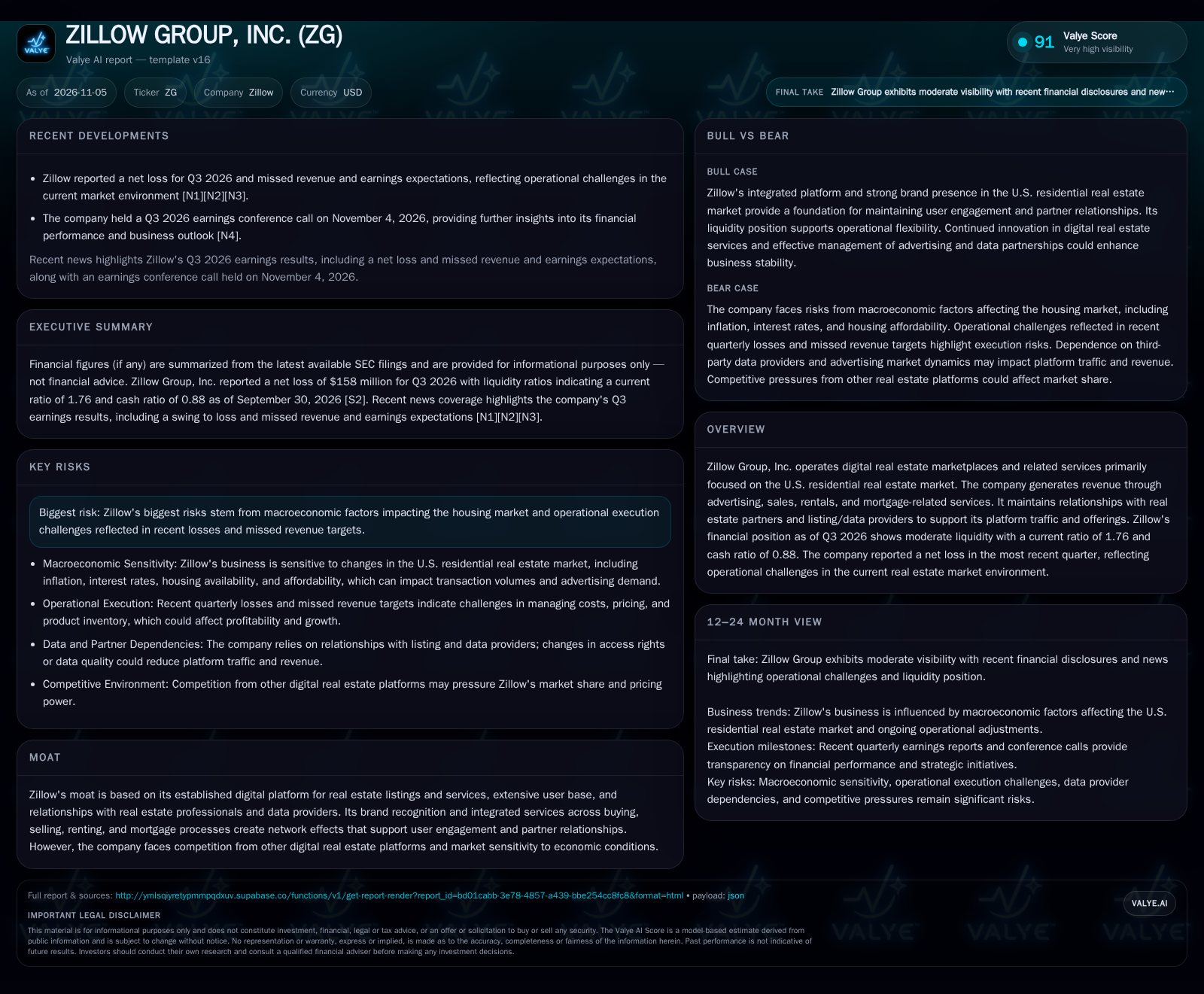
Zillow reported a Q3 2026 net loss and missed expectations, reflecting macro-driven headwinds and operational challenges. Execution on user engagement and partner relationships is critical as the digital real estate landscape evolves. [S2] [N1] [N2] [N3]
Zillow Group’s latest quarter paints a picture of a digital real estate platform navigating the dual challenges of cyclical housing market pressure and the persistent need to innovate within a crowded, data-driven ecosystem. The company’s position at the intersection of advertising, data management, and real estate transactions makes its fortunes acutely sensitive to macroeconomic trends, while the evolving landscape of digital competition and data access rights adds further complexity to its outlook. [S2] [N1] [N2] [N3]
Recent Financial Results and Platform Sensitivities Shape the Near-Term Outlook
Zillow reported a net loss of $158 million for Q3 2026, with basic and diluted EPS of -$0.70, missing analyst expectations and reflecting the ongoing operational and market challenges facing the digital real estate sector. The company reported cash and liquidity metrics for the period; these figures do not by themselves establish operating runway, investment capacity, financial flexibility, or financing capacity. Zillow’s business performance is closely tied to macroeconomic factors—particularly the health of the U.S. housing market, inflation, and interest rates—which directly impact transaction volumes and advertising demand. The company’s reliance on third-party data providers and real estate partners to drive platform traffic and product inventory management remains a core operational lever. [S2] [S1] [N1] [N2] [N3]
Additionally, the interplay between Zillow's platform dynamics and broader economic indicators can create nonlinear effects on its financial performance. For instance, shifts in consumer confidence or employment rates may indirectly influence housing demand and, by extension, platform engagement and advertising spend. Understanding these linkages is critical because even marginal changes in macroeconomic variables can amplify or mitigate operational outcomes. Moreover, Zillow’s dependency on third-party data is not only a cost consideration but also a strategic vulnerability; disruptions in data quality or timeliness can degrade user experience and reduce the platform's competitive edge, thereby affecting traffic and monetization potential.
Digital Platform Economics: Revenue Drivers, Operating Leverage, and Cost Dynamics
Zillow’s core economic engine centers on its digital marketplace for residential real estate, generating revenue through advertising, lead generation, and ancillary services such as rentals and mortgages. The platform model is inherently scalable, with fixed costs in technology, data infrastructure, and marketing, while incremental traffic and transaction volume can drive meaningful margin expansion if conversion and retention rates improve. However, the company’s cost structure is exposed to volatility in advertising spend, partner commissions, and technology investments required to sustain platform innovation.
Revenue mix is sensitive to shifts in user engagement and real estate market cycles. In downturns, lower transaction volumes and reduced advertising budgets from real estate professionals can compress top-line growth. Conversely, periods of housing market strength tend to amplify monetization opportunities. [S1] [S2]
From a cost perspective, Zillow faces the challenge of balancing investment in technology and marketing against the volatility of revenue streams. The fixed nature of many platform costs means that during market downturns, the company must carefully manage spending to avoid margin erosion. However, underinvestment in innovation or user acquisition during these periods risks longer-term competitive positioning. Furthermore, the elasticity of advertising demand relative to housing market conditions suggests that revenue growth may lag recovery in transaction volumes, as real estate professionals adjust budgets cautiously. This dynamic underscores the importance of operational agility and cost discipline in preserving financial health while maintaining growth optionality.
Network Effects, Data Access, and the Pressures of Digital Real Estate Competition
Zillow’s platform benefits from network effects: a large user base attracts real estate partners and advertisers, while comprehensive listings and services reinforce user engagement. Brand recognition and integrated offerings across buying, selling, renting, and mortgages help sustain platform stickiness. However, these advantages are countered by several structural risks.
The company’s dependence on third-party data providers and listing partners introduces ongoing vulnerability—any disruption in data access or unfavorable renegotiation of data rights could erode traffic and inventory quality. The digital real estate landscape remains crowded, with competing platforms, brokerage hybrids, and emerging tech-driven models vying for consumer and partner attention. Switching costs for users and agents are moderate, as listings and leads are often multi-homed across platforms. Pricing power is limited by the transparency of online marketplaces and the commoditization of digital advertising products.
Sustained competitive edge will likely require ongoing investment in product innovation, user experience, and ecosystem breadth—areas where operational execution and technological differentiation may become decisive.
The structural pressure from multi-homing behaviors among users and agents further complicates Zillow’s competitive moat. Since listings and leads are often accessible across multiple platforms, Zillow must continuously enhance its value proposition to prevent churn and maintain pricing power. This necessitates not only superior data integration and user interface design but also the development of differentiated services that could increase switching costs. Additionally, regulatory developments around data privacy and platform neutrality could impose constraints on data usage or advertising practices, potentially increasing compliance costs and limiting monetization strategies. Thus, Zillow’s ability to innovate within these evolving regulatory frameworks will be a key determinant of sustainable competitive advantage.
If Market Cycles Turn and Platform Monetization Improves, Operating Leverage Could Unlock Value
A favorable scenario for Zillow hinges on a cyclical rebound in the U.S. housing market—especially if falling interest rates or improved affordability drive higher transaction volumes and agent advertising budgets. If Zillow successfully deepens user engagement through new digital tools, expands its mortgage and rental offerings, and negotiates stable long-term data partnerships, incremental revenue could flow through with high operating leverage, given the platform’s fixed-cost base.
Confirmation of this scenario would include a return to positive net income, sustained sequential growth in user engagement metrics (unique visitors, time on platform, conversion rates if disclosed), and evidence of margin expansion as revenue rebounds outpace cost growth. Announcements of new high-margin services, strategic partnerships, or exclusive data agreements would further support the case for improved long-term economics.
Navigating Cyclical Headwinds While Maintaining Platform Engagement and Data Access
The most plausible near-term trajectory is one of continued operational resilience amid persistent macroeconomic headwinds. Zillow is likely to experience modest revenue growth or near-term stagnation as housing affordability and transaction volumes remain pressured by interest rates and broader economic uncertainty. Advertising and partner revenue may remain muted, but the company’s platform scale and liquidity provide time to adjust product offerings and optimize costs.
Confirmation would come from relatively stable user traffic, sustained relationships with key data and listing partners, and incremental improvements in operating margin, even if headline profitability remains elusive. Falsification would involve material declines in platform engagement, loss of critical data feeds, or further deterioration in cash burn that threatens the company’s reported liquidity position buffer.
Adverse Shocks: Data Access Disruption or Prolonged Market Weakness Undermine Platform Economics
The most acute risks for Zillow stem from two fronts: a protracted housing market downturn that further compresses transaction and advertising volumes, and a disruption in access to critical listing or data feeds. In this scenario, fixed costs would become increasingly burdensome, with negative operating leverage amplifying net losses and eroding the company’s liquidity cushion.
Evidence of this downside would include sequential declines in both revenue and user engagement, loss of major partner relationships, or public disclosures of renegotiated (and less favorable) data access terms.
Tracking Zillow’s Execution and Market Exposure: What Will Test the Digital Real Estate Thesis
Sustained or growing unique user traffic and engagement metrics would signal resilience or improvement in platform value, especially if disclosed alongside conversion rates.
Trends in advertising and partner revenue will help gauge the health of Zillow’s core business and the willingness of real estate professionals to spend on digital lead generation.
Updates on the status and terms of data and listing provider relationships would clarify the risk of inventory or traffic disruption.
Gross margin and operating margin progression—especially during periods of revenue volatility—will test the company’s ability to achieve operating leverage.
Cash burn rates and periodic liquidity updates will be critical, given the recent net losses and moderate reported cash balance.
Any announced product innovations, exclusive partnerships, or ecosystem expansions could indicate progress on strategic differentiation.
Changes in the U.S. housing market—such as shifts in mortgage rates, transaction volumes, or affordability metrics—will have direct implications for Zillow’s addressable opportunity set.
Disclaimer: This is research-only, informational analysis and not investment advice. It may include AI-generated interpretation and general industry context. Always verify important details using primary sources.

Comments