
Coeur Mining at an Inflection: Cash Generation, Canadian Expansion, and the Leverage of Portfolio Diversification
A quadrupled cash balance, robust free cash flow, and a major Canadian acquisition mark Coeur Mining’s transition to a multi-asset, North American-focused producer. The key test ahead: translating operational ramp-up and portfolio breadth into sustainable earnings, amid persistent commodity price volatility and integration risk.
Coeur Mining’s 77% revenue surge and over fourfold increase in cash reflect both operational execution and favorable market conditions, but profit margins remain exposed to metal price swings and asset integration challenges. The pending New Gold acquisition could consolidate Coeur’s position as a leading diversified precious metals producer in North America—if execution matches ambition. Watch for cost discipline, Canadian mine ramp-up, and regulatory resolution as the next thesis-defining milestones.
Coeur Mining, Inc. enters late 2026 at a pivotal moment: after a year of surging revenue and cash generation, the company faces the challenge—and opportunity—of integrating major Canadian assets through the pending New Gold acquisition. While Q3 results show the benefits of operational scale and cost discipline, declining realized metal prices and a profit dip reveal the persistent volatility inherent to the sector. The next phase will test whether Coeur’s diversified North American portfolio can deliver sustained earnings growth and offset commodity and integration risks.
Recent Financial Surge, Canadian Acquisition, and Cost Improvements Set the Stage
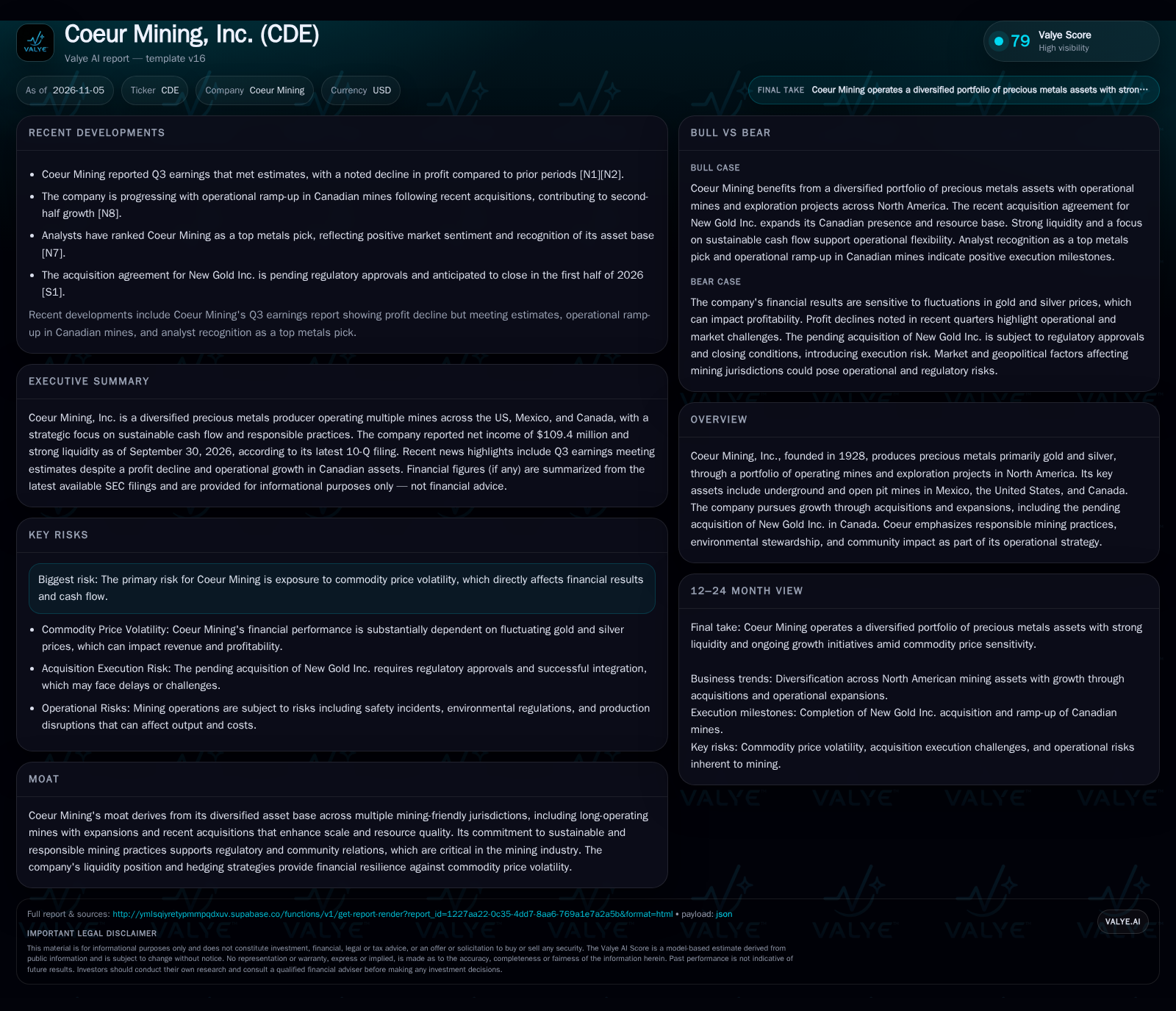
Coeur Mining reported a dramatic 77% increase in Q3 2026 revenue to $1.0 billion, with adjusted EBITDA up 69% and free cash flow rising 27% year-over-year to $240 million [S2]. [S2] The operational ramp-up at recently acquired Canadian assets contributed to this performance, although profits declined in the quarter as average realized gold and silver prices fell [S2] [N2] [N8].
Strategically, Coeur’s pending acquisition of New Gold Inc.—adding the New Afton and Rainy River mines in Canada—signals a push to deepen its North American footprint and further diversify production [S1]. However, this move brings integration and regulatory risks, as the transaction requires approval and successful blending of new operations into the existing portfolio [S1].
How Coeur Converts Ore into Cash: Revenue Mix, Cost Management, and Operating Leverage
Coeur’s business model hinges on extracting gold and silver from a mix of underground and open-pit mines, with revenue tied directly to production volumes and realized commodity prices. In Q3, gold production totaled 161,400 ounces and silver 4.2 million ounces, with silver accounting for 27% of total revenue [S2]. The company employs both co-product and by-product accounting, with revenues from secondary metals treated as cost credits—an approach that can help smooth reported unit costs when metal prices diverge.
Operating leverage is pronounced: fixed costs of mine operation and sustaining capital are high, but incremental production—especially from expanded assets like Rochester and ramping Canadian mines—can meaningfully boost cash flow when prices are favorable. Cost discipline is evident in the 16% and 1% quarter-over-quarter declines in adjusted costs applicable to sales (CAS) per gold and silver ounce, respectively [S2].
[S2]
Diversification, Jurisdictional Advantage, and the Challenge of Sustained Differentiation
Coeur’s portfolio spans seven operating mines and a polymetallic exploration project across the U.S., Canada, and Mexico, reducing dependence on any single asset or jurisdiction [S1]. This geographic and asset diversification is a relative strength compared to single-mine or regionally concentrated peers. The focus on mining-friendly jurisdictions (notably Nevada, Alaska, and Canada) may lower regulatory and political risk compared to operators in less stable regions.
However, competitive differentiation in precious metals is tenuous: production costs, ore grades, and reserve life are subject to depletion and variability, while commodity prices are set globally. Coeur attempts to mitigate price volatility through hedging, but this can only partially shield margins. Large, diversified global producers (e.g., Newmont, Barrick) retain scale advantages, while smaller niche players may be nimbler or have higher-grade assets. Coeur’s moat, such as it exists, rests on balanced scale, cost discipline, and a track record of responsible operation and community engagement.
The pending New Gold acquisition, if completed and well-integrated, could meaningfully boost Coeur’s scale and resource quality, but also exposes the company to new operational and integration risks common in sector M&A.
If Canadian Integration Succeeds and Metal Prices Stabilize, Cash Flow Could Accelerate
The most favorable scenario for Coeur is one in which the New Gold acquisition closes smoothly, regulatory approvals are obtained without delay, and the New Afton and Rainy River mines ramp up to or exceed planned production and cost targets. In this scenario, Coeur’s revenue base becomes both larger and more diversified, potentially mitigating the impact of any single-mine disruption.
If gold and silver prices stabilize or rebound from current levels, the company’s high operating leverage could translate incremental revenue directly into margin and cash flow expansion. Sustained cost discipline—such as further declines in CAS per ounce—and continued free cash generation would support debt reduction, future growth projects, or additional capital returns.
Evidence confirming this scenario would include: timely regulatory approval and seamless operational integration of New Gold assets; stable or rising realized metal prices; further improvement in unit costs; and visible production growth from Canadian mines. Conversely, early integration stumbles, regulatory setbacks, or cost overruns would undermine this outcome.
Portfolio Breadth Offsets Commodity Headwinds, but Cyclicality and Integration Risks Remain
The most plausible trajectory is that Coeur’s expanded portfolio delivers steady, if volatile, cash flow—balancing contributions from U.S., Mexican, and Canadian mines. The company continues to generate operating profits and cash, but realized margins fluctuate with metal prices and occasional operational hiccups.
The New Gold acquisition likely closes, but integration requires time and entails some cost and production variability. Cost control initiatives and hedging strategies partially offset commodity swings, but cannot eliminate volatility. Share buybacks and prudent capital allocation continue, but are paced by underlying cash flow.
This scenario would be confirmed by moderate, ongoing improvements in consolidated production and cost metrics, regular updates on integration milestones, and continued positive operating cash flow—even if quarterly earnings remain variable. It would be falsified by persistent cost overruns, inability to integrate new assets, or sustained declines in commodity prices that erode cash generation.
Commodity Price Declines or Integration Missteps Could Reverse Recent Gains
A less favorable scenario is one in which gold and silver prices continue declining, squeezing margins across Coeur’s asset base and reversing recent cash gains. The company’s high fixed cost structure means that falling prices can quickly render some operations marginal or unprofitable.
If the New Gold acquisition faces regulatory delays or integration complications—such as production disruptions, cost overruns, or cultural misalignment—Coeur could see a drain on cash, lower earnings, and potential write-downs.
Confirming evidence for this scenario would include: further declines in average realized metal prices; missed production or cost targets at new or legacy mines; regulatory setbacks in the Canadian acquisition; or a significant drop in free cash flow and working capital.
Milestones That Will Define Coeur’s Trajectory in a Volatile Metals Cycle
Quarterly production volumes and grades at legacy and newly acquired mines—especially New Afton and Rainy River—will signal whether operational ramp-up is on track.
Adjusted costs applicable to sales (CAS) per gold and per silver ounce, if disclosed, will provide a direct view into cost discipline and margin resilience.
Progress updates on regulatory approval and integration of the New Gold acquisition, including any disclosed timeline changes or synergies.
Trends in realized gold and silver prices, given their direct impact on revenue and margins.
Free cash flow and operating cash generation, especially in the context of capital return programs and future growth investment.
Share repurchase activity and management commentary on capital allocation priorities, as a window into confidence and potential financial flexibility.
Any disclosed operational disruptions, environmental incidents, or regulatory challenges at key assets, which could signal emerging risks.
Disclaimer: This is research-only, informational analysis and not investment advice. It may include AI-generated interpretation and general industry context. Always verify important details using primary sources.

Comments