
American States Water: Rate Mechanism Shifts, Contracted Services, and the Stakes of Regulatory and Climate Realignment
As American States Water navigates regulatory transitions and deepens its commitment to climate adaptation, the interplay between stable utility operations and long-term government contracts will shape its earnings visibility and risk profile. The company’s next phase hinges on regulatory outcomes, capital efficiency, and the durability of its contracted services model.
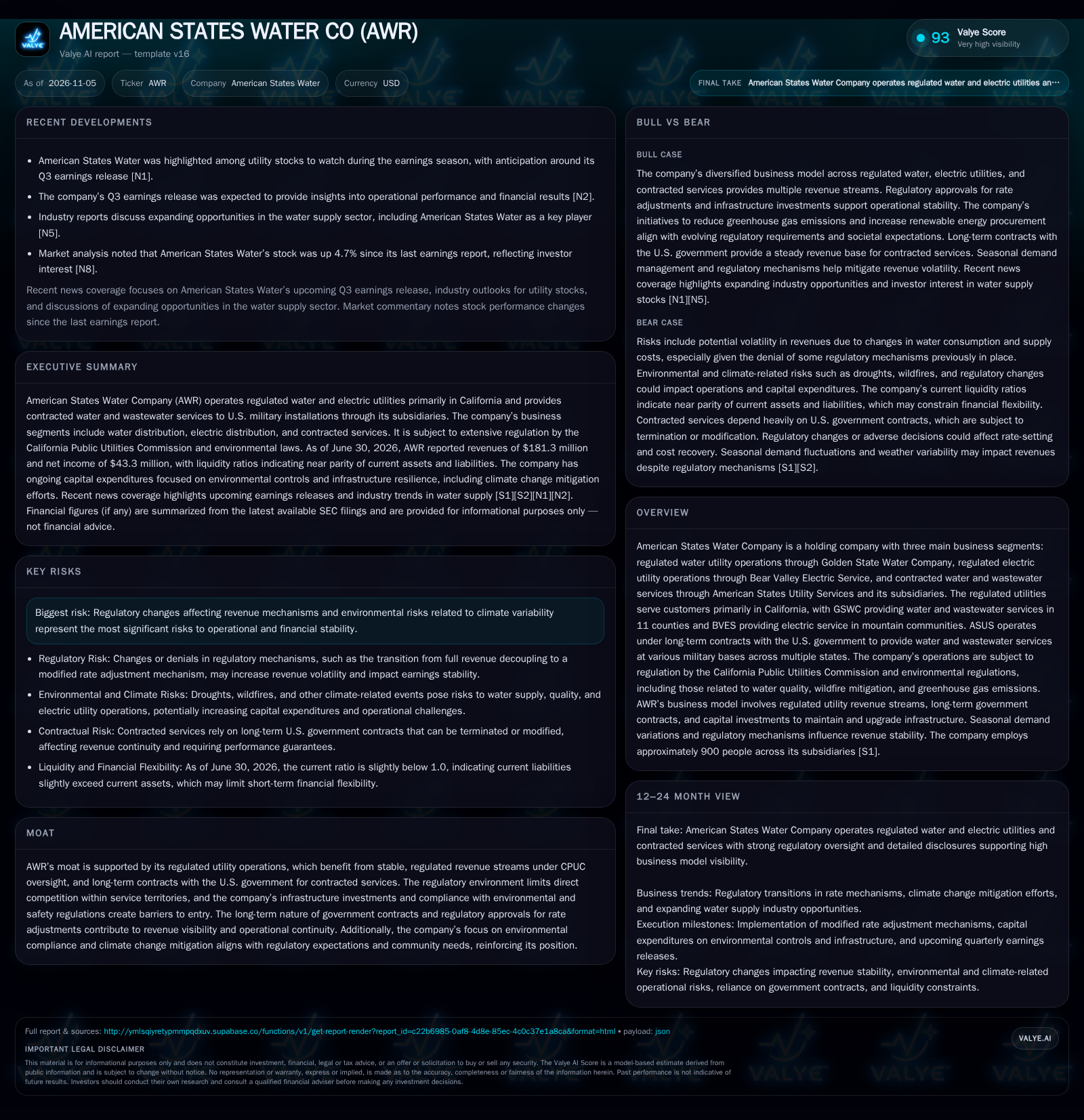
American States Water’s regulated utility businesses and long-term government contracts provide foundational revenue stability, but changes in regulatory mechanisms and environmental risks introduce new volatility. The company’s next chapter will be defined by its ability to adapt to evolving rate structures, execute infrastructure investments, and sustain its government services pipeline amid heightened climate and regulatory scrutiny. [S1] [S2]
American States Water’s business model blends the predictability of regulated utility operations with the complexity of long-term government service contracts. The company’s ability to deliver stable earnings has long rested on regulatory frameworks and infrastructure investment discipline. However, shifts in rate-setting mechanisms, intensifying climate adaptation requirements, and the inherent uncertainties of government contracting are reshaping the risk-reward balance. As the company enters a period of regulatory transition and capital allocation scrutiny, its core challenge is to preserve earnings visibility while navigating new volatility drivers—making execution, regulatory engagement, and contract management more critical than ever. [S1] [S2]
Recent Regulatory and Financial Developments Reshape the Operating Backdrop
American States Water’s regulated utilities—Golden State Water Company and Bear Valley Electric Service—served roughly 265,000 water and 25,000 electric customers at year-end 2025, anchoring the company’s revenue base. In parallel, its ASUS subsidiary continues to provide contracted water and wastewater services to U.S. military bases under multi-decade agreements, including a 50-year firm-fixed-price contract with price adjustments tied to economic indices and contract modifications. [S1]
A significant shift occurred on January 1, 2025, with the transition from a full revenue decoupling mechanism to a modified rate adjustment mechanism for the water and electric businesses. This regulatory change increases exposure to demand fluctuations—particularly from weather variability—potentially amplifying revenue swings not previously experienced under the older structure. [S1]
Financially, as of June 30, 2026, the company reported $181.3 million in revenue and $43.3 million in net income, with a current ratio of 0.98 and a cash ratio of 0.09. The near-parity of current assets and liabilities does not, by itself, establish a financial constraint, but it does suggest limited short-term cushion against shocks. [S2]
In the background, BVES’s renewable power contracts reached 47% of total retail sales in 2025, supporting compliance with California’s aggressive renewable energy mandates. Environmental and climate initiatives—including a 60% greenhouse gas emissions reduction target by 2035—continue to shape capital allocation and long-term planning. [S1]
Rate Structures, Contracted Services, and the Economics of Regulated Infrastructure
American States Water’s economics are anchored by regulated utility models, where pricing is determined by cost-of-service ratemaking and regulatory approval for capital recovery. In water and electric, the company’s ability to earn its authorized return depends on prudent investment, regulator-accepted operating costs, and timely rate relief. The move to a modified rate adjustment mechanism introduces more direct sensitivity to actual volumes—so while regulatory lag and capital recovery remain, volume risk is now partially reintroduced, potentially increasing earnings volatility in extreme weather years.
The contracted services segment, run by ASUS, operates under long-term, often multi-decade contracts with the federal government. These agreements—such as the 50-year firm-fixed-price contract—provide a base of predictable revenue, subject to annual price adjustments tied to inflation and negotiated modifications for scope. However, these contracts can be subject to federal budget cycles and renegotiation risk; capital outlays are typically reimbursable or embedded in rates, but large upfront investment requirements can still create timing mismatches and balance-sheet pressure if not carefully managed.
Operating leverage in the utility segments is moderate: fixed costs (depreciation, labor, baseline maintenance) are high, but allowed returns are typically set to ensure recovery plus an equity return over the asset life. Capital intensity is structurally high, especially as environmental mandates and wildfire mitigation drive incremental infrastructure spending. The contracted services business, while less capital-intensive per dollar of revenue, can require working capital to fund project work ahead of reimbursement, and carries the risk of cost overruns or delayed payment if contract terms are challenged.
The company's ability to fund capital expenditures—required for both regulatory compliance and growth—relies on a mix of internally generated cash and external financing. The company reported cash and liquidity metrics for the period; these figures do not by themselves establish operating runway, investment capacity, financial flexibility, or financing capacity. [S2]
Barriers and Counterforces in Regulated Utilities and Government Contracting
AWR’s strongest competitive advantage lies in its regulated utility franchises: within granted service areas, competition is structurally limited by the regulatory regime, and new entrants face prohibitive capital and approval barriers. This creates a stable customer base with high revenue visibility, provided regulatory relationships remain constructive and authorized returns are adequate.
In contracted services, the company faces competition from other utility outsourcing and engineering firms for new federal contracts and for renewals/extensions. The 50-year contract structure provides a moat for existing installations, but any lapse in performance, cost control, or compliance could threaten renewal prospects or trigger early termination. Federal budget uncertainty and shifting government priorities can also lead to abrupt changes in scope or funding.
Substitution risk is low in core regulated water and electric, as physical infrastructure and regulatory mandates make alternatives (such as self-supply or microgrids) viable only at the margin. However, customer sentiment, political pressure, and regulatory activism can influence allowed returns, capital approval, and cost-recovery mechanisms, introducing a non-market form of competition for shareholder value.
AWR’s environmental and climate adaptation initiatives—while necessary to meet regulatory and community expectations—could become a differentiator if executed efficiently, but also raise the bar for capital discipline and stakeholder engagement. The risk is that mandated investments outpace the company’s ability to recover costs, compressing margins and eroding the regulatory compact.
Regulatory Stability and Efficient Capital Deployment Unlock Value
A favorable outcome for American States Water would involve constructive regulatory implementation of the new rate mechanisms, allowing timely and adequate cost recovery as capital investments rise. If the CPUC continues to grant reasonable returns and recognizes the necessity of environmental and resilience spending, the company could sustain or even expand its earnings base despite the shift from full decoupling.
In the contracted services segment, the durability of long-term government contracts—especially renewals, scope expansions, or new base wins—would reinforce revenue visibility. Efficient execution, minimal cost overruns, and positive government audits could drive margin expansion and justify further infrastructure investment.
Evidence confirming the upside would include: regulatory approval of rate cases that fully recognize increased capital and operating costs; disclosure of new or expanded U.S. military contracts; stable or growing contracted services backlog (if disclosed); and continued customer growth in regulated territories. Outperformance versus allowed returns and positive free cash flow generation during elevated capex cycles would also support the thesis.
Managing Through Volatility: Moderate Growth Amid Regulatory and Climate Shifts
The most plausible scenario is one in which American States Water experiences moderate, policy-driven revenue growth, with earnings stability somewhat reduced by the new rate adjustment mechanism. Regulatory lag and weather-driven demand swings could increase year-to-year volatility, but the company’s underlying franchise value—anchored by its service area monopolies and long-term government contracts—remains intact.
Capital expenditures are likely to remain elevated due to environmental mandates and infrastructure aging, but rate cases and government contract adjustments mostly keep pace with rising costs. Some pressure on margins and free cash flow is possible if regulatory or contract cost recovery falls behind, but the overall business remains resilient.
This scenario would be confirmed by: relatively steady revenue and net income growth in line with historical trends; regular but not excessive capital spending; and the absence of major contract losses or regulatory disallowances. Temporary dips in cash flow or working capital ratios may occur during capex spikes, but are managed through routine financing activities. [S1] [S2]
Adverse Regulatory and Environmental Events Disrupt Earnings Visibility
A negative scenario would unfold if the CPUC’s new rate mechanisms prove less responsive to rising costs or demand volatility, resulting in regulatory lag and under-recovery of investments. Severe drought, wildfire, or other climate events could simultaneously drive up operating costs and require emergency capital outlays, straining cash flow and potentially forcing the company to defer dividends or seek dilutive financing.
On the contracted services side, termination or unfavorable modification of major government contracts—whether due to performance issues, shifting federal priorities, or budget cuts—could abruptly erode a significant revenue stream.
Milestones and External Triggers That Will Shape American States Water’s Next Chapter
The outcome of CPUC rate cases and the practical impact of the modified rate adjustment mechanism on revenue stability—especially in high-variability weather years.
Disclosure of major new, renewed, or terminated government contracts in the ASUS segment, including any changes to contract scope, reimbursement terms, or base count.
Actual versus allowed returns in regulated utilities, particularly if disclosed by segment and over multi-year periods.
Trends in capital expenditure outlays and the company’s ability to recover those costs through rates or contract modifications.
Liquidity management and external financing activity, especially during periods of elevated capital spending or adverse operating events.
Progress toward environmental and climate targets, including greenhouse gas reduction milestones, renewable energy procurement, and wildfire mitigation outcomes.
Customer count and usage trends in core regulated territories, as a proxy for organic growth and resilience to conservation mandates or demographic shifts.
If disclosed, backlog or pipeline metrics in the contracted services business, to gauge visibility and risk concentration.
Disclaimer: This is research-only, informational analysis and not investment advice. It may include AI-generated interpretation and general industry context. Always verify important details using primary sources.

Comments