
TriplePoint Venture Growth BDC: Earnings Volatility and Leverage Dynamics in Venture Lending
TriplePoint Venture Growth BDC Corp. faces persistent earnings shortfalls amid a leveraged venture lending strategy. As competitive pressure and credit quality risks mount, the company’s ability to sustain distributions and net asset value will hinge on portfolio performance, expense discipline, and market conditions.
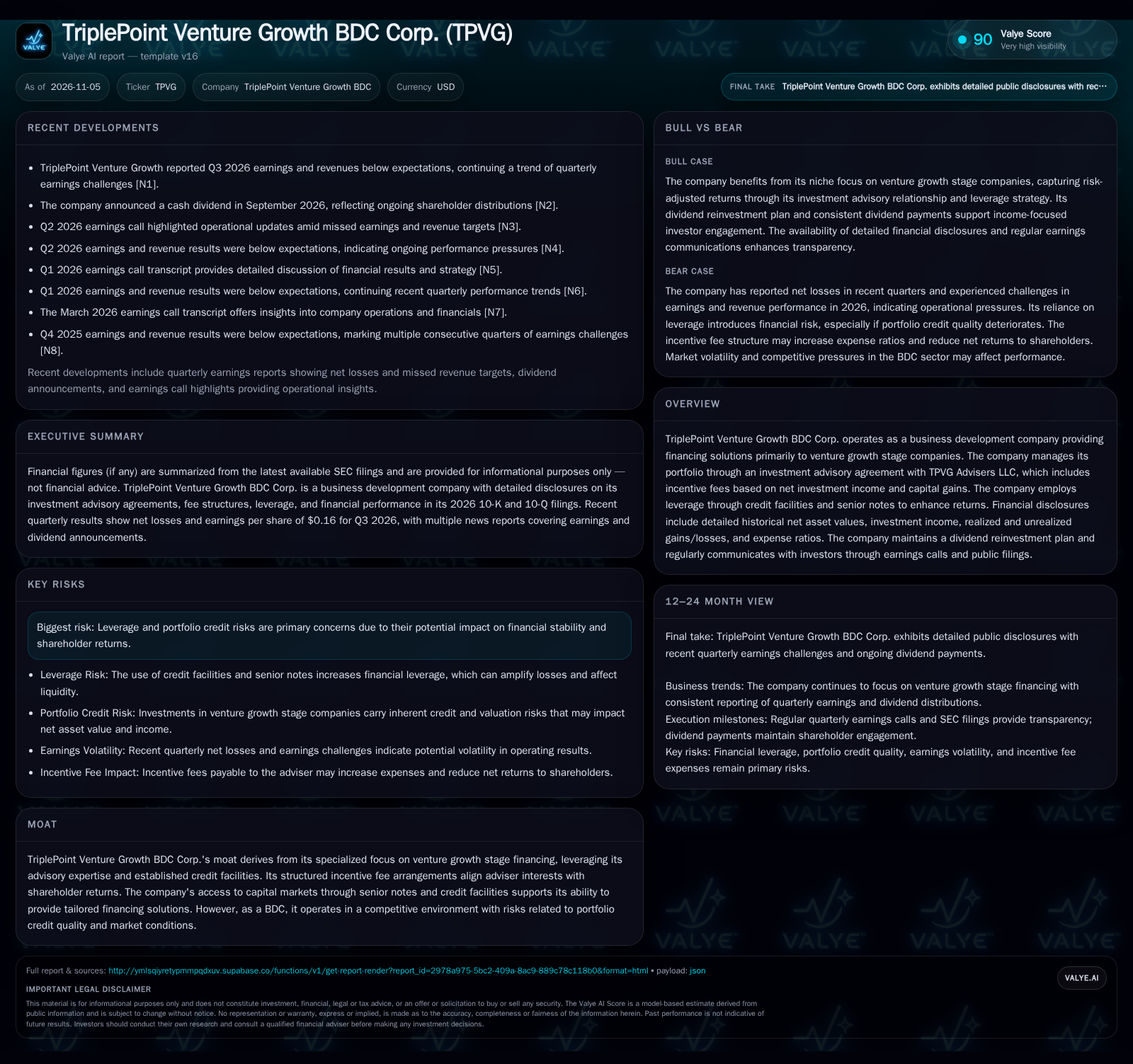
TriplePoint Venture Growth BDC Corp. (TPVG) continues to report quarterly earnings and revenue below expectations, with a Q3 2026 net loss and modest EPS. Sustaining returns will depend on managing these risks as competitive and macro headwinds persist. [S2] [N1] [N2]
TriplePoint Venture Growth BDC Corp. is at a crossroads: persistent earnings and revenue shortfalls through 2026 have illuminated the pressures of operating a leveraged, venture-focused lending platform in a competitive BDC landscape. The coming quarters will test whether TPVG can maintain asset quality and shareholder returns amid sector headwinds and rising macro uncertainty.
Recent Results Highlight Ongoing Earnings Fluctuations
TriplePoint Venture Growth BDC Corp. reported a net loss of $1.7 million for Q3 2026, with basic and diluted EPS of $0.16 per share and $17.6 million in cash and equivalents as of September 30, 2026 [S2]. This continues a multi-quarter trend of missing earnings and revenue expectations, as highlighted in Q1, Q2, and Q3 2026 reporting [N1] [N4] [N6]. The cited source reports dividend-related activity; that disclosure alone does not establish dividend-policy continuity, management confidence, or a material constraint on capital flexibility. [N2] These facts frame a company under pressure to convert portfolio lending into sustainable income, all while operating in a competitive and risk-prone segment of the BDC universe.
Leverage and Fee Structures Define Venture Lending Economics
TriplePoint Venture Growth BDC’s economics are driven by its core business: providing debt financing to venture growth stage companies, typically with higher yields than conventional middle-market loans. The company enhances returns by employing leverage, utilizing credit facilities and senior notes with various maturities and rates [S1]. This approach can amplify both gains and losses, making credit quality and underwriting discipline paramount.
Revenue is primarily generated through interest income on loans, with the potential for capital gains on warrants or equity kickers. However, the company’s investment advisory agreement introduces a two-pronged fee structure: incentive fees based on net investment income (above a hurdle rate) and capital gains, alongside a base management fee [S1]. While intended to align adviser and shareholder interests, these fees can materially increase expense ratios and dilute net returns, especially when portfolio performance lags.
Fixed operating costs and external management fees mean that scale and asset growth are critical to achieving operating leverage. Leverage magnifies returns on equity in favorable conditions but exposes the company to liquidity and solvency risk if portfolio companies underperform or market rates rise. The cited source reports dividend-related activity; that disclosure alone does not establish dividend-policy continuity, management confidence, or a material constraint on capital flexibility.
The interplay between leverage and fee structures creates a complex risk-return profile that requires careful calibration. For example, while leverage can enhance returns during periods of stable or improving credit conditions, it simultaneously increases sensitivity to interest rate fluctuations and refinancing risks. If the cost of debt rises due to broader market rate increases or credit spread widening, net interest margins could compress, pressuring net investment income. Additionally, the timing and structure of incentive fees introduce non-linear expense dynamics; during periods of underperformance, fees may remain relatively fixed, but in strong performance periods, incentive fees can significantly reduce net returns. Thus, understanding the marginal impact of incremental portfolio gains or losses on net earnings after fees is critical to assessing sustainable profitability.
Venture Lending Specialization Faces Sector-Specific Challenges
TPVG’s specialization in venture growth stage lending provides access to a segment underserved by traditional banks, potentially commanding superior risk-adjusted yields. Its established relationships and sector expertise help source deals that may be less accessible to more generalist BDCs or lenders. However, this niche focus also introduces heightened portfolio volatility, as venture-backed borrowers often lack the cash flow stability of more mature companies.
Competition is intensifying as other BDCs, private credit funds, and non-bank lenders target the same high-growth borrower cohort. These competitors may drive down spreads or offer more flexible terms, eroding TPVG’s pricing power. Moreover, the incentive fee structure—common across externally managed BDCs—may create a structural disadvantage relative to internally managed peers with lower expense ratios.
Technology and market cycles can further disrupt the competitive landscape: a downturn in venture capital activity or IPO markets could reduce demand for growth loans and increase default risk, while a buoyant exit environment could unlock capital gains and support returns. Ultimately, TPVG’s competitive position is shaped by its ability to maintain credit discipline, manage cost drag, and adapt to evolving borrower and investor expectations.
Operating Leverage May Boost Returns if Credit Quality and Origination Improve
A favorable scenario would see stabilization in credit markets and renewed strength in venture activity, enabling TPVG to deploy capital into high-yielding loans with attractive risk profiles. If portfolio credit quality remains resilient—evidenced by low non-accrual rates and minimal realized losses—interest income could rise, supporting both net investment income and dividend coverage.
Operating leverage would improve if fixed costs and advisory fees are spread across a larger asset base, while sustained portfolio performance could reduce the impact of incentive fees as a percentage of returns. Evidence confirming this scenario would include a reversal of the recent trend of earnings misses, higher net investment income per share, improved net asset value, and stable or rising dividend payments. Increased public venture exit activity and tighter credit spreads would further corroborate a positive shift.
Navigating Cyclical Pressures While Maintaining Lending Capacity
The most plausible near-term outlook is one of continued earnings volatility, as TPVG manages through a challenging environment for venture-backed borrowers and heightened competitive pressure.
Expense ratios are likely to remain elevated under the current advisory structure, limiting net return upside unless asset growth resumes or fee waivers are implemented. Falsification would require either a material deterioration in credit quality or a surprise improvement in origination volumes and margins.
Dividend Reductions and Asset Value Risks from Portfolio and Funding Pressures
A negative scenario would be triggered by a marked deterioration in portfolio credit quality, with rising non-accruals, realized losses, or markdowns on existing loans.
Leverage would amplify these effects, increasing the risk of covenant breaches or refinancing difficulties if asset values fall or capital markets tighten. Persistent expense drag from incentive and management fees could further erode net returns, while sector-wide stress in venture lending or a pullback in exit opportunities would exacerbate funding constraints.
Evidence of this scenario would include a spike in non-accrual rates, significant reductions in net asset value per share, dividend cuts or suspensions, and negative trends in net investment income. News of borrower defaults or a sharp decline in venture funding activity would further confirm a downside trajectory.
Factors Influencing TriplePoint Venture Growth BDC’s Stability in Venture Lending
Quarterly net investment income per share versus dividend declared—if disclosed, this will test whether core earnings cover distributions or if return of capital is required.
Portfolio non-accrual rate and realized credit losses—rising figures would indicate deteriorating asset quality and pressure on future returns.
Net asset value per share trends—persistent declines may signal underlying portfolio stress or excessive fee drag.
Origination volume and yield on new loans—a rebound would suggest improved competitive positioning and risk appetite.
Expense ratio and disclosed incentive fee payments—if disclosed, rising ratios may erode shareholder returns.
Leverage ratio and covenant compliance—if disclosed, this would highlight the company’s flexibility or vulnerability in a stressed scenario.
Broader venture capital and IPO market health—external indicators of borrower demand and exit opportunities would contextualize portfolio risk.
Disclaimer: This is research-only, informational analysis and not investment advice. It may include AI-generated interpretation and general industry context. Always verify important details using primary sources.

Comments