
Riley Exploration Permian: Acquisition-Driven Growth Meets Liquidity Pressure in the Permian Basin
Riley Exploration Permian’s expansion through acquisitions and robust operational cash flow highlights its growth ambitions, but a deepening working capital deficit and persistent commodity price volatility create a complex risk-reward profile for investors. The company’s use of derivatives, access to credit, and disciplined asset management are strengths, yet the path to sustained profitability will hinge on its ability to balance capital commitments with operational execution in a cyclical market.
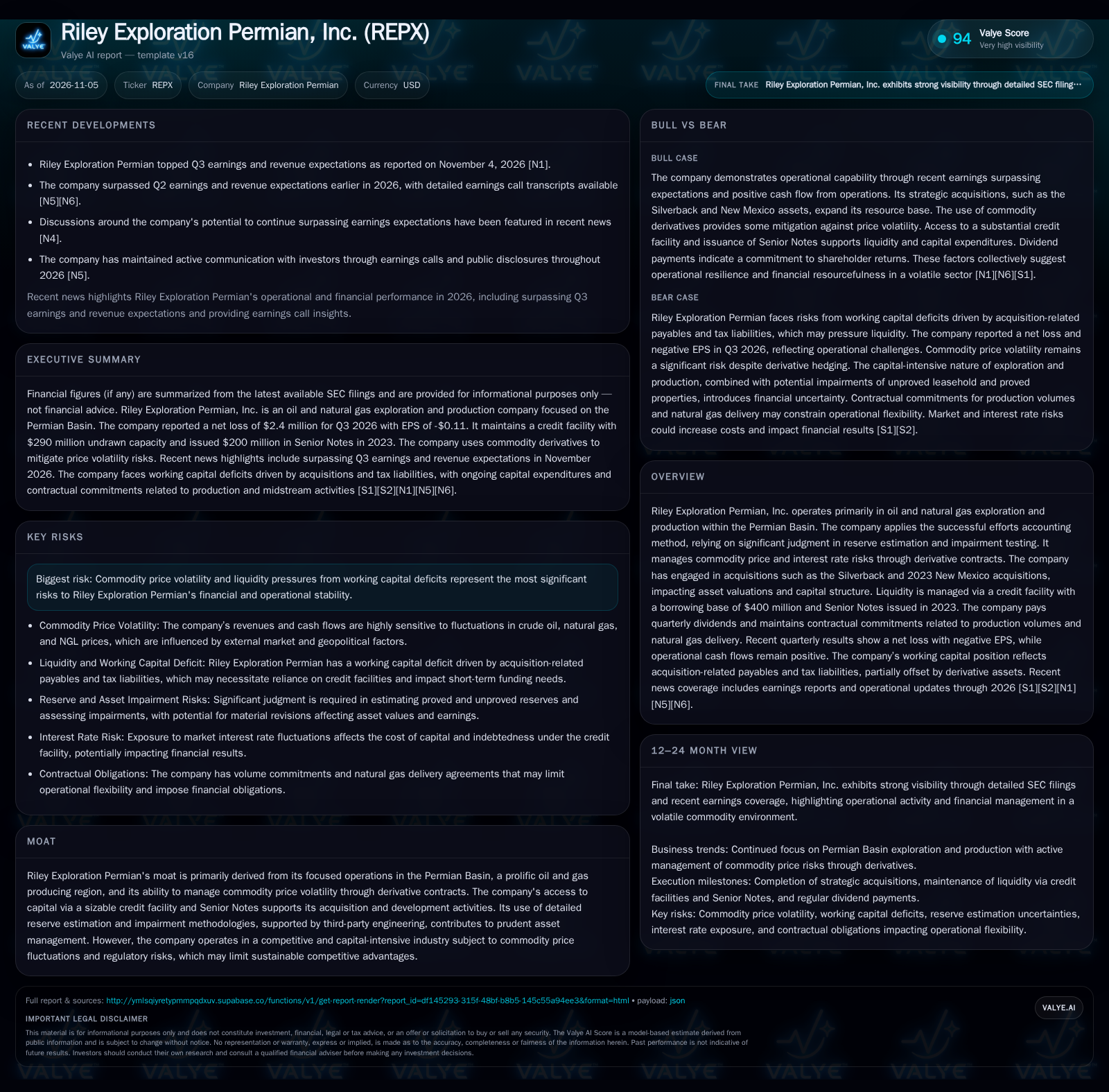
Riley Exploration Permian has outperformed recent earnings expectations and expanded its resource base via strategic acquisitions, but faces a mounting working capital deficit and reported a Q3 net loss. Its future trajectory will depend on commodity prices, operational efficiency, and navigating capital-intensive commitments in the Permian Basin. [S1] [S2] [N1] [N5] [N6]
Riley Exploration Permian, Inc. stands at a pivotal juncture in the Permian Basin, pursuing growth through acquisitions and operational scaling, even as its financial statements reflect both the opportunities and strains of this strategy. The company’s recent outperformance versus earnings expectations and continued investment in production assets reveal ambition and capability. However, a mounting working capital deficit, short-term net losses, and the persistent specter of commodity price volatility underscore the risks inherent in its expansion. For investors, the central question is whether Riley can convert near-term scale and cash generation into durable profitability, while managing liquidity pressures in a capital-intensive and cyclical sector.
Recent Performance: Growth, Losses, and Liquidity Constraints Shape the Outlook
Riley Exploration Permian reported a net loss of $2.4 million for Q3 2026, translating to basic and diluted EPS of -$0.11, despite exceeding consensus earnings and revenue estimates for the period. The company’s working capital deficit widened, standing at a current ratio of just 0.41 as of September 30, 2026—a consequence of acquisition-driven payables and tax liabilities, only partially offset by derivative assets. The company reported cash and liquidity metrics for the period; these figures do not by themselves establish operating runway, investment capacity, financial flexibility, or financing capacity. The company has access to substantial liquidity via a $400 million credit facility, with $290 million undrawn as of December 31, 2025, and $145 million in Senior Notes outstanding. These facts collectively highlight a business in expansion mode but with pronounced short-term financial pressures and balance-sheet complexity. [S1] [S2] [N1] [N5] [N6]
How Riley Turns Production into Cash—and Where the Economic Pressure Points Lie
Riley Exploration Permian’s economics are fundamentally shaped by its oil and natural gas production volumes, realized commodity prices, and the efficiency of capital allocation. Revenue is highly sensitive to price swings in crude oil, natural gas, and NGLs, with partial mitigation via commodity derivatives that can smooth but not eliminate volatility. The company’s cost base blends significant fixed elements—such as lease operating costs, G&A, and debt service—with variable drilling and completion expenses that scale with activity.
Recent acquisitions have expanded production potential, but also increased capital intensity and exposure to depletion and impairment risks. The successful efforts accounting method means exploration costs are expensed unless tied to proved reserves, focusing management attention on capital discipline and reserve replacement. Operating leverage is present: higher production at stable or rising prices could drive significant incremental cash flow, but the reverse is equally true if prices fall or operational issues arise.
Potential financial flexibility is underpinned by the undrawn credit facility and derivative gains, but persistent working capital deficits and recurring dividends ($33.6 million paid in 2025) create ongoing funding needs. The company’s ability to sustain and grow dividends while investing in new development will depend on balancing cash inflows, capital expenditures, and debt obligations—especially as acquisition-related payables and tax liabilities come due.
Permian Basin Focus: Advantages, Imitators, and Structural Headwinds
Riley Exploration Permian’s competitive positioning is anchored in the prolific Permian Basin, where scale, technical expertise, and asset quality can provide cost and production advantages. The region attracts intense competition from both large independents and major integrated producers, driving up acreage costs and raising the bar for operational efficiency. Riley’s recent acquisitions have enhanced its resource base, but the company still competes against larger, better-capitalized peers capable of absorbing price shocks and investing in advanced technology.
Commodity derivatives offer some insulation from market swings but are widely used across the industry, limiting their differentiation value. The company’s disciplined use of third-party reserve engineering and focus on impairment testing may improve capital allocation, but these are table stakes in a sector where capital destruction from poorly timed deals or overleveraging is common. Switching costs for customers are negligible—oil and gas are fungible commodities—so Riley’s moat depends on cost structure, reserve quality, and the ability to execute capital programs efficiently relative to peers.
What It Would Take for Acquisitions and Scale to Drive Sustainable Free Cash Flow
The most favorable outcome for Riley Exploration Permian would see recent acquisitions and organic development translating into higher production volumes at stable or improving commodity prices. If derivative strategies continue to successfully hedge downside risks without capping too much upside, and if the company can manage operating costs and capital spending tightly, operating leverage could convert incremental revenues into disproportionately higher free cash flow.
Additional evidence would include reserve growth outpacing depletion, strong production metrics, and the ability to sustain or increase dividends without incremental leverage. Conversely, failure to translate acquisitions into tangible production or margin gains, or persistent net losses despite high activity, would undermine the upside case.
Balancing Expansion With Liquidity: The Most Likely Trajectory
In the most plausible scenario, Riley Exploration Permian continues to deliver solid operational performance, with production growth from recent acquisitions offsetting natural declines and price volatility.
The company likely draws modestly on its credit facility to bridge funding gaps, but avoids distress thanks to positive operating cash flow and prudent use of derivatives. Reserve replacement keeps pace with production, and asset impairments are managed within expectations. Margin expansion is gradual, with cost inflation and competitive pressures offsetting some gains. Significant deviation from these trends, such as a substantial deterioration in liquidity or a sharp rise in impairments, would challenge this base case.
How Liquidity Strain and Market Volatility Could Threaten Riley’s Expansion Strategy
An adverse scenario would see commodity prices falling sharply, eroding Riley Exploration Permian’s cash flow and rendering derivative protection insufficient. If working capital deficits deepen and acquisition-related payables come due faster than anticipated, the company could be forced to draw heavily on its credit facility, raising leverage and interest costs just as operating margins compress.
In this environment, asset impairments become more likely as reserve values are marked down, and dividend payments could become unsustainable. Failure to deliver production growth from acquired assets, or unexpected operational setbacks, would compound financial stress. Key signals for this downside path would be a rapid increase in net debt, persistent negative free cash flow, reductions or suspensions of dividends, and asset write-downs that materially impact book value.
What Will Determine If Riley’s Permian Growth Is Profitable or Precarious?
Quarterly net income and EPS trends: Sustained movement from net loss to profitability would support the case for acquisition-driven scale translating into financial gains. [S2]
Working capital deficit trajectory: Monitoring whether the deficit narrows as acquisition payables and tax liabilities are absorbed, or if it deepens further, will be critical. [S2]
Production volume changes: Consistent, reported growth in oil and gas output from acquired and legacy assets would help confirm operational execution. If disclosed, segment-level production data would provide further insight.
Reserve replacement ratio and impairment charges: Evidence of reserve growth outpacing depletion and limited asset impairments would support the investment case. Third-party reserve reports, if disclosed, would be useful.
Credit facility utilization: Any significant increase in borrowings against the credit facility would signal rising liquidity pressure. [S1]
Dividend coverage by free cash flow: Tracking whether dividends remain covered by operating cash flow, or require incremental leverage, will test the sustainability of shareholder returns. If disclosed, payout ratio and free cash flow coverage metrics would clarify this.
Commodity derivative performance: Changes in the net fair value of derivative contracts, and their realized impact on cash flows, will indicate how effectively the company is managing price risk. [S1]
Asset acquisition and integration outcomes: Updates on the performance of recently acquired assets (e.g., Silverback, New Mexico) and their contribution to overall results would help assess the success of Riley’s expansion strategy.
Disclaimer: This is research-only, informational analysis and not investment advice. It may include AI-generated interpretation and general industry context. Always verify important details using primary sources.

Comments