
Rapid7’s Restructuring: Platform Focus, Leadership Change, and the Stakes of Execution in Cybersecurity
Rapid7 enters a pivotal phase as it executes a 12% workforce reduction and leadership transition to sharpen its cybersecurity platform strategy. With a sub-1.0 current ratio and ongoing restructuring costs, the company’s ability to balance operational efficiency, innovation, and financial discipline will shape its competitive trajectory in an evolving threat landscape.
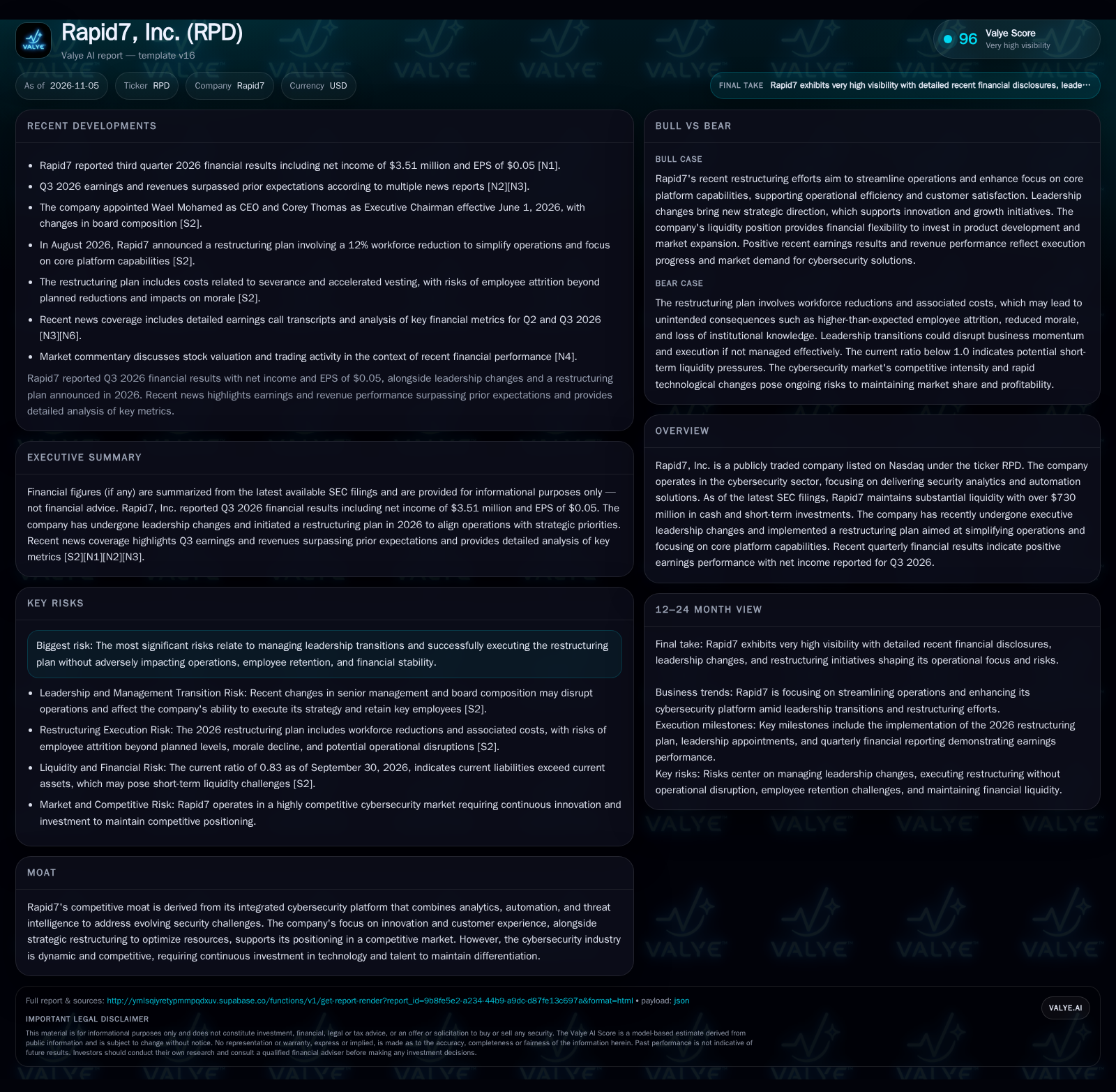
Rapid7, a Nasdaq-listed cybersecurity provider, is undergoing significant transformation in 2026: a new CEO, a 12% workforce reduction, and renewed focus on core platform capabilities. While the company holds over $730 million in liquid assets, its current ratio of 0.83 signals short-term liquidity pressure. The outcome of these changes will hinge on execution, employee retention, and the pace of innovation in a highly competitive market. [S2]
Rapid7, Inc. is navigating a period of intensive change, marked by executive turnover and a sweeping restructuring plan that reduces headcount by 12% to streamline its focus on core cybersecurity platform capabilities. These moves underscore management’s intent to drive operational efficiency and innovation but also introduce risks around employee retention, execution, and morale—especially as the company’s current liabilities outpace its current assets. In a cybersecurity market defined by rapid evolution and fierce competition, Rapid7’s next chapter will be shaped by how well it manages this transition and sustains product momentum.
Why 2026 Marks a Strategic Inflection Point for Rapid7
Rapid7’s 2026 is defined by three material developments: a 12% workforce reduction as part of an operational restructuring announced in August, the appointment of Wael Mohamed as CEO with Corey Thomas becoming Executive Chairman effective June 1, and a liquidity profile showing $731.6 million in cash and short-term investments but a current ratio of just 0.83 as of September 30. The restructuring is intended to align resources toward core platform priorities, reflecting a sharper focus on Rapid7’s integrated cybersecurity offerings. However, the operational cost of this transition—both financially, through severance and accelerated vesting costs, and culturally, through potential attrition and morale risks—raises execution stakes. The leadership transition adds strategic uncertainty, as new management must maintain momentum while navigating these disruptions. These events collectively set the stage for a critical test of Rapid7’s ability to balance renewal with stability in a sector where innovation and consistency are both paramount. [S2]
Core Platform Economics: Margin Leverage or Resource Strain?
Rapid7’s business model centers on security analytics and automation delivered through a platform approach, which typically aims for subscription-based recurring revenue, high gross margins, and scalable operating leverage. In cybersecurity, R&D and sales effectiveness are critical to sustaining growth and defending share; aggressive cost cuts risk undermining both if not carefully targeted. The company’s reported net income of $3.51 million for Q3 2026 suggests modest profitability, but the durability of these margins will depend on the success of the restructuring in driving both efficiency and product relevance. If the platform strategy delivers higher attach rates, cross-sell, and stickier customer relationships, operating leverage could improve. Conversely, if cost reductions hollow out customer-facing capabilities or product cadence, margin gains may prove fleeting. [S2]
Platform Differentiation Meets Cybersecurity’s Relentless Arms Race
Rapid7 competes in a cybersecurity market crowded with platform peers and point-solution providers spanning vulnerability management, security automation, threat intelligence, and cloud security. The company’s integrated approach—combining analytics and automation—aims to create switching frictions via unified dashboards, workflow integration, and ecosystem partnerships. However, switching costs in cybersecurity are often moderate: customers can be reluctant to rip-and-replace core security infrastructure but are open to multi-vendor strategies, especially if innovation lags or support falters. Major competitors include both large, diversified security vendors and nimble cloud-native entrants, all of whom invest heavily in R&D and leverage scale to drive down per-customer costs. The risk for Rapid7 is that restructuring-induced disruptions—such as delayed feature rollouts or weakened customer support—could erode differentiation and open doors for competitors. On the flip side, a streamlined, focused platform could strengthen value proposition and retention if executed cleanly. Ultimately, sustainable advantage will depend on the pace of innovation, breadth of integrations, and ability to deliver measurable risk reduction for enterprise customers.
If Restructuring Delivers: Sharper Focus, Margin Expansion, and Customer Stickiness
In a favorable scenario, Rapid7’s restructuring enables a leaner, more agile organization focused on high-impact platform features and customer needs. Cost savings from headcount reductions are reinvested into R&D and targeted go-to-market initiatives, accelerating the release of differentiated security analytics, automation, and cloud-native capabilities. The new leadership team forges a coherent strategic narrative, retaining top talent and restoring morale. As a result, Rapid7 stabilizes or accelerates revenue growth, expands margins through operating leverage, and increases net retention rates via improved cross-sell and upsell. Indicators confirming this scenario would include: sequential improvement in revenue growth, expanding gross and operating margins, positive customer retention or NRR trends (if disclosed), and evidence of new product adoption or platform expansion by marquee customers. Evidence that would falsify this scenario includes persistent revenue stagnation, margin compression, or spikes in voluntary attrition and customer churn following the restructuring.
Transition Risks Temper Gains: Gradual Progress Amid Execution Headwinds
The most plausible outcome is a period of uneven performance as Rapid7 digests restructuring costs and leadership transition. Near-term headwinds may include morale challenges, some loss of institutional knowledge, and temporary delays in product development or customer support responsiveness. Revenue growth may slow or remain steady, with margin improvement lagging as severance and vesting costs are absorbed. However, if management can stabilize the organization, rebuild engagement, and maintain focus on core platform enhancements, operational improvements could materialize over several quarters. Confirmation would come from stabilization of attrition rates, steady or improving customer satisfaction (if disclosed), and eventual normalization of margins and cash flow. Falsifying evidence would include protracted operational disruptions, ongoing talent flight, or a visible loss of competitive momentum.
Execution Falters: Attrition, Customer Loss, and Margin Compression
The downside risk is that restructuring and leadership turmoil trigger higher-than-expected employee attrition, loss of key talent, and cultural instability, resulting in delayed or degraded product delivery and weakened customer relationships. If execution stumbles, Rapid7 could see increased churn, slower sales cycles, and difficulty defending existing accounts against aggressive competitors. The company’s liquidity position—while substantial in absolute terms—may come under pressure if revenue growth stalls and restructuring costs persist, especially given the sub-1.0 current ratio. Evidence supporting this scenario would be rising voluntary attrition rates, customer losses to competitors, missed product milestones, and margin or cash flow deterioration. Conversely, stabilization of headcount, customer retention, and a return to margin expansion would challenge this view.
Milestones That Will Define Rapid7’s Post-Restructuring Trajectory
Quarterly net retention rate (NRR) or customer churn, if disclosed, to gauge whether platform focus is translating into customer stickiness or if disruptions are driving defections.
Gross and operating margin trends over the next several quarters, as an indicator of whether cost reductions are sustainable or undermining product/service quality.
Voluntary employee attrition rates, especially among technical and customer-facing teams, to assess cultural and operational stability.
Product release cadence and feature roadmap progress, as delays or acceleration will signal the effectiveness of restructured R&D investment.
Revenue growth rates—sequential and year-over-year—relative to peer benchmarks to track whether platform focus is translating into renewed demand.
Cash flow from operations and free cash flow, to monitor the impact of restructuring and ongoing liquidity health.
Customer satisfaction or Net Promoter Score (NPS), if disclosed, as a real-time proxy for the impact of organizational changes on service levels.
Disclaimer: This is research-only, informational analysis and not investment advice. It may include AI-generated interpretation and general industry context. Always verify important details using primary sources.

Comments