
Dorian LPG: Funding Expansion While Navigating Aging Fleet and Market Volatility
Dorian LPG’s recent vessel orders and reported liquidity position underscore its intent to capitalize on global LPG shipping demand, but the economics of expansion are counterbalanced by the realities of asset aging, rate volatility, and the capital intensity of fleet renewal.
However, the company’s exposure to volatile charter rates, rising maintenance costs as its fleet ages, and interest rate risk on floating debt will shape returns and risk over the next several years. The sustainability of earnings and the ultimate payoff of expansion depend on market conditions, cost discipline, and the timing of new vessel integration.
Dorian LPG stands at a pivotal juncture in the LPG shipping cycle. Armed with substantial liquidity and freshly secured credit, the company is making a calculated bet on future demand by ordering new, more efficient vessels. Yet this expansion comes as the bulk of its current fleet, built between 2007 and 2015, continues to age—raising the stakes for maintenance outlays and asset valuation. With nearly all revenue tied to the Helios Pool’s charter-rate dynamics, Dorian’s path forward will be shaped by its ability to balance capital deployment, cost control, and market timing, all while navigating pronounced exposure to rate and asset-value volatility.
Fleet Modernization and Financial Position: Where Dorian LPG Stands Now
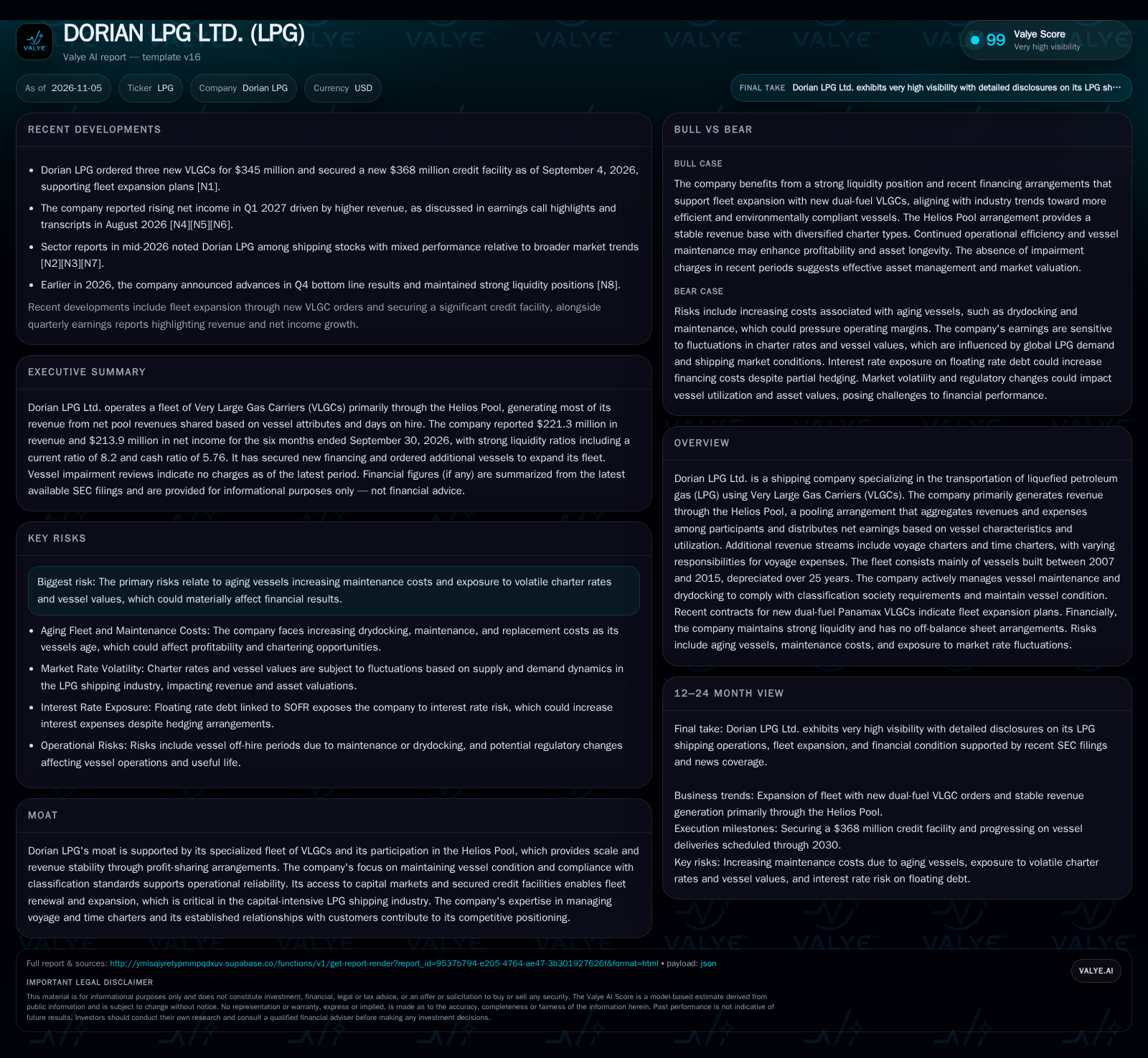
As of September 30, 2026, Dorian LPG reported $578.8 million in cash and equivalents, and current assets of $844.8 million against current liabilities of $103.1 million, resulting in a current ratio of 8.2 and a cash ratio of 5.76 [S2]. The company reported cash and liquidity metrics for the period; these figures do not by themselves establish operating runway, investment capacity, financial flexibility, or financing capacity. [N1] For the six months ended September 2026, Dorian generated $221.3 million in revenue and $213.9 million in net income, with EPS above $5 [S2]. Nearly all revenue—99%—was derived from the Helios Pool, indicating a heavy reliance on pooled chartering arrangements for earnings [S2].
No vessel impairments were recognized as of the latest period, suggesting that current market values and cash flow projections for the aging fleet remain supportive [S2]. However, the company explicitly notes rising drydocking and maintenance costs as risks tied to its older vessels, alongside exposure to volatile charter rates and floating-rate debt [S2].
The Economics of Pooling, Charter Mix, and Fleet Renewal
Dorian’s core revenue engine is the Helios Pool, where net earnings are shared among participants based on vessel characteristics (size, age, efficiency) and days on hire. This structure provides some mitigation against individual vessel downtime or market swings, but aggregate pool performance is still highly sensitive to global LPG shipping rates and vessel utilization. The company’s other commercial mechanisms—voyage charters and time charters—offer additional flexibility: voyage charters expose Dorian to voyage expenses and margin variability, while time charters can lock in daily rates but may lag spot market upside.
The cost side is dominated by crew wages, insurance, repairs, maintenance, and increasingly, drydocking expenses as vessels age. Depreciation is straight-line over 25 years, but as the majority of the fleet was built between 2007 and 2015, maintenance intensity and the risk of off-hire periods will rise through the late 2020s. The capital needs for newbuilds are substantial—nearly $400 million in outstanding commitments for vessels delivering between 2029 and 2030 [S2]. This creates a multi-year period where Dorian must balance cash flow generation from older assets against heavy upfront investment in new tonnage. If market rates remain strong, operating leverage could amplify returns; if rates weaken or costs spike, the fixed cost base and debt service could squeeze margins.
How Pooling, Asset Quality, and Capital Access Shape Dorian’s Competitive Edge
Within the LPG shipping sector, scale and vessel quality are primary differentiators. Dorian’s participation in the Helios Pool offers network benefits—higher fleet utilization, improved scheduling, and some revenue smoothing compared to pure spot operators. The company’s move to order dual-fuel VLGCs positions it ahead of many peers in terms of future regulatory compliance and fuel efficiency, which could become more valuable as emissions standards tighten.
However, Dorian’s competitive position is not immune to counterforces. The bulk of its current fleet is older than the latest newbuilds entering the global market, potentially making them less attractive to charterers prioritizing emissions and fuel cost. The capital intensity of newbuilds requires both access to credit and disciplined allocation, as oversupply or weak demand could erode returns. Sector peers—including other public and private VLGC operators—are also adding capacity and modernizing fleets, which could pressure rates if industry supply growth outpaces demand. The lack of long-term fixed-rate contracts limits Dorian’s revenue visibility relative to operators with higher time-charter exposure.
If LPG Shipping Rates Stay Firm, Newbuilds Could Power a Step-Change in Earnings
The most favorable scenario for Dorian is one where global LPG trade volumes expand—driven by U.S. export growth, Asian petrochemical demand, and constrained new vessel supply—keeping charter rates elevated through the late 2020s. In this context, Dorian’s new dual-fuel vessels, arriving from 2029 onward, would enter a tight market, commanding premium rates due to their size, efficiency, and compliance profile.
Such a backdrop would enable high fleet utilization, strong cash flows to service debt, and potentially accretive returns on invested capital. Confirmation of this scenario would come from sustained high pool rates, minimal off-hire days, and a smooth integration of newbuilds into the fleet. If Dorian can maintain cost discipline and avoid major maintenance or impairment shocks on its older vessels, the result could be materially higher long-term earnings and asset values.
Balancing Aging Fleet Economics with Incremental Growth
The most plausible forward trajectory sees Dorian generating solid, but not exceptional, returns—driven by average charter rates that fluctuate with global supply-demand cycles, and a gradual integration of new vessels as older units require more frequent and costly maintenance. The Helios Pool continues to provide revenue smoothing, but overall earnings remain sensitive to market swings and vessel utilization.
In this scenario, drydocking and repair costs steadily rise, offsetting some of the margin gains from new, more efficient vessels. Debt service on the new credit facility is manageable, provided cash flows hold up, but interest expense could edge higher if floating rates climb. Asset values for older vessels may drift lower, but no major impairments occur unless there is a sharp market downturn. Evidence for this scenario would be stable, but not rising, pool rates, moderate increases in fleet opex, and financial results tracking close to recent trends.
Compression of Margins from Rate Weakness and Surging Costs
The adverse chain is triggered if global LPG shipping rates weaken—due to oversupply of VLGCs, a slowdown in demand growth, or new regulatory shocks that increase operating costs. Dorian’s aging fleet would see escalating drydocking and maintenance costs, and possibly higher off-hire days, just as debt service ramps up on new vessels.
If the market value of older vessels falls faster than anticipated, impairment charges could hit earnings, and refinancing risk could increase if credit markets tighten. Interest expense could also rise if SOFR-linked debt is not fully hedged. Evidence confirming this scenario would include declining pool rates, a spike in vessel opex, impairment losses, and negative revisions to future cash flow guidance.
What Will Determine Whether Dorian’s Expansion Pays Off?
Fleet utilization rates and off-hire days, if disclosed, will show whether aging vessels are being kept in revenue service or are increasingly sidelined for repairs.
Actual charter rates achieved by the Helios Pool, as reported in earnings or filings, will test whether market conditions are strong enough to support newbuild economics.
Trends in vessel operating expenses—especially drydocking, repairs, and insurance—will clarify the drag from fleet aging over the next 24-36 months.
The pace and cost of newbuild deliveries, including any delays or overruns, will impact both capital needs and future earnings leverage.
Debt service coverage ratios and interest expense trends, particularly as new credit is drawn down, will reveal sensitivity to floating rate risk.
Any vessel impairment charges or downward revisions to asset values would signal market stress or aging fleet obsolescence.
Progress on securing long-term charters or diversifying commercial exposure away from pure pooling would help test the visibility and stability of future cash flows.
Updates on regulatory developments for emissions or safety standards, and Dorian’s compliance status, would indicate potential capex or operating cost headwinds.
Disclaimer: This is research-only, informational analysis and not investment advice. It may include AI-generated interpretation and general industry context. Always verify important details using primary sources.

Comments