
eHealth, Inc.: Liquidity Strength Meets Persistent Losses as Health Insurance Distribution Evolves
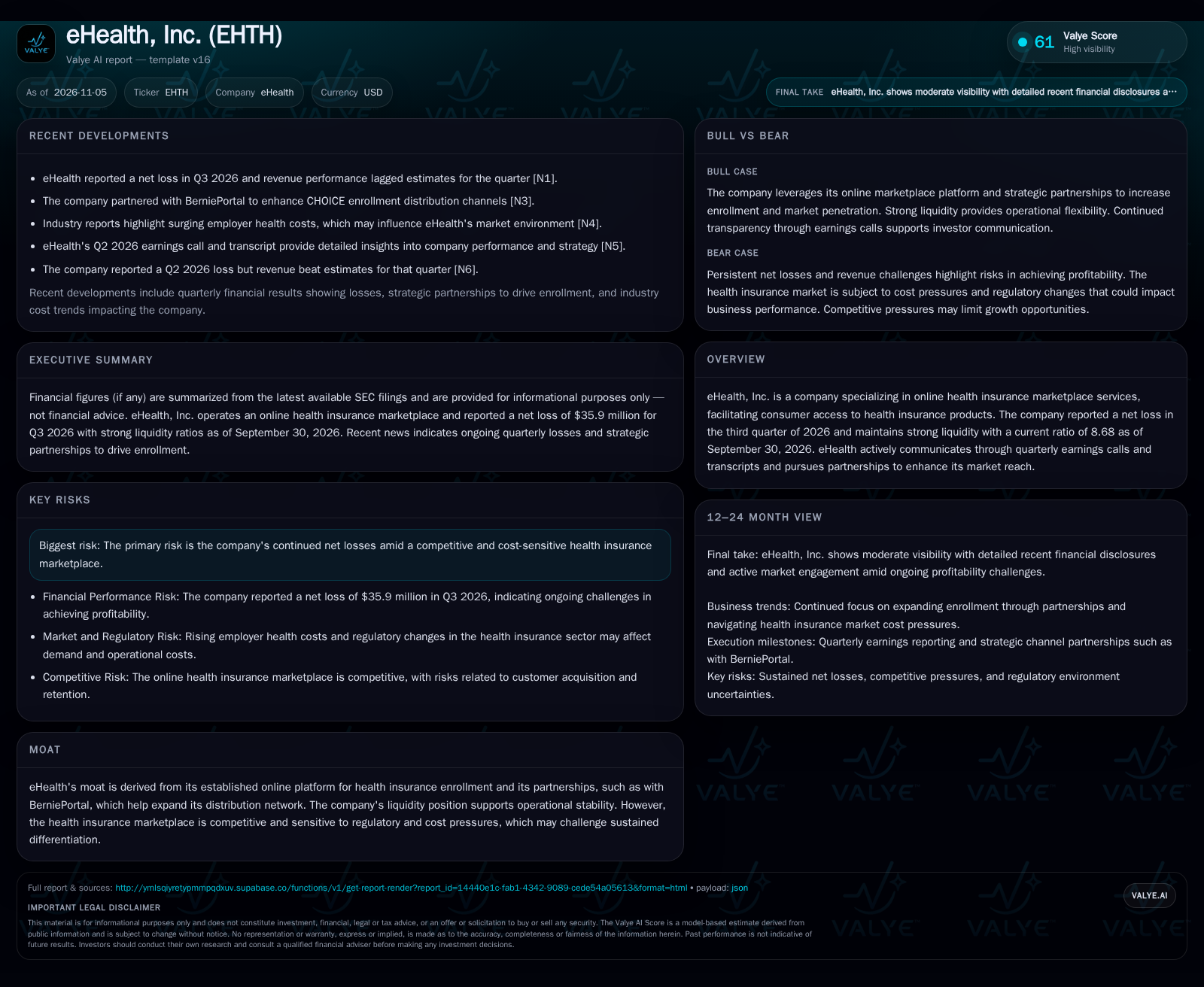
eHealth reported a net loss of $35.9 million for Q3 2026 despite maintaining a reported current ratio of 8.68 and cash ratio of 1.57 as of September 30, 2026.
eHealth reported a net loss of $35.9 million for Q3 2026 despite maintaining a reported current ratio of 8.68 and cash ratio of 1.57 as of September 30, 2026. The company’s recent partnership with BerniePortal aims to expand distribution, but ongoing losses and volatile revenue performance underscore the difficulty of achieving sustainable profitability in a cost-pressured, highly competitive sector [S1] [N1] [N3].
eHealth, Inc. stands at a crossroads in the digital health insurance distribution landscape. Despite a reported liquidity position, the company continues to post sizable quarterly losses, with Q3 2026 showing a net loss of $35.9 million. Recent moves to broaden distribution—such as the BerniePortal partnership—signal an intent to capture greater enrollment volumes, but the company must contend with volatile revenue results and the pressures of a sector facing both regulatory uncertainty and rising employer health costs. The challenge for eHealth is clear: can its operational flexibility and evolving channel strategy overcome persistent margin and growth headwinds?
Recent Financial Results and Strategic Moves Define Near-Term Landscape
eHealth reported cash and cash equivalents of $57.3 million and current assets of $316.1 million against current liabilities of $36.4 million as of September 30, 2026, resulting in a reported current ratio of 8.68 and a cash ratio of 1.57 [S1]. The company reported cash and liquidity metrics for the period; these figures do not by themselves establish operating runway, investment capacity, financial flexibility, or financing capacity. The company posted a net loss of $35.9 million for Q3 2026, with basic and diluted EPS of -$1.57, extending a trend of recurring quarterly losses [S1] [N1].
On the distribution front, eHealth’s partnership with BerniePortal is designed to expand its enrollment reach by tapping into an established employer benefits network [N3]. This move reflects a broader strategy to access new customer segments and diversify distribution channels. Meanwhile, the industry context is marked by rising employer health costs, which could reshape both customer preferences and margin structures for health insurance distributors [N4]. These factors set the stage for a company with strategic optionality but ongoing performance volatility.
Marketplace Economics: Scale Ambitions Confront Margin Pressure
eHealth operates as an online intermediary, connecting individuals and small businesses to health insurance products via a digital marketplace. Its revenue model is generally based on commissions from policies sold and renewals, with potential for ancillary income streams such as lead generation or advertising. The business is fundamentally volume-driven: higher policy enrollments and retention rates can drive top-line growth, but the economics are sensitive to customer acquisition costs (CAC), carrier commission rates, and regulatory changes affecting insurance products.
Fixed costs—primarily technology infrastructure, compliance, and marketing—are significant, but the marginal cost of enrolling an additional customer is relatively low, creating potential for operating leverage if enrollment volumes scale. However, persistent net losses suggest that either CAC remains high, commission rates are under pressure, or eHealth is not yet reaching the scale needed to cover fixed costs. The company’s capital needs are mostly tied to maintaining platform competitiveness, regulatory compliance, and funding customer acquisition efforts.
Recent SEC filings do not provide updated revenue figures beyond 2018, complicating a precise assessment of current operating leverage or margin trajectory [S1]. The recurring losses highlight the challenge of balancing growth investments against the need for eventual profitability. Without more granular disclosure on enrollment volumes, CAC, or commission rates, it remains unclear whether current initiatives are translating into improved economics.
Distribution Partnerships and Platform Reach in a Crowded Arena
eHealth competes in a fragmented and highly competitive landscape that includes other digital health insurance marketplaces, direct insurer platforms, traditional brokers, and emerging insurtech firms. Potential sources of advantage include platform breadth (the range of policies and carriers offered), user experience, pricing transparency, and the ability to efficiently acquire and retain customers.
The recent BerniePortal partnership reflects an attempt to broaden distribution by leveraging established employer networks, aiming to drive greater enrollment through trusted benefit platforms [N3]. Such partnerships could help offset high direct CAC and improve access to the small-business and employer-sponsored insurance segments. However, major competitors—ranging from other online aggregators to large insurers with direct digital offerings—can replicate or counter similar strategies.
Switching costs for consumers are generally low, though stickiness can be improved through value-added services, renewal management, and integration with broader benefits platforms. Regulatory changes and rising employer health costs add further complexity, as they may shift demand patterns or compress commission margins.
If Channel Expansion and Cost Discipline Align, Operating Leverage Could Materialize
The most favorable scenario for eHealth would see its expanded distribution—bolstered by partnerships like BerniePortal—driving a significant uptick in policy enrollments and renewal rates. If the company can convert these enrollments at attractive commission rates while controlling CAC, operating leverage could emerge: fixed costs would be spread across a larger revenue base, potentially reversing net losses and moving towards profitability.
Confirmation of this scenario would require disclosed evidence of sharply rising new policy enrollments, improving retention, and stable or rising commission rates—ideally accompanied by a narrowing of quarterly net losses or a transition to operating profit. Additionally, disclosures showing CAC efficiency gains or favorable renewal trends would support the thesis that distribution partnerships are translating into economic value. Conversely, if enrollment growth remains muted or CAC escalates faster than revenue, this scenario would be undermined.
Liquidity Position Buys Time, but Profitability Remains Elusive Absent Enrollment Acceleration
In a more neutral scenario, enrollment volumes may rise incrementally through initiatives like BerniePortal, but not at a pace sufficient to achieve significant operating leverage or margin expansion in the next several quarters. The company’s reported liquidity position would provide a buffer, but not guarantee a path to profitability.
Quarterly results would likely continue to show fluctuating revenue performance and ongoing losses, with periodic outperformance when partnerships or marketing campaigns deliver short-term enrollment boosts. Confirmation would come from continued negative EPS and limited improvement in operating margins, even as liquidity ratios remain solid. A falsification of this scenario would require a clear inflection in profitability, supported by sustained enrollment and retention gains that materially narrow losses.
Sustained Losses and Margin Compression Erode Optionality
A more adverse outcome would see eHealth’s enrollment initiatives failing to gain traction, while competitive and regulatory pressures further erode commission rates and increase CAC. If rising employer health costs lead to greater price sensitivity or regulatory shifts reduce the attractiveness of available products, eHealth could face shrinking gross margins and a deepening of net losses.
In this scenario, the cash and current asset cushion would be gradually depleted to fund ongoing deficits, forcing the company to consider cost-cutting, asset sales, or even external financing under less favorable terms. Evidence would include accelerating cash burn, declining liquidity ratios, and no material improvement in enrollment or retention metrics. If disclosed, a spike in customer churn or a sharp drop in policy volumes would further confirm this trajectory.
Milestones That Will Shape eHealth’s Enrollment and Profitability Outlook
Quarterly net loss and EPS trends: A sustained narrowing of losses or a swing to profitability would signal a meaningful shift in operating leverage.
New policy enrollment volume: If disclosed, a sharp increase would confirm traction from new partnerships and marketing initiatives.
Customer acquisition cost (CAC): Improvements, if disclosed, would indicate more efficient scaling and partnership effectiveness.
Commission rate stability: Evidence of stable or rising commission rates would support margin potential amid industry cost pressures.
Policy renewal and retention rates: Higher retention, if reported, would enhance recurring revenue and reduce reliance on costly new acquisition.
Impact from employer health cost trends: Shifts in product mix or pricing strategies in response to rising costs would provide insight into adaptability.
Effectiveness of BerniePortal and other partnerships: Any disclosed metrics or qualitative commentary on enrollment impact would help test the thesis.
Disclaimer: This is research-only, informational analysis and not investment advice. It may include AI-generated interpretation and general industry context. Always verify important details using primary sources.

Comments