
BBSI’s Operating Dynamics: Seasonality, Claims Risk, and Value Chain Complexity
Barrett Business Services, Inc. (BBSI) sits at the intersection of management consulting and HR outsourcing for small and mid-sized businesses. Recent quarters highlight both its capacity for stable profitability and its ongoing vulnerability to seasonal cycles and workers’ compensation volatility. The company’s decentralized model and sector focus create opportunities and risks that hinge on execution and external shocks.
The company’s business is highly seasonal and exposed to claims volatility, especially in sectors like agriculture. Recent results show mixed momentum, with Q3 meeting expectations but Q2 missing on earnings and revenue. The key question is whether BBSI can consistently manage claims and regulatory headwinds while leveraging its specialized, localized service model to retain clients and grow.
Barrett Business Services, Inc. (BBSI) delivers integrated management consulting and HR outsourcing to small and mid-sized businesses—a model designed to create stickiness and value through deep local relationships and specialized expertise. Yet, the company’s latest financials and sector positioning reveal a business highly exposed to seasonal swings, workers’ compensation claims, and sector-specific cycles. With Q3 2026 results meeting expectations but a shaky Q2 in the rearview mirror, BBSI’s ability to balance profitability, claims volatility, and regulatory risk will determine whether its differentiated platform translates to enduring advantage or persistent vulnerability.
Volatility and Resilience Evident in Recent Financial Performance
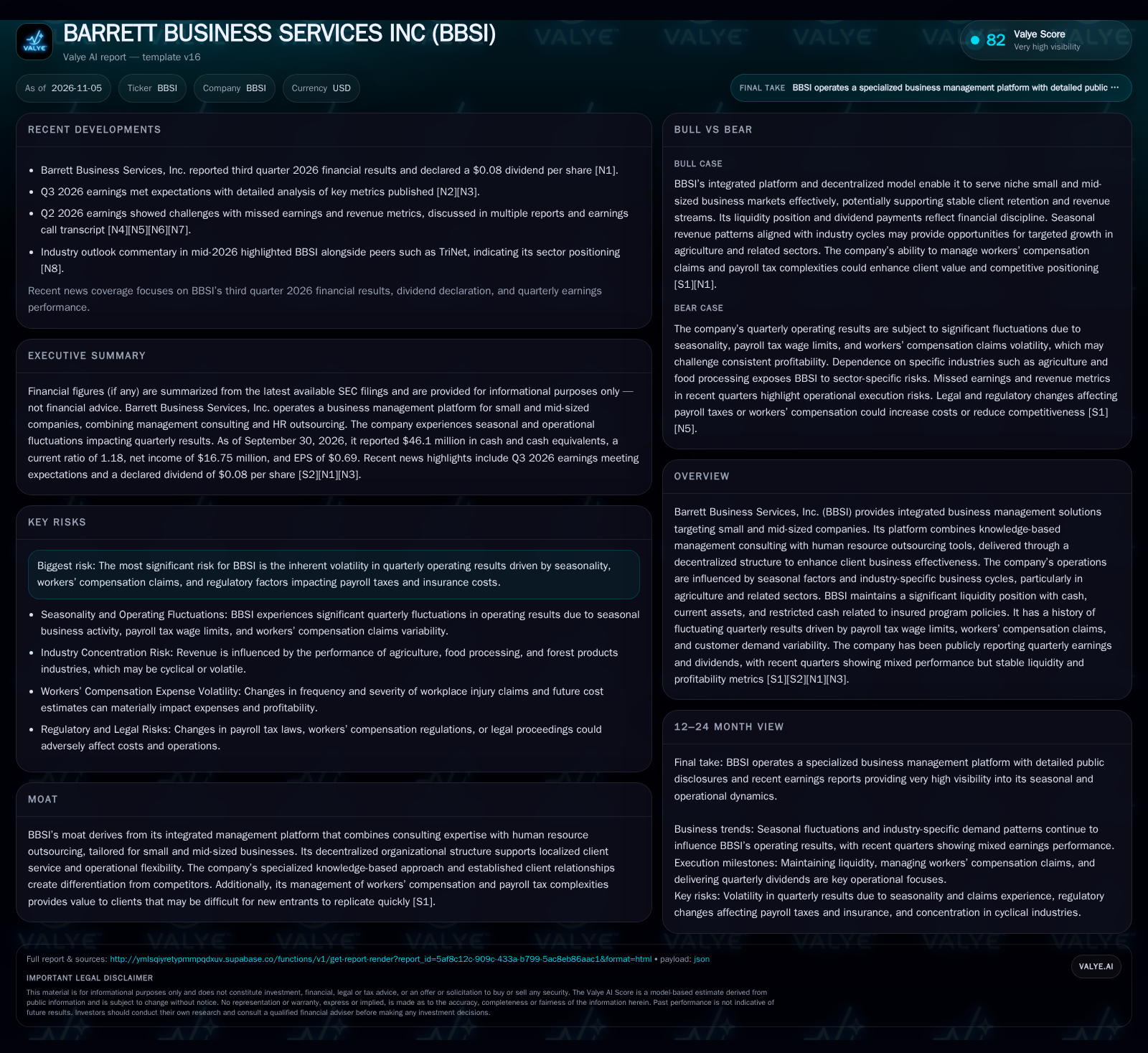
BBSI reported net income of $16.75 million and basic/diluted EPS of $0.69 for Q3 2026, with cash and cash equivalents at $46.1 million as of September 30, 2026 [S2]. The company reported cash and liquidity metrics for the period; these figures do not by themselves establish operating runway, investment capacity, financial flexibility, or financing capacity. [S2] The company declared a $0.08 per share dividend in November 2026 [N1]. Q3 results met expectations, but Q2 2026 missed both earnings and revenue forecasts, underscoring the company’s exposure to operational and seasonal swings [N3] [N5]. These outcomes matter because they reinforce the thesis that BBSI’s profitability is structurally volatile, driven by factors such as workers’ compensation claims and sector-specific cycles in agriculture and related industries [S1] [S2].
BBSI’s Platform Translates Client Complexity into Revenue and Risk
BBSI’s core business model integrates management consulting with HR outsourcing, targeting small and mid-sized businesses that often lack in-house expertise in payroll, compliance, and workers’ compensation. Revenue is typically generated through service fees tied to client payroll processing and risk management programs. A substantial portion of costs—particularly workers’ compensation—are variable and can spike with claim frequency or severity. Seasonality is pronounced: Q3 tends to be the strongest due to heightened activity in agriculture, food processing, and forest products, while Q4 may soften due to holiday disruptions [S1].
Operating leverage is inherently limited by the need to scale service teams and claims management with client volume, but there is potential for margin expansion if claims are well-managed and client retention remains high. Capital needs are moderate; the company maintains significant restricted cash to cover insured program liabilities, which constrains deployable liquidity but is necessary for regulatory compliance [S1] [S2]. If BBSI can improve claims management efficiency or negotiate better insurance terms, more of each revenue dollar could drop to the bottom line, but the inverse is also true: cost spikes can quickly erode margins.
Decentralized Service Model Offers Differentiation with Limitations
BBSI’s competitive edge lies in its decentralized structure, which allows regional teams to build close relationships with clients and tailor solutions to local market needs. This approach can foster higher retention and create switching frictions, as clients benefit from both consulting and HR outsourcing tailored to their business context. However, the sector is crowded, with competitors ranging from national HR outsourcing providers (such as TriNet and Insperity) to regional payroll processors and insurance brokers [N8].
While BBSI’s integration of risk management and consulting is distinctive, its moat is not insurmountable. Larger players may offer broader technology platforms or deeper risk pools, while smaller local firms can undercut on price or offer hyper-local service. Technology-driven substitutes—such as SaaS-based HR and payroll platforms—could erode the value of BBSI’s human-centric model if clients prioritize automation and self-service over hands-on support. Ultimately, the company’s ability to manage claims and regulatory complexity faster and more accurately than competitors will determine whether its differentiation is sustainable.
Margin Expansion Potential from Claims Management and Industry Trends
If BBSI successfully leverages its decentralized service model to deepen client relationships and improve retention, the company could see steady growth in high-value client accounts. The upside scenario hinges on tighter control of workers’ compensation costs—through better risk assessment, loss prevention, or favorable insurance negotiations—which would reduce earnings volatility and expand operating margins.
A favorable external environment, such as regulatory clarity or robust demand in agriculture and related industries, could further boost revenue and support operating leverage. Confirmation of this scenario would come through a sustained period of above-average margins, declining claims ratios, and rising client count or wallet share (if disclosed). Conversely, a spike in claims severity, regulatory shocks, or client attrition would quickly falsify the thesis.
Structural Volatility Shapes Moderate Growth Prospects
The most plausible path is one where BBSI continues to deliver modest profitability, with quarter-to-quarter results fluctuating in line with sector cycles and claims experience. The company is likely to retain its niche in small and mid-sized business outsourcing, leveraging its decentralized model for stable (if not rapid) client growth.
Margins may remain under pressure from periodic spikes in workers’ compensation expense or soft demand in core sectors like agriculture. Liquidity and dividend continuity are maintained, but capital deployment remains cautious given the need to reserve for insured program liabilities. A break from this pattern—either through sustained margin expansion or a new round of earnings misses—would challenge the base case.
Claims Volatility and Sector Focus Highlight Vulnerabilities
The adverse scenario materializes if sector-specific downturns (such as a weak agricultural season or recession in food processing) coincide with a spike in workers’ compensation claims. This could drive a sharp drop in revenue, higher insurance or claims costs, and possibly force a reduction in dividend or operational retrenchment.
Regulatory changes—such as increased payroll taxes or shifts in workers’ compensation law—could exacerbate margin compression and introduce new compliance costs. Evidence of this scenario would include a series of earnings misses, rising claims ratios, client attrition (if disclosed), or a need to draw down restricted cash to cover unexpected liabilities. Failure to adapt to technology-driven competition or to maintain differentiation in client service would further accelerate downside risks.
Factors Influencing BBSI’s Endurance in HR Outsourcing
Trends in workers’ compensation claims frequency and severity—whether disclosed in earnings commentary or filings—since these are the most direct drivers of margin volatility.
Revenue and margin trends by sector exposure, especially in agriculture and food processing, as cyclicality in these areas can swing overall results.
Client retention, expansion, or churn rates—if disclosed—would clarify the stickiness of BBSI’s platform and the effectiveness of its decentralized model.
Developments in regulatory and legal environments affecting payroll taxes or workers’ compensation, as these can abruptly alter cost structures.
Any disclosed changes in restricted cash balances or insured program policy liabilities, which could indicate emerging claims pressure or shifts in risk exposure.
Dividend continuity or changes, especially if correlated with periods of claims volatility or sector downturns.
Evidence of competitive encroachment from technology-driven HR outsourcing or SaaS platforms, which could erode BBSI’s value proposition.
Management commentary on automation, process improvements, or risk management initiatives, which may signal margin levers or defensive responses.
Disclaimer: This is research-only, informational analysis and not investment advice. It may include AI-generated interpretation and general industry context. Always verify important details using primary sources.

Comments