
Trulieve Cannabis: Retail Scale, Vertical Integration, and the Stakes of U.S. Cannabis Reform
Trulieve Cannabis leads U.S.
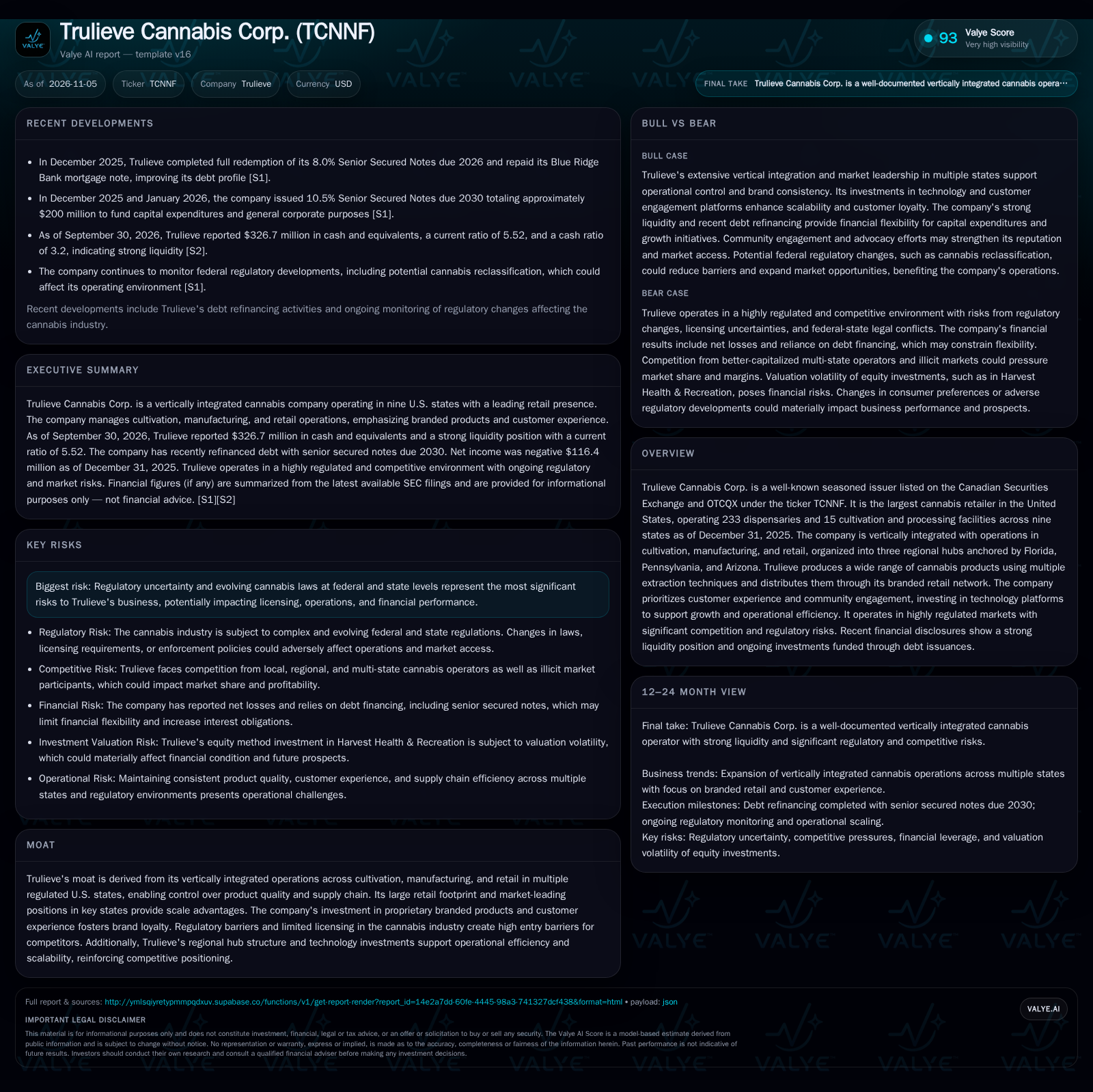
Trulieve Cannabis leads U.S. cannabis retail with 233 dispensaries and a vertically integrated supply chain across nine states. The company's growth and margin outcomes hinge on market expansion, operating leverage, and the evolving federal cannabis policy landscape. [S1] [S2]
Trulieve Cannabis Corp. stands as the largest legal cannabis retailer in the United States, anchoring its business on a vertically integrated model that spans cultivation, manufacturing, and retail across nine states. With a retail network of 233 dispensaries and a significant cash position, Trulieve is positioned for continued expansion and operational scaling. However, the company operates at a net loss and faces a complex regulatory environment that governs nearly every aspect of its business. The interplay between Trulieve’s scale advantages, operational integration, and the evolving landscape of U.S. cannabis regulation will determine whether the company can convert its retail dominance into sustainable profitability and long-term value. [S1] [S2]
Trulieve’s Footprint, Financial Position, and Regulatory Exposure: What Has Changed?
As of December 31, 2025, Trulieve operated 233 dispensaries and 15 cultivation and processing facilities across nine states, maintaining its position as the largest cannabis retailer in the U.S. [S1]. The company is organized into three regional hubs—Southeast, Northeast, and Southwest—anchored by Florida, Pennsylvania, and Arizona. Trulieve’s liquidity profile as of September 30, 2026, included $326.7 million in cash and equivalents, a current ratio of 5.52, and a cash ratio of 3.2, following the issuance of $200 million in 10.5% Senior Secured Notes due 2030 and the redemption of prior debt. [S2] While this strengthens the near-term balance sheet, Trulieve reported negative net income of $116.4 million for the year ended December 31, 2025, reinforcing the challenge of converting revenue scale into profitability. [S2]
The company’s ongoing monitoring of federal cannabis reclassification and state-level licensing changes reflects the high-stakes regulatory environment in which it operates. Any movement toward federal legalization or rescheduling could materially alter the competitive landscape, cost structure, and addressable market for Trulieve. [S1]
How Vertical Integration and Retail Scale Shape Trulieve’s Economics
Trulieve’s business model is built on vertical integration, with cultivation, manufacturing, and retail operations under a single corporate umbrella in most of its major markets. In Florida and Georgia, the company controls the full supply chain from seed to sale, which may enable cost efficiencies, consistent product quality, and higher gross margins compared to less integrated peers. In other states, integration is partial, potentially diluting these advantages.
Revenue is generated primarily through proprietary branded cannabis products sold in Trulieve-owned dispensaries. Pricing is heavily influenced by local supply-demand dynamics, state-level regulatory caps, and the presence of both legal and illicit competitors. Volume growth depends on store expansion, same-store sales, and broader market adoption as cannabis regulation evolves.
The capital intensity of cultivation and retail buildout, combined with high regulatory compliance costs, means fixed costs are significant. This creates potential for operating leverage if revenue growth outpaces the increase in fixed expenses. However, persistent net losses suggest that margin expansion is not yet offsetting overheads, and the need for periodic debt refinancing introduces interest expense as a drag on profitability. The success of Trulieve’s economics will depend on its ability to drive higher throughput per store, maintain pricing discipline, and realize cost advantages from scale and integration.
Competitive Pressures: Scale, Brand, and Regulatory Moats—But for How Long?
Trulieve’s competitive edge derives from its market-leading retail footprint, vertical integration, proprietary branded products, and entrenched positions in limited-license states. Regulatory barriers—such as state caps on licenses and requirements for vertical integration—currently protect incumbents from rapid new entry, especially in Florida and Pennsylvania.
However, the competitive landscape is fluid. Multi-state operators (MSOs) with access to capital are expanding aggressively, and local operators can outmaneuver larger firms through superior community relationships or lower cost structures. The illicit market remains a persistent source of price competition, particularly in less mature regulatory environments.
Technology investments in data analytics, customer engagement, and supply chain management may further differentiate Trulieve if they lead to better customer retention and operating efficiencies. Yet, these advantages could erode if federal legalization opens the market to national brands, CPG entrants, or if licensing barriers are relaxed. The question is whether current regulatory moats will endure or become vulnerable to policy shifts.
Federal Reform and Margin Expansion: What Could Unlock Trulieve’s Earnings Power?
A favorable scenario for Trulieve would involve a combination of federal cannabis reclassification, expanded state-level legalization, and the company’s successful execution on retail expansion and margin improvement. Federal reform could reduce tax and banking frictions (such as the removal of IRS 280E restrictions), lower capital costs, and expand the addressable market by accelerating consumer adoption and enabling interstate commerce.
If Trulieve leverages its scale and integration to drive higher throughput per dispensary and improves gross margins through operational efficiencies, the company could move toward sustained profitability. Evidence confirming this scenario would include successive quarters of positive net income, expanding gross and operating margins, and meaningful same-store sales growth, particularly in core markets like Florida and Pennsylvania.
Further upside could be unlocked if technology investments result in higher customer retention, increased basket size, or successful cross-selling of new product formats. Confirmation would come from disclosed improvements in customer loyalty metrics, higher per-store sales, and robust return on invested capital.
Scale Maintained, Margin Pressures Persist: The Most Likely Trajectory
The most plausible outcome for Trulieve is continued retail dominance in its core states, with incremental market share gains in newer markets offset by ongoing pricing and margin pressures. Regulatory barriers are likely to remain in place in the near term, supporting incumbency advantages but limiting the pace of national expansion.
Operating leverage may gradually improve as the company optimizes its cost structure and scales technology investments, but persistent net losses suggest that break-even is not imminent. Revenue growth will depend on disciplined store expansion, product innovation, and effective marketing, but upward pressure on labor, compliance, and input costs could offset efficiency gains.
Confirmation of this scenario would include stable or modestly improving gross margins, flat to slightly negative net income, and ongoing store count growth without a dramatic shift in the regulatory environment. Evidence refuting it would be either a sudden move to profitability (suggesting upside) or a marked deterioration in liquidity or margins (indicating downside risk).
Regulatory Setbacks or Margin Compression: How Trulieve’s Model Could Falter
An adverse scenario would involve either unfavorable regulatory changes—such as increased federal enforcement, adverse state-level licensing shifts, or delayed federal reform—or intensifying competitive pressures leading to sustained margin compression. If illicit market share expands or if new entrants undercut pricing in key states, Trulieve could see same-store sales decline and gross margin erosion.
If cash burn accelerates due to rising operating costs, interest expenses, or unsuccessful investments, the company may be forced to seek additional external financing on less favorable terms. A sharp decline in the valuation of its equity-method investments (e.g., Harvest Health & Recreation) could also impair the balance sheet.
Regulatory setbacks—such as license losses or unfavorable federal actions—would further validate the downside thesis.
Milestones That Could Shift Trulieve’s Profitability and Strategic Value
Quarterly gross and operating margin trends—evidence of sustained margin expansion or contraction would clarify the company’s progress toward profitability.
Same-store sales growth in core markets, especially Florida and Pennsylvania, if disclosed, would test consumer demand resilience and competitive positioning.
Regulatory developments at both federal and state levels—progress on cannabis reclassification, banking reform, or changes in state licensing frameworks would directly impact Trulieve’s addressable market and cost structure.
Interest expense as a percentage of revenue, if disclosed, as rising debt service could offset operating improvements.
Updates on the valuation and performance of the Harvest Health & Recreation equity-method investment, given its potential to affect reported financial condition.
Customer retention, loyalty, and basket size metrics—if disclosed, these would provide insight into the effectiveness of Trulieve’s customer engagement and technology investments.
Store count growth and the pace of new market entries, as excessive expansion in saturated or unprofitable markets could dilute returns.
Disclaimer: This is research-only, informational analysis and not investment advice. It may include AI-generated interpretation and general industry context. Always verify important details using primary sources.

Comments