
Enovis’s Robotics Push and Portfolio Expansion: Integration, Differentiation, and the Stakes of Medical Device Scale
Enovis is executing a dual-pronged strategy of organic product development and targeted acquisitions—most notably the €155 million eCential Robotics deal—to strengthen its position in medical devices, particularly in surgical robotics and reconstructive solutions. The next phase will hinge on integration success, operational leverage, and the ability to differentiate amid competitive and capital constraints.
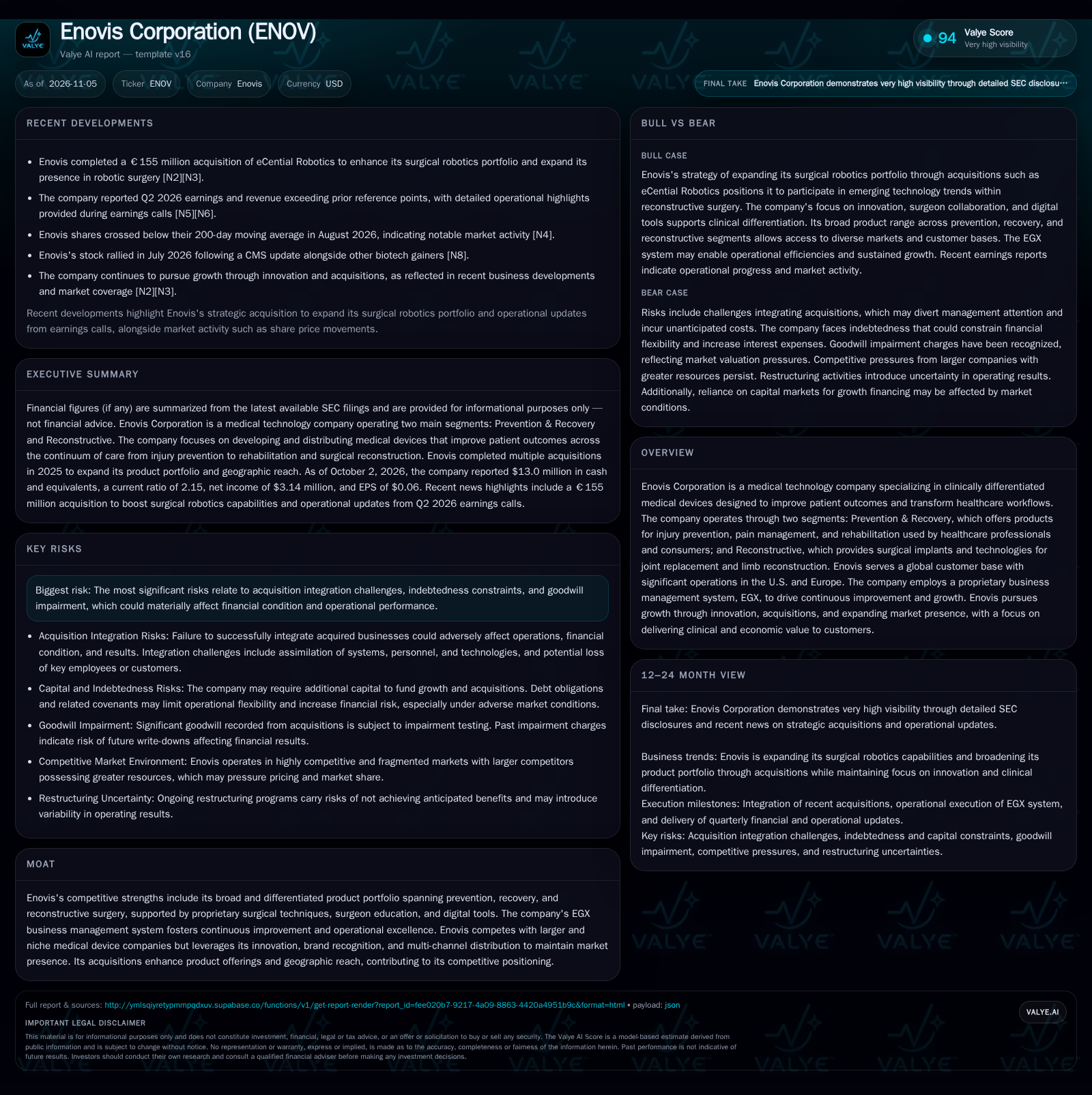
Enovis is advancing its strategy by expanding its robotics and reconstructive device offerings through significant acquisitions and international reach.While the company reported modest net income and maintains a reported current ratio, the integration and performance of acquired businesses and capital allocation choices will determine whether it can drive sustainable growth and margin improvement in a competitive medtech landscape. [S2] [N2] [N3]
Enovis Corporation is attempting to scale the value chain in medical devices by marrying clinical differentiation with operational breadth—a strategy now defined by its €155 million acquisition of eCential Robotics and a series of recent deals across its core Prevention & Recovery and Reconstructive segments. The company’s global sales footprint and expanding robotics portfolio position it to capture share in both mature and emerging medtech markets, but the real test will be whether Enovis can integrate its acquisitions, manage capital intensity, and sustain margin improvement in a field where operational missteps and capital constraints can quickly erode competitive gains. [S2] [N2] [N3]
Acquisitions and Robotics as Catalysts: What’s Changed for Enovis
Enovis’s most material recent move is the €155 million acquisition of eCential Robotics, which expands its surgical robotics capabilities and signals a deeper push into digitally enabled reconstructive solutions. This deal, along with three other Prevention & Recovery and four Reconstructive acquisitions in 2025, has broadened Enovis’s product portfolio and geographic reach. The company reported Q2 2026 net income of $3.14 million, EPS of $0.06, and a current ratio of 2.15, but with only $13.0 million in cash and equivalents, its near-term liquidity is constrained relative to its current asset base. Approximately 42% of net sales in 2025 were derived from international operations, highlighting broad exposure beyond the U.S. [S2] [N2] [N3]
How Enovis Could Unlock Operating Leverage in Medtech
Enovis’s business model relies on selling a mix of high-value surgical implants, robotics, and rehabilitation devices to hospitals, surgeons, and healthcare providers, as well as some direct-to-consumer channels in Prevention & Recovery. In reconstructive surgery, pricing can be premium—especially for differentiated implants and enabling technology like robotics—while volumes are driven by procedure rates, demographics, and reimbursement dynamics. Operating leverage may be achievable if Enovis can scale its robotics and implant platforms, as fixed R&D and manufacturing costs are spread across a larger revenue base. However, the capital intensity of acquisitions and product development means that free cash flow conversion can lag, especially if integration costs or restructuring charges escalate.
The company’s EGX business management system is designed to drive continuous improvement, which could support margin expansion if efficiency gains materialize. The economics of robotics are particularly sensitive to adoption curves and utilization rates—if hospitals buy but underutilize robots, recurring revenue from disposables and software could fall short of expectations.
The scalability of Enovis’s robotics platform hinges critically on the interplay between fixed and variable costs within its manufacturing and R&D functions. If the company can achieve higher production volumes without proportionate increases in overhead, the incremental margin on each additional unit sold could improve substantially. However, this assumes that the robotics technology attains sufficient market penetration and that the cost structure benefits from economies of scale rather than being offset by rising complexity or customization demands. Furthermore, the timing and pace of reimbursement approvals and hospital capital expenditure cycles will materially influence the revenue ramp and, consequently, the operating leverage achievable in the near to medium term.
Another dimension affecting operating leverage is the balance between proprietary technology development and external partnerships or licensing. If Enovis invests heavily in in-house innovation, it may incur higher upfront costs but retain greater control over intellectual property and margin capture. Conversely, strategic alliances or licensing agreements could accelerate time-to-market and reduce capital intensity but might compress margins due to royalty obligations or shared revenues. The optimal approach will depend on the competitive landscape and the company's ability to differentiate its robotics and implant offerings through unique clinical benefits or integration capabilities.
Defending Share in a Crowded Medical Device Arena
Enovis faces entrenched competition from large diversified medtech firms such as Stryker, Zimmer Biomet, and DePuy Synthes in reconstructive implants and surgical solutions, as well as specialized players like Össur and Breg, Inc. in Prevention & Recovery. These incumbents have broad portfolios, established surgeon relationships, and global distribution networks. While Enovis’s strategy of clinical differentiation—through robotics, digital tools, and a wide product suite—could increase switching costs and could support premium pricing, success depends on sustained surgeon adoption and demonstrated clinical outcomes.
The fragmented nature of the market offers opportunities for niche innovation, but also means that price competition and procurement-driven commoditization are real risks. Hospital systems and group purchasing organizations (GPOs) can exert downward pressure on margins, especially in mature product categories. Enovis’s multi-channel approach and international presence broaden its addressable market but require complex channel management and regulatory compliance across regions.
Integration Success and Robotics Adoption Drive Margin Expansion
If Enovis successfully integrates its recent acquisitions—particularly eCential Robotics—and accelerates surgeon adoption of its robotics and digital platforms, it could achieve above-market growth and expand operating margins. In this scenario, the company leverages its EGX system to extract cost synergies, realizes cross-selling across a broadened portfolio, and builds recurring revenue streams from robotics disposables and software.
Evidence that would confirm this scenario includes rising gross and operating margins, increased share of revenue from robotics and digital solutions, and accelerating international growth. Sustained improvement in free cash flow, successful integration cost containment, and positive surgeon or hospital feedback on clinical outcomes would further validate this pathway.
In scenarios where Enovis successfully leverages data analytics and digital integration within its robotics platforms, the company could unlock new revenue streams beyond hardware sales. For instance, recurring software subscriptions, predictive maintenance services, and outcome-tracking tools could create stickier customer relationships and higher lifetime value per client. This would also enhance switching costs for hospitals and surgeons, reinforcing Enovis’s competitive moat. However, realizing this potential requires robust IT infrastructure, cybersecurity safeguards, and user-friendly interfaces, which entail ongoing investment and operational discipline.
Moreover, if Enovis can demonstrate superior clinical outcomes and workflow efficiencies through its robotics-enabled reconstructive solutions, it could command premium pricing and justify higher reimbursement rates. This clinical validation would be pivotal in overcoming adoption barriers and accelerating penetration in both mature and emerging markets. The company’s ability to generate and disseminate compelling real-world evidence and to engage key opinion leaders will be essential in this regard. Such differentiation could also mitigate the risk of commoditization and price erosion that often afflicts medtech products in competitive categories.
Portfolio Expansion Delivers Incremental Growth, But Integration and Capital Constraints Remain
The most plausible outcome is that Enovis achieves incremental revenue growth from its expanded product offerings and geographic reach, but faces ongoing integration costs, competition, and capital allocation challenges. Robotics and digital platforms begin to contribute meaningfully to sales, but adoption is gradual and margin gains are offset by restructuring expenses and amortization of acquisition-related intangibles.
Confirming evidence would include moderate revenue growth tracking with market trends, stable but unimproved operating margins, and periodic restructuring or integration charges. If cash flow remains tight and further acquisitions are pursued, the company could face pressure to prioritize organic investments or pursue selective divestitures to maintain balance sheet health.
Integration Missteps and Capex Overhang Erode Value Creation
The adverse scenario involves failure to integrate recent acquisitions, leading to operational disruptions, customer attrition, or loss of key personnel. If robotics adoption falls short—due to clinical inertia, reimbursement headwinds, or technical challenges—Enovis could be left with underutilized assets and impairment risks. Elevated debt or restructuring costs could further constrain innovation and flexibility, while competitive pricing pressure erodes margins in core franchises.
This scenario would be confirmed by declining or stagnant revenues, increasing goodwill impairments, negative operating leverage, and deteriorating cash flow. Evidence of customer loss, rising churn in recurring revenue segments if disclosed, or adverse regulatory or reimbursement developments would further support the downside view.
Milestones and Metrics That Will Determine Enovis’s Medtech Trajectory
Progress on integrating eCential Robotics and other 2025 acquisitions—especially evidence of cost synergies, cross-selling, or retention of key talent.
Trends in gross and operating margins, particularly in the Reconstructive segment, as a test of whether robotics and digital platforms are accretive.
Surgeon and hospital adoption rates of new robotics platforms—if disclosed, procedure volume growth or installed base metrics would be especially informative.
International revenue growth versus domestic trends, to gauge geographic diversification and regulatory execution.
Goodwill and intangible asset impairment charges, which would signal integration or performance challenges.
Free cash flow generation and changes in net debt or capital allocation priorities, as indicators of potential financial flexibility.
Customer retention or recurring revenue metrics in Prevention & Recovery and robotics-related consumables, if disclosed.
Any regulatory or reimbursement developments affecting core product categories, especially in major non-U.S. markets.
Disclaimer: This is research-only, informational analysis and not investment advice. It may include AI-generated interpretation and general industry context. Always verify important details using primary sources.

Comments