
Tapestry’s Direct-to-Consumer Engine: Brand Strength, Digital Investment, and the Stakes of Global Expansion
Tapestry, Inc. leans on the enduring power of Coach and kate spade new york, with direct-to-consumer sales and digital initiatives fueling recent margin and earnings growth. But as marketing intensity rises and global ambitions sharpen, the company’s ability to sustain brand desirability, navigate supply chain risks, and execute on international growth will dictate whether its current financial momentum proves durable.
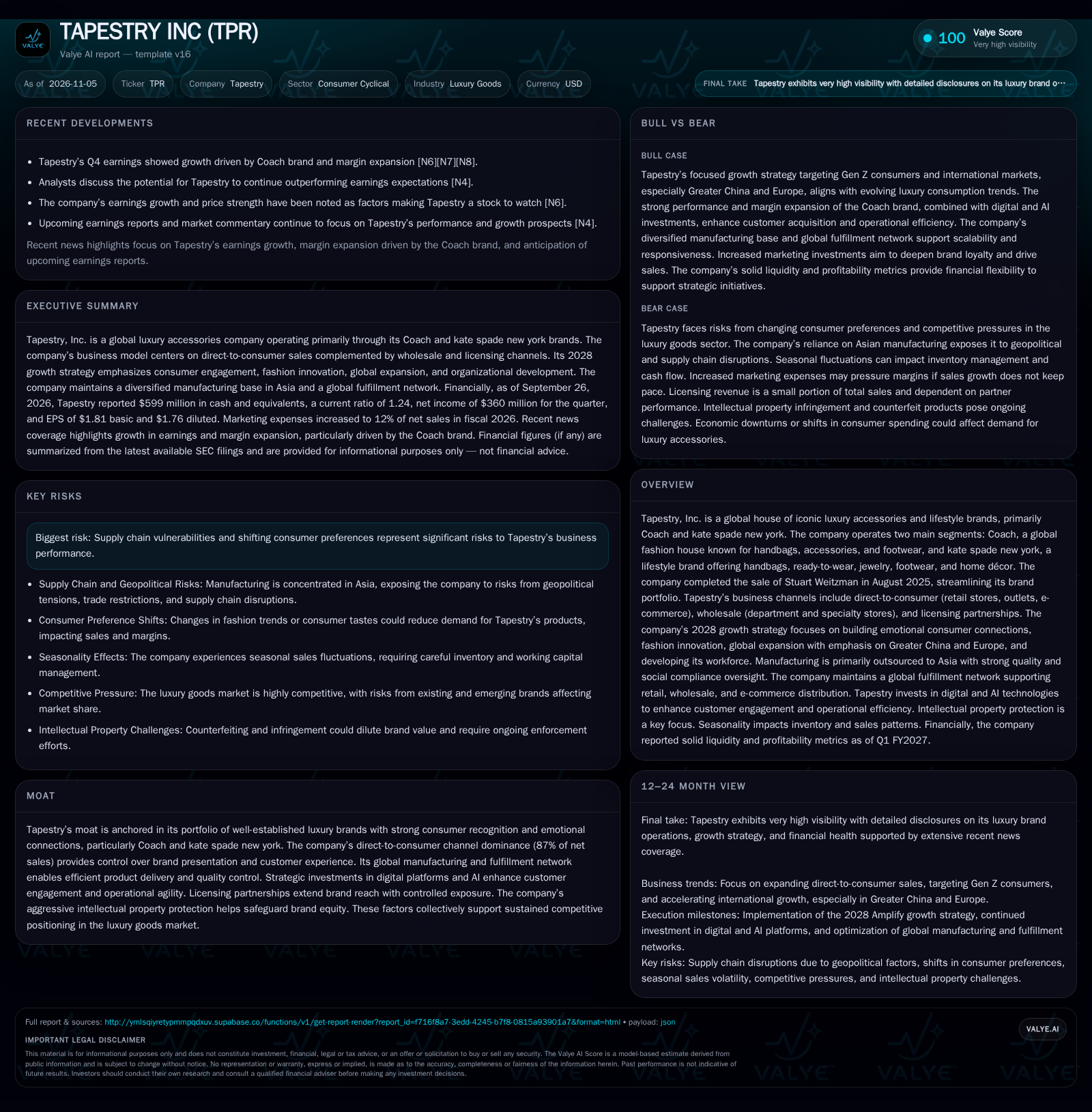
Tapestry’s Q4 momentum is anchored by strong Coach performance, ongoing margin expansion, and a direct-to-consumer model now representing 87% of sales. The company’s increased marketing investment and digital/AI initiatives support customer acquisition and operational efficiency. Execution of its 2028 'Amplify' strategy—including international growth and deepening emotional brand connection—remains central, but risks include supply chain concentration and luxury demand volatility. Sustained earnings growth will hinge on proving that higher marketing spend translates to durable brand equity and global consumer resonance.
Tapestry, Inc. enters late 2026 with a sharpened focus on its two flagship brands—Coach and kate spade new york—having divested Stuart Weitzman and realigned its business around direct-to-consumer sales and digital innovation. With Coach delivering the majority of revenue and recent margin expansion, management has doubled down on marketing and technology to deepen customer engagement and fuel global growth. Yet, as marketing intensity rises and the company bets on international expansion, the question shifts from whether Tapestry can grow, to whether it can do so profitably and sustainably amid luxury market volatility, evolving consumer tastes, and concentrated supply chain exposure.
Coach Drives Q4 Performance as DTC Model and Marketing Spend Take Center Stage
Tapestry’s fiscal 2026 closed with Coach accounting for 86.4% of net sales, cementing its role as the primary growth engine and profit contributor [S1]. Recent quarterly results highlighted margin expansion and earnings growth, with net income reaching $360 million and diluted EPS at $1.76 for the quarter ended September 26, 2026 [S2] [N6] [N7] [N8]. The company’s direct-to-consumer channels—encompassing retail stores, outlets, and e-commerce—now represent 87% of total sales, underscoring a strategic pivot that gives Tapestry more control over brand experience and customer relationships [S1]. Marketing investment climbed to 12% of net sales in fiscal 2026, up from nearly 11% the prior year, reflecting a deliberate push to deepen consumer engagement [S1]. These developments frame the company’s 2028 'Amplify' strategy, which prioritizes digital innovation and international expansion, particularly in Greater China and Europe [S1].
How Tapestry’s Revenue Model and Cost Structure Shape Profit Potential
Tapestry’s core economics are driven by high-margin branded accessories sold primarily through direct channels, reducing reliance on wholesale partners and allowing for greater pricing control and brand stewardship. The DTC model can yield stronger gross margins by capturing retail markups and leveraging proprietary e-commerce platforms, but it also carries higher fixed costs due to store operations, fulfillment, and customer acquisition.
The company’s rising marketing expense—now 12% of net sales—reflects a willingness to invest heavily in brand equity and top-of-funnel demand generation [S1]. If these investments translate into higher customer lifetime value and improved retention, Tapestry could see operating leverage as revenue scales. Conversely, if incremental spend fails to drive proportionate sales growth, margin pressure could intensify.
Manufacturing is primarily outsourced to Asia, converting much of the cost base into variable costs tied to production volume. This structure offers flexibility in downturns but creates exposure to external shocks. Capital needs are moderate, with investment focused on digital infrastructure and store refreshes rather than heavy physical expansion. Seasonality remains a factor, as holiday sales cycles drive inventory build and working capital swings.
Brand Equity, DTC Control, and Digital Investment: Tapestry’s Strategic Defenses
Tapestry’s main competitive advantage lies in its portfolio of established brands—especially Coach—known for aspirational yet accessible luxury positioning. Emotional resonance and brand loyalty are strategic assets, but require constant renewal through design innovation and marketing.
The company’s dominance in DTC channels (87% of sales) provides advantages in customer data, pricing discipline, and the ability to quickly adapt merchandising and promotions. However, this also intensifies the need for efficient omnichannel execution and seamless e-commerce operations, as luxury consumers increasingly expect high-touch digital and physical experiences.
Digital and AI investments may enhance personalization and operational agility, but nearly all large luxury peers are pursuing similar strategies. Tapestry’s scale is dwarfed by global luxury conglomerates, so differentiation hinges on the strength of its brand storytelling and the efficiency of its digital infrastructure rather than sheer breadth. The company’s intellectual property enforcement efforts help defend brand equity, though counterfeiting remains a persistent risk.
If Marketing and Digital Investments Unlock Global Brand Resonance
The most constructive scenario for Tapestry is one in which increased marketing spend and digital platform enhancements convert into sustained customer acquisition, higher retention, and pricing power—especially among Gen Z and international consumers. This would require clear evidence that incremental investments are not merely supporting short-term volume, but are deepening emotional brand connection and expanding addressable demand.
If the company’s DTC model translates into consistently higher gross margins and operating leverage—reflected in improving profitability metrics as sales scale—while international growth outpaces domestic luxury demand, then Tapestry could achieve above-industry growth rates and margin expansion. Confirmation would come from rising same-store sales, e-commerce growth, and share gains in target geographies, with margin improvement outpacing marketing spend increases. Falsification would be evident if marketing ROI declines, digital investments stall in impact, or international expansion fails to deliver incremental sales and margins.
Sustaining Brand Momentum Amid Luxury Market Crosscurrents
The most plausible path is that Tapestry maintains moderate growth and stable-to-improving margins, led by Coach and supported by incremental gains at kate spade. The company’s DTC-centric model continues to provide margin support, but higher marketing intensity is required to defend share against entrenched and emerging luxury competitors. Digital and AI investments yield operational improvements but do not create a step-change in customer economics relative to peers.
International expansion, especially in Greater China and Europe, contributes to growth but is offset by persistent currency and geopolitical risks. Manufacturing concentration in Asia remains a vulnerability, but is managed through supplier diversification and inventory planning. Confirmation would be ongoing EPS growth, stable gross/operating margins, and healthy cash flow, with no material decline in DTC or core brand performance. Falsification would be signaled by stagnation in core brand sales, rising promotional intensity, or margin erosion outpacing revenue gains.
When Marketing Spend Fails to Defend Brand Equity and Supply Chain Risks Materialize
In a negative scenario, increased marketing expenditures fail to translate into lasting brand desirability or sales growth, forcing the company into a cycle of discounting and higher promotional activity to maintain volume. This would erode gross margins and undermine the operating leverage sought from DTC scale.
External shocks—such as geopolitical tensions, trade restrictions, or supply chain disruptions in Asia—could compound these pressures, leading to inventory imbalances, delayed product launches, or higher costs. If consumer preferences shift away from Tapestry’s core brands or if luxury demand contracts due to macroeconomic weakness, the company’s fixed store costs and elevated marketing spend could drive a rapid decline in profitability. Confirmation would include rising inventory, falling like-for-like sales, margin compression, or downward earnings revisions linked to either demand weakness or operational disruptions.
Milestones That Will Reveal If Tapestry’s Brand and DTC Bet Is Paying Off
Quarterly same-store sales growth for Coach and kate spade, especially in key international markets, would help test whether brand momentum is translating to real demand.
Gross and operating margin trends relative to changes in marketing spend will show whether incremental investment is driving profitable growth.
E-commerce and omnichannel sales mix, if disclosed, would indicate the effectiveness of digital investments and DTC execution.
Inventory turnover rates and promotional intensity are crucial signals for demand health and operational discipline.
International sales growth in Greater China and Europe will clarify the success of the global expansion strategy.
Supply chain resilience metrics—such as lead times, cost of goods sold, or supplier diversification—would help assess vulnerability to external shocks.
Trends in counterfeit enforcement actions or intellectual property litigation, if disclosed, would indicate the ongoing strength of brand protection efforts.
Customer acquisition cost and lifetime value metrics, if available, would allow a direct assessment of marketing ROI and digital strategy effectiveness.
Disclaimer: This is research-only, informational analysis and not investment advice. It may include AI-generated interpretation and general industry context. Always verify important details using primary sources.

Comments