
Zai Lab: Advancing Commercial Scale in China with Ambitious Global Pipeline Goals
Zai Lab’s diversified commercial portfolio and robust clinical pipeline signal strong growth potential, but the company remains in investment mode, posting quarterly losses as it contends with regulatory, execution, and partnership risks. The next phase hinges on pipeline progress and commercial leverage in Greater China.
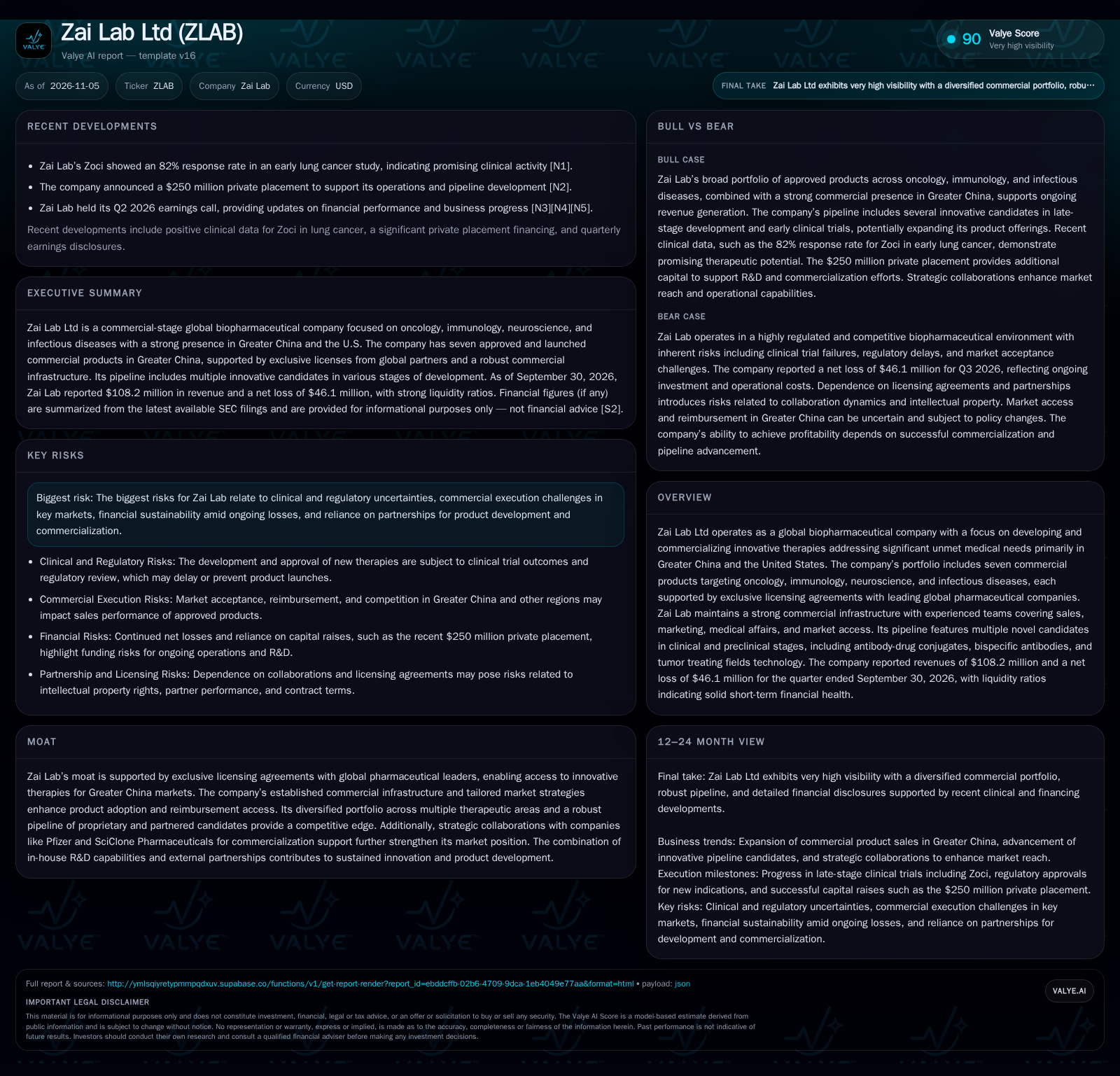
Zai Lab operates a commercial-stage biopharma business with seven approved products in Greater China and a pipeline of novel candidates targeting oncology, immunology, and infectious disease. Despite $108.2 million in Q3 2026 revenue, the company reported a net loss, reflecting ongoing investment and the high costs of drug development. With $550 million in cash, Zai Lab has financial resources to advance its pipeline, but must navigate clinical, regulatory, and commercial risks in a competitive and policy-sensitive Chinese market [S1] [S2].
Zai Lab Ltd stands at the intersection of commercial execution and innovation in the biopharmaceutical sector, leveraging a diversified portfolio of licensed therapies across oncology, immunology, and infectious disease for the Greater China market. With seven approved products and a global pipeline of next-generation candidates, the company has built a commercial platform that is rare among China-based biotechs. The company’s future will be shaped by its ability to convert pipeline assets into commercial successes, manage regulatory and reimbursement hurdles in China, and sustain its financial position while scaling globally.
Current Operating Landscape: Balancing Growth and Losses
Zai Lab reported Q3 2026 revenue of $108.2 million, reflecting sales from seven approved commercial products in Greater China, where the company holds exclusive licenses from global partners [S1] [S2]. Despite this commercial footprint, Zai Lab posted a quarterly net loss of $46.1 million, with basic and diluted EPS at -$0.04 [S2]. As of September 30, 2026, the company had a current ratio of 2.04 and a cash ratio of 1.32, translating to approximately $550 million in cash and equivalents on hand [S2]. This financial snapshot underscores a business that has reached commercial scale but remains in a phase of heavy investment, with ongoing losses driven by R&D, licensing costs, and commercial buildout.
Revenue Streams and Cost Drivers Influencing Profitability Prospects
Zai Lab’s economics reflect the hybrid realities of a commercial-stage biopharma with a lean toward in-licensed innovation. Revenue is generated through sales of seven therapies, each acquired via exclusive licensing agreements for Greater China, which likely involve upfront payments, milestones, and ongoing royalties or profit-sharing with the original developers. This structure accelerates product launches and market access but compresses gross margins compared to wholly owned, internally developed drugs.
The company’s cost base is characterized by substantial R&D spend—supporting both global and locally led pipeline programs—and significant SG&A outlays to maintain a robust commercial infrastructure across key medical centers. Fixed costs are high due to the need for experienced sales, medical affairs, and market access teams, while variable costs scale with product volume and promotional intensity.
Operating leverage is plausible if Zai Lab can expand product uptake and introduce new therapies without proportionally increasing its fixed commercial and administrative expense base. However, the company’s continued net losses indicate that current revenue scale is insufficient to cover the aggregate cost of commercialization, licensing obligations, and pipeline investment [S2]. Capital needs remain substantial if the company is to progress its pipeline to late-stage trials and support new launches, particularly as it pursues both China and global market opportunities.
Zai Lab’s Market Position: Exclusive Rights and China’s Biopharma Environment
Zai Lab’s competitive positioning in Greater China is built on exclusive licensing deals with leading global pharmaceutical companies, providing access to innovative therapies that may not otherwise reach the local market as quickly [S1]. This approach allows Zai Lab to differentiate itself from domestic peers that rely more heavily on generics or locally developed drugs. The company’s strong commercial infrastructure and relationships with major medical centers further reinforce its ability to drive adoption and navigate complex reimbursement processes.
However, the reliance on in-licensed products means Zai Lab faces structural limits on pricing power and margin, as global licensors often retain significant economic rights. Furthermore, China’s rapidly evolving biopharma landscape is marked by increasing competition from multinational companies expanding their own commercial footprints, as well as domestic peers accelerating innovation and regulatory approvals.
Potential substitutes include alternative therapies developed locally or by multinationals, and the risk of biosimilar or generic competition if market exclusivity or reimbursement terms shift. Zai Lab’s ability to sustain its edge will depend on the pace of pipeline innovation, the durability of licensing relationships, and its execution in a market where policy and pricing pressures are persistent counterforces.
Unlocking Value Through Pipeline Breakthroughs and Expanded Commercial Footprint
A favorable scenario for Zai Lab would see several late-stage pipeline assets—such as its antibody-drug conjugates or bispecific antibodies—achieve positive clinical readouts, accelerate through regulatory review, and gain timely market access in China. This could drive new product launches that leverage the company’s existing commercial infrastructure, enabling revenue growth with enhanced operating leverage.
Success would also depend on expanding indications or patient populations for currently approved therapies, improving payer coverage, and achieving better-than-expected uptake. If the company can negotiate favorable terms with licensors for new assets or renegotiate existing agreements to capture greater economics, margin expansion is possible.
Confirmation of this scenario would come from reported late-stage trial successes, regulatory approvals for pipeline assets, and evidence of substantial year-over-year revenue growth outpacing expense increases. Announcements of expanded reimbursement or the ability to launch new therapies without proportional SG&A growth would further validate the thesis.
Maintaining Growth Momentum Amid Financial Challenges
The central expectation is that Zai Lab will continue to drive revenue growth from its existing base of seven commercial products in Greater China, with incremental contributions from pipeline launches over the next 12–24 months. [S2]
Market access and reimbursement trends in China remain variable, and while the company’s commercial infrastructure provides a competitive edge, ongoing pricing and policy pressures may limit margin expansion. The pace of new product launches will depend on both internal development and the company’s ability to secure additional licenses from global partners.
Evidence for this trajectory would include steady, single-digit or low double-digit revenue growth, ongoing but narrowing quarterly losses, and continued advancement of pipeline candidates into later-stage trials. Falsification would come from unexpected regulatory setbacks, significant partnership disruptions, or a sharp deterioration in gross margins.
Risks to Growth from Clinical, Regulatory, or Partnership Setbacks
A negative outcome could be triggered by clinical trial failures or regulatory delays affecting key pipeline assets, reducing the likelihood of future product launches and limiting growth potential. If reimbursement terms in China deteriorate or the company loses exclusivity or faces generic/biosimilar competition, revenue from existing products could decline.
Dependence on global licensing partners introduces another layer of risk: adverse changes in contract terms, loss of exclusivity, or disputes could materially impact both product access and economics. In a scenario where cash burn accelerates and pipeline progress stalls, Zai Lab could face the prospect of additional dilutive financing or forced cost reductions.
This scenario would be confirmed by negative clinical or regulatory news, missed revenue targets, widening losses, or announcements of partnership disputes or asset impairments.
Key Elements Shaping Zai Lab’s Future Success
Quarterly revenue growth by product, especially for recently launched therapies, will reveal whether commercial momentum is accelerating or plateauing.
Gross margin trends, if disclosed, would indicate the evolving balance between licensing costs, pricing power, and operational efficiency.
R&D spending as a percentage of revenue will provide clues about the company’s commitment to pipeline advancement versus commercial optimization.
Clinical and regulatory milestones for late-stage pipeline assets (such as Zoci or ZL-1503), including trial readouts and approval timelines, are critical to future product flow.
Updates on partnership agreements—new licenses, renewals, or renegotiations—could materially alter the economics and future product portfolio.
Reimbursement and market access developments in China, especially for new indications or therapies, will shape both volume and margin prospects.
Disclaimer: This is research-only, informational analysis and not investment advice. It may include AI-generated interpretation and general industry context. Always verify important details using primary sources.

Comments