
ARKO Corp.: Dealerization, Margin Defense, and the Economics of Fuel Retail Transformation
ARKO Corp. is navigating a multi-year transformation through dealerization and operational restructuring, as it seeks to enhance margins and growth in the face of fuel price volatility, regulatory pressure, and intense competition. Recent EBITDA guidance raises and a subsidiary IPO highlight both progress and the stakes of execution.
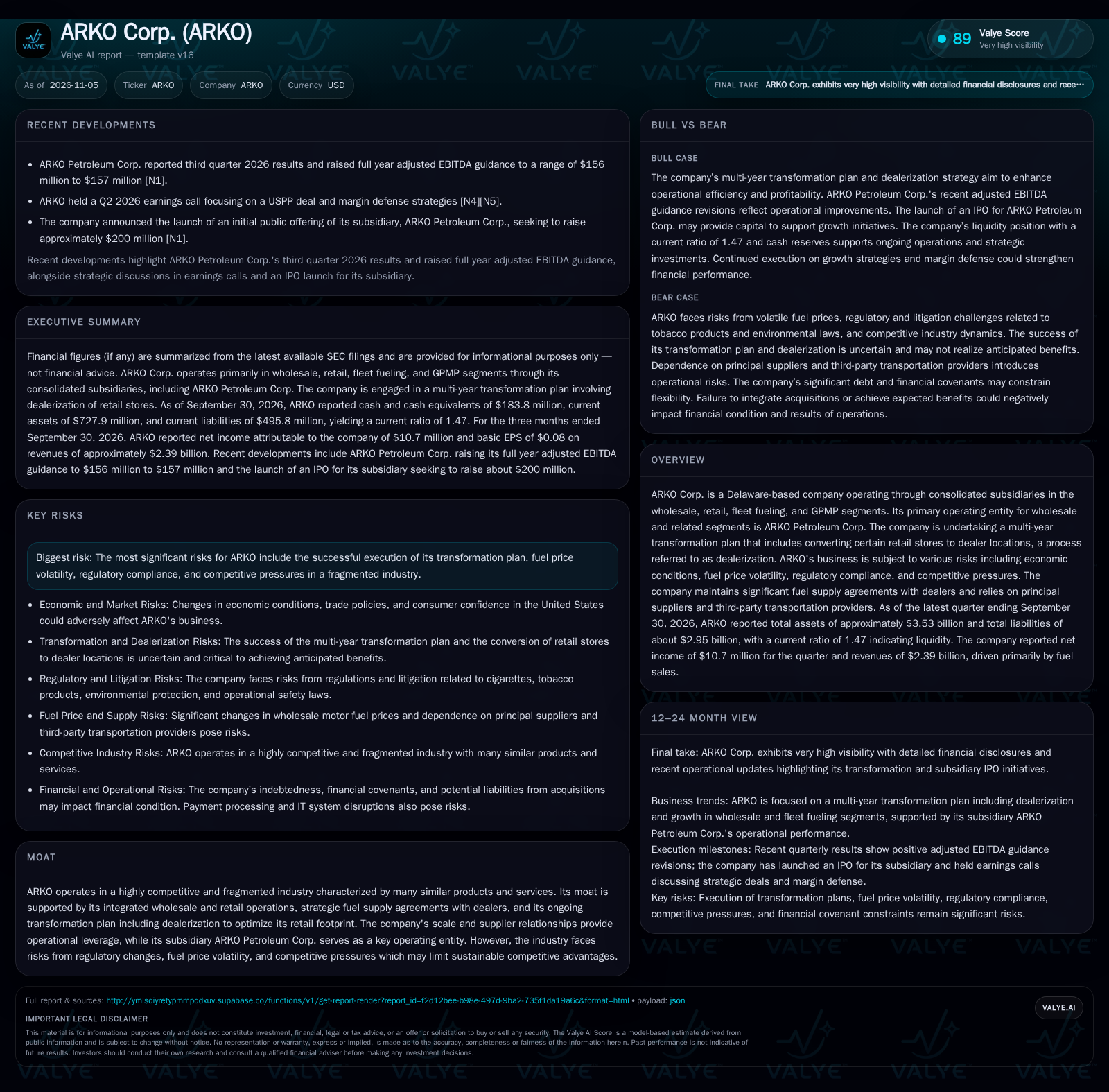
With a transformation plan centered on converting company-operated stores to dealer locations, ARKO Corp. is focused on operational efficiency and margin defense. The company reported $2.39 billion in Q3 2026 revenue, raised full-year adjusted EBITDA guidance, and initiated a subsidiary IPO. Key risks remain execution, fuel price volatility, and industry competition.[N1] [S1]
ARKO Corp. stands at a strategic inflection point as it pursues a multi-year transformation aimed at reshaping its retail and wholesale fuel distribution footprint. With Q3 2026 revenues of $2.39 billion and raised full-year EBITDA guidance, the company is demonstrating some operational momentum. However, the complexity of its dealerization strategy, exposure to fuel price swings, and competitive pressures in a fragmented industry mean that the ultimate payoff—and durability—of its transformation remains uncertain. The upcoming subsidiary IPO could provide the financial firepower needed for the next phase, but execution risks loom large.[S1] [N1]
Recent Financial Performance and Strategic Moves Define the Near-Term Landscape
ARKO Corp. reported $2.39 billion in revenue and $10.7 million in net income for Q3 2026, with an operating income of $35.2 million and basic EPS of $0.08.[S1] The company’s fuel sales drove the bulk of revenue at approximately $2.01 billion, while merchandise contributed $351 million.[S1] ARKO Petroleum Corp., the primary operating entity for wholesale and related segments, raised its full-year adjusted EBITDA guidance to $156–$157 million, signaling management’s confidence in margin defense and operational improvements.[N1] In parallel, ARKO has launched an IPO for its subsidiary, targeting a $200 million capital raise, which could be used to fund continued transformation and growth initiatives.
The company reported cash and liquidity metrics for the period; these figures do not by themselves establish operating runway, investment capacity, financial flexibility, or financing capacity. [S1]
Dealerization and Margin Defense: How ARKO’s Model Could Unlock Value
ARKO’s underlying economics hinge on its ability to manage razor-thin margins in fuel retail, optimize merchandise sales, and extract efficiency from its wholesale and fleet fueling operations. The dealerization strategy—converting company-operated stores to dealer-run locations—has the potential to shift ARKO’s cost structure from fixed labor and operating expenses to a more variable, royalty-based revenue model. This could reduce direct operating costs and working capital needs, while providing steadier income streams from dealer fees or supply agreements.
Fuel sales, the primary revenue driver, are highly volume-dependent but subject to intense price competition and volatility. Merchandise sales, while a smaller portion of revenue, typically carry higher margins and are critical for store-level profitability. The company’s ability to defend or expand margins will depend on its success in passing through fuel price changes, managing supply agreements, and improving the merchandise mix.
Capital needs remain significant, particularly for store conversions, technology upgrades, and potential acquisitions. The upcoming subsidiary IPO could provide fresh capital, but the efficiency of capital deployment will be a key determinant of return on investment. Operating leverage may improve if scale efficiencies and dealerization yield lower per-store overhead, but this is contingent on execution and competitive response.
Fragmented Markets, Commoditized Offerings, and the Quest for Differentiation
ARKO operates in a highly competitive and fragmented industry characterized by low switching costs, commoditized fuel offerings, and numerous regional and national competitors. Its integrated wholesale and retail footprint, along with strategic fuel supply agreements, provide some scale advantages and operational leverage. However, these advantages can be fleeting if competitors match pricing, improve convenience, or secure more favorable supply terms.
Dealerization may allow ARKO to optimize its store portfolio, focusing on supply relationships and higher-margin locations while offloading direct operating risk. Yet, competitors—ranging from large chains to independent dealers—can often replicate dealer models or undercut on price. Non-traditional threats, including electric vehicle charging networks and alternative fuel providers, present longer-term substitution risk.
Regulatory pressures, particularly around tobacco and environmental compliance, are industry-wide but could disproportionately impact operators with significant exposure to regulated product categories or legacy assets. ARKO’s scale may help absorb compliance costs, but it does not confer a durable moat in itself.
Margin Expansion and Capital Efficiency Drive Outperformance
If ARKO executes its dealerization strategy effectively, operating leverage could improve as fixed costs decline and a greater share of income comes from dealer fees and supply margins. Successful renegotiation of fuel supply agreements and disciplined merchandise curation could further enhance gross margins. The $200 million subsidiary IPO, if completed on favorable terms, may provide the capital needed for accretive acquisitions or technology investments that further widen the margin gap.
Confirmation of this scenario would come from sustained expansion in adjusted EBITDA margins, growth in dealer-operated locations relative to company-operated stores, and improved return on invested capital. Additional evidence would include successful completion of the IPO at or above target proceeds, and disclosure of accretive reinvestment opportunities that translate into higher per-store profitability or market share gains.
Incremental Progress Amid Persistent Margin Pressures and Execution Risk
The most plausible path forward for ARKO involves steady, if uneven, progress on dealerization and operational efficiency, with ongoing exposure to fuel price volatility and competitive pricing. Margins may stabilize or improve modestly if ARKO manages to convert a significant proportion of stores without major disruptions or dealer attrition. However, the benefits of the transformation could be offset by rising regulatory costs, competitive responses, or difficulties in retaining high-performing locations within the dealer network.
Evidence supporting this scenario would include a gradual increase in the proportion of dealer-operated stores, stable or slightly improving gross and EBITDA margins, and continued positive net income. Signs of slippage would include delays in store conversions, lack of growth in merchandise revenue per location, or margin compression tied to supply renegotiations or rising compliance costs.
Dealerization Stalls and Margin Compression Erodes Profitability
The principal downside risk is that the dealerization strategy fails to deliver expected efficiency gains, either due to execution missteps, dealer resistance, or unfavorable renegotiations with suppliers. If ARKO is unable to pass through fuel price increases or loses volume to more aggressive competitors, both top-line and margin performance could deteriorate. Regulatory or litigation shocks—especially related to tobacco or environmental compliance—could add new cost burdens or restrict key revenue streams.
Confirmation of this scenario would be seen in declining adjusted EBITDA, shrinking net income, or a reversal in the trend of dealer-operated store conversions. Additional warning signs include unsuccessful or highly dilutive outcomes from the subsidiary IPO, covenant breaches tied to debt, or rising working capital needs that erode liquidity.
Milestones and Metrics That Will Test the ARKO Transformation Thesis
Dealerization progress: Track the proportion and pace of retail store conversions to dealer-operated locations, if disclosed.
Adjusted EBITDA trends: Monitor quarterly adjusted EBITDA for consistent margin expansion or signs of margin erosion.
Fuel supply agreement renewals: Watch for disclosures on major supply contract renegotiations and their terms.
IPO execution: Assess the completion, size, and use of proceeds from the ARKO Petroleum Corp. subsidiary IPO.
Merchandise margin evolution: A useful metric would be merchandise gross margin per store, to gauge success in higher-margin categories.
Regulatory and litigation developments: Monitor for new compliance costs, litigation outcomes, or regulatory changes impacting tobacco or fuel.
Net income and return on invested capital: Track trends in net income and ROIC for signs of improved capital efficiency.
Working capital dynamics: Watch for changes in working capital requirements that could signal stress or inefficiency.
Disclaimer: This is research-only, informational analysis and not investment advice. It may include AI-generated interpretation and general industry context. Always verify important details using primary sources.

Comments