
EOS Energy: Project Scale, Federal Incentives, and the Stakes of Dilution in Long-Duration Storage
EOS Energy’s surge into large-scale storage through marquee partnerships and supportive U.S. policy highlights both its expanding opportunity set and the risks of project complexity, regulatory flux, and capital structure. The next phase hinges on translating liquidity and federal credits into durable, high-margin deployments—while managing exposure to FPUSA and dilution from convertibles.
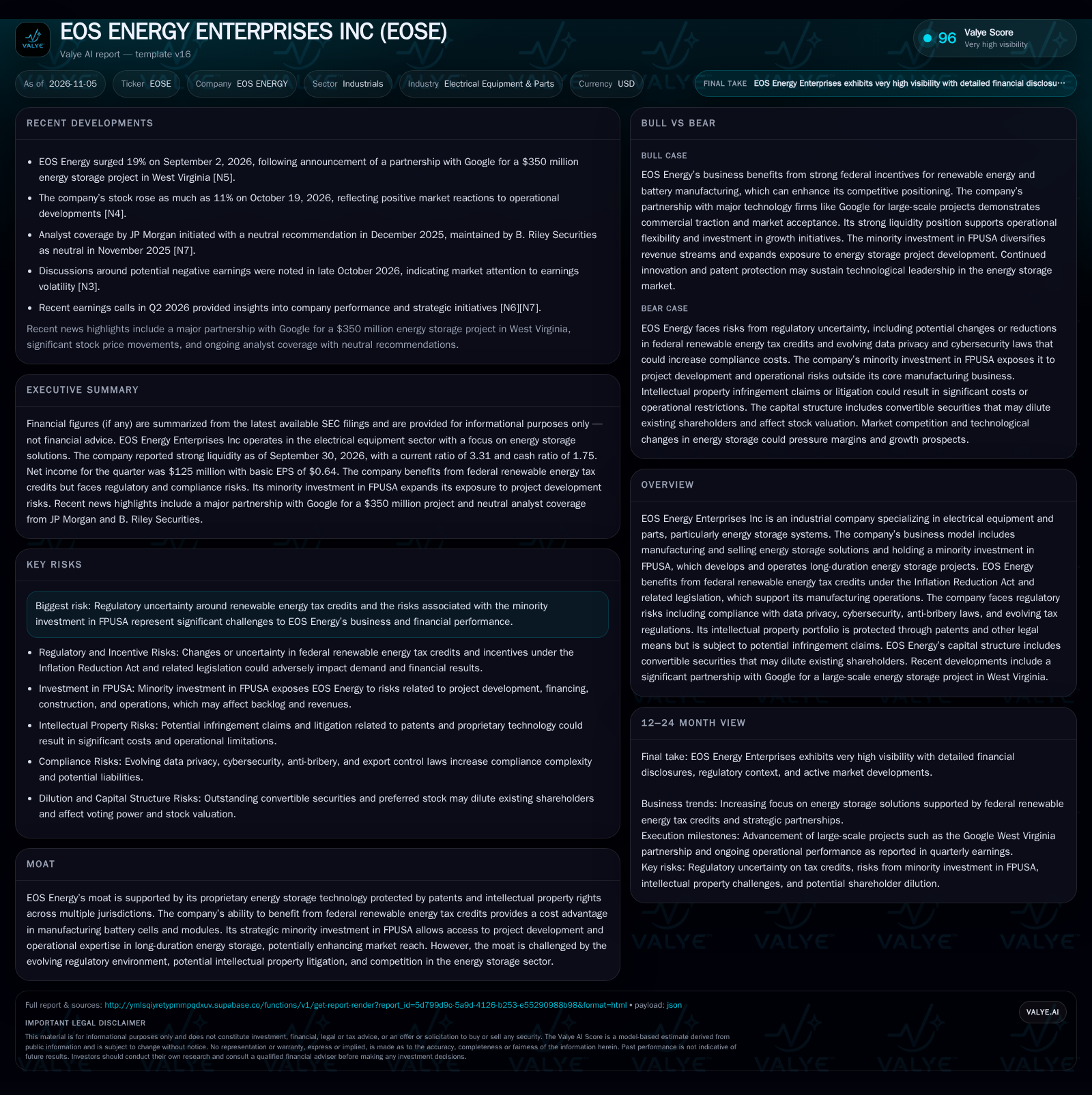
EOS Energy Enterprises’ current strength is built on reported liquidity position, strong federal incentives, and headline partnerships like its $350M Google-backed project. Yet, exposure to project risks via FPUSA and the reality of potential dilution from convertibles are central to the investment debate. Execution on large deployments and regulatory clarity will likely determine whether EOS can convert its financial runway into sustainable earnings.
EOS Energy Enterprises stands at a pivotal juncture in the U.S. energy storage value chain. Its recent $350 million project with Google, buoyed by robust federal incentives and a reported liquidity position, has catapulted it into the spotlight. However, the company’s capital structure—laden with convertibles and preferreds—raises questions about future dilution, while its minority stake in FPUSA means exposure to project risk outside its core manufacturing domain. The next chapters for EOS will be written not just by headline wins, but by its ability to convert financial resources and policy tailwinds into durable, margin-rich deployments in a competitive, rapidly evolving sector.
Recent Liquidity, Earnings, and Strategic Partnerships Define the Near-Term Landscape
[S2] This liquidity is significant in a capital-intensive sector where inventory build, project execution, and working capital swings can be pronounced.
For the same quarter, EOS posted net income of $125 million, with basic earnings per share of $0.64 but diluted EPS at -$0.17—a sharp divergence that highlights the impact of its convertible and preferred securities on potential shareholder value [S2]. This signals that while the company is currently profitable on a basic share count, the pathway to distributable returns for common shareholders is complicated by its capital structure.
The September 2026 announcement of a $350 million energy storage project partnership with Google in West Virginia provided a significant commercial milestone and was met by a 19% stock price surge [N5]. Such headline partnerships serve as validation for EOS’s technology and market positioning, but also raise the stakes for flawless execution.
How Federal Credits and Capital Structure Shape EOS’s Economic Model
EOS’s core business is the manufacture and sale of energy storage systems, a sector where gross margins are heavily influenced by manufacturing scale, bill-of-material costs, and the ability to capture premium pricing for duration or performance advantages. The economics are currently bolstered by federal renewable energy tax credits under the Inflation Reduction Act and the One Big Beautiful Bill Act, which provide material support for both battery cell and module production [S2]. These credits can function as a direct margin enhancer, lowering effective costs or enabling more aggressive pricing.
However, the company’s capital structure introduces complexity. Substantial convertible securities and preferred stock mean that even strong net income may not translate into proportional value for common shareholders if these instruments convert or are exercised. This structure can be advantageous for funding growth without immediate dilution, but introduces long-term overhang and complicates EPS visibility.
The minority stake in FPUSA gives EOS indirect exposure to project development returns, but also means the company is subject to the risks and economics of project financing, construction delays, and operational variability—none of which it fully controls. This can lead to lumpy or unpredictable revenue streams, particularly if FPUSA’s projects experience setbacks.
Technology, Policy, and Execution: EOS’s Potential Edge and Sector Headwinds
EOS’s moat is rooted in proprietary battery technology, supported by patents and IP protections that could enable differentiation on performance or lifespan. In energy storage, where reliability and cost per cycle are paramount, any sustained technical edge can justify premium pricing or preferred status in large-scale deployments.
Federal incentives provide EOS with a cost advantage relative to offshore competitors or less integrated U.S. players, at least as long as current policy frameworks persist. However, this advantage is policy-contingent and not structural; a future reduction or reinterpretation of credits would quickly erode this edge.
The company’s marquee projects, such as the Google partnership, may grant it first-mover credibility in utility-scale, long-duration storage—an area where many competitors remain at pilot or demonstration scale. However, the sector is crowded with lithium-ion incumbents, alternative chemistries, and emerging players with strong balance sheets or deeper integration with renewable project developers. Switching costs for utility buyers are moderate: while project-specific integration can create some lock-in, most customers seek proven, bankable solutions at scale, and are willing to switch if a superior technology or pricing emerges.
From Policy Tailwinds to Profitable Scale: What Could Drive Durable Outperformance
The most favorable scenario for EOS is one in which federal tax credits remain robust and clear, enabling the company to outcompete on cost and secure a steady stream of large-scale deployments. If the Google project executes successfully—on time and on budget—it could become a reference point for further partnerships with other major utilities or technology firms.
Strong execution could allow EOS to demonstrate compelling unit economics (if disclosed), such as declining cost per installed kWh and improving gross margins, as manufacturing scales. If the FPUSA investment matures into a recurring revenue stream with limited project risk volatility, EOS could begin to see more stable, diversified earnings.
Key confirming evidence for this scenario would include: sustained backlog growth, margin expansion in financial reports, additional blue-chip partnerships, and regulatory clarity around federal credits. A falsifier would be a significant cost overrun, regulatory reversal, or project delay undermining the Google deployment.
Balancing Growth with Dilution and Policy Uncertainty in a Crowded Market
The most plausible path is one where EOS continues to secure high-profile projects and benefits from ongoing (if periodically contested) federal tax credits, but faces intermittent project risks and earnings volatility from its FPUSA exposure. Revenue growth is likely to remain uneven, tied to the timing and execution of large deals.
Dilution from convertibles and preferreds becomes an increasingly salient issue as profitability scales: even if nominal net income rises, per-share value for common shareholders could lag unless the company manages capital structure proactively or redeems these instruments from free cash flow.
This scenario is confirmed by: continued headline project wins, neutral-to-positive but volatile analyst coverage, and quarterly earnings showing both growth and swings in EPS. It would be falsified by either a collapse in new project bookings or a material regulatory shift that undermines the economic rationale for U.S.-based storage manufacturing.
Regulatory Shifts, Project Failures, and Shareholder Dilution as Downside Catalysts
A negative chain of events could be triggered by a reduction or reinterpretation of federal renewable energy credits, eroding EOS’s cost advantage and compressing margins. Simultaneously, if the Google project or other large deployments face delays, cost overruns, or underperformance, EOS could suffer not only from missed revenue but also reputational damage, making future wins harder.
The company’s minority stake in FPUSA could compound downside risk if project losses or delays flow through to EOS’s financials, especially if the company lacks operational control to mitigate issues. In this scenario, the overhang from convertibles and preferreds could be realized at inopportune times, amplifying dilution just as operating performance falters.
Evidence for this downside includes: negative earnings surprises (as flagged in late October 2026 coverage [N3]), regulatory actions or uncertainty, cost escalations in project execution, and any sign of deteriorating liquidity despite the current reported cash balance.
Factors That Will Determine Whether EOS Converts Its Tailwinds Into Durable Value
Progress on the Google West Virginia project: Are milestones met on time and on budget? If disclosed, project-level margins and performance metrics would help test scalability.
Federal tax credit landscape: Ongoing clarity or changes to the Inflation Reduction Act and related incentives could materially impact economics—any proposed amendments or regulatory reinterpretations should be closely watched.
Backlog growth and conversion: If disclosed, the size, quality, and conversion rate of EOS’s project backlog would serve as a leading indicator of sustained demand.
Dilution impact: Tracking convertible and preferred conversions, as well as any management commentary on capital structure strategy, will be critical for assessing per-share value.
FPUSA project outcomes: Updates on project development, financing, and operational performance at FPUSA (if disclosed) could signal risk or upside for EOS’s indirect exposure.
Gross margin trends: If disclosed, changes in gross margin per unit or project indicate whether scale and policy support are translating into sustainable profitability.
Regulatory and compliance developments: Any new data privacy, cybersecurity, or anti-bribery regulations that materially increase compliance costs or risk profile.
Disclaimer: This is research-only, informational analysis and not investment advice. It may include AI-generated interpretation and general industry context. Always verify important details using primary sources.

Comments