
Core Natural Resources: Metallurgical Coal, Liquidity Strength, and the Realities of Market Volatility
Core Natural Resources, Inc. stands out for its operational scale and resumed longwall mining, with a substantial liquidity buffer and a mixed track record of earnings outperformance and volatility. As the metallurgical coal cycle faces regulatory, demand, and pricing crosscurrents, the company's ability to translate operational milestones into durable profitability remains the central question.
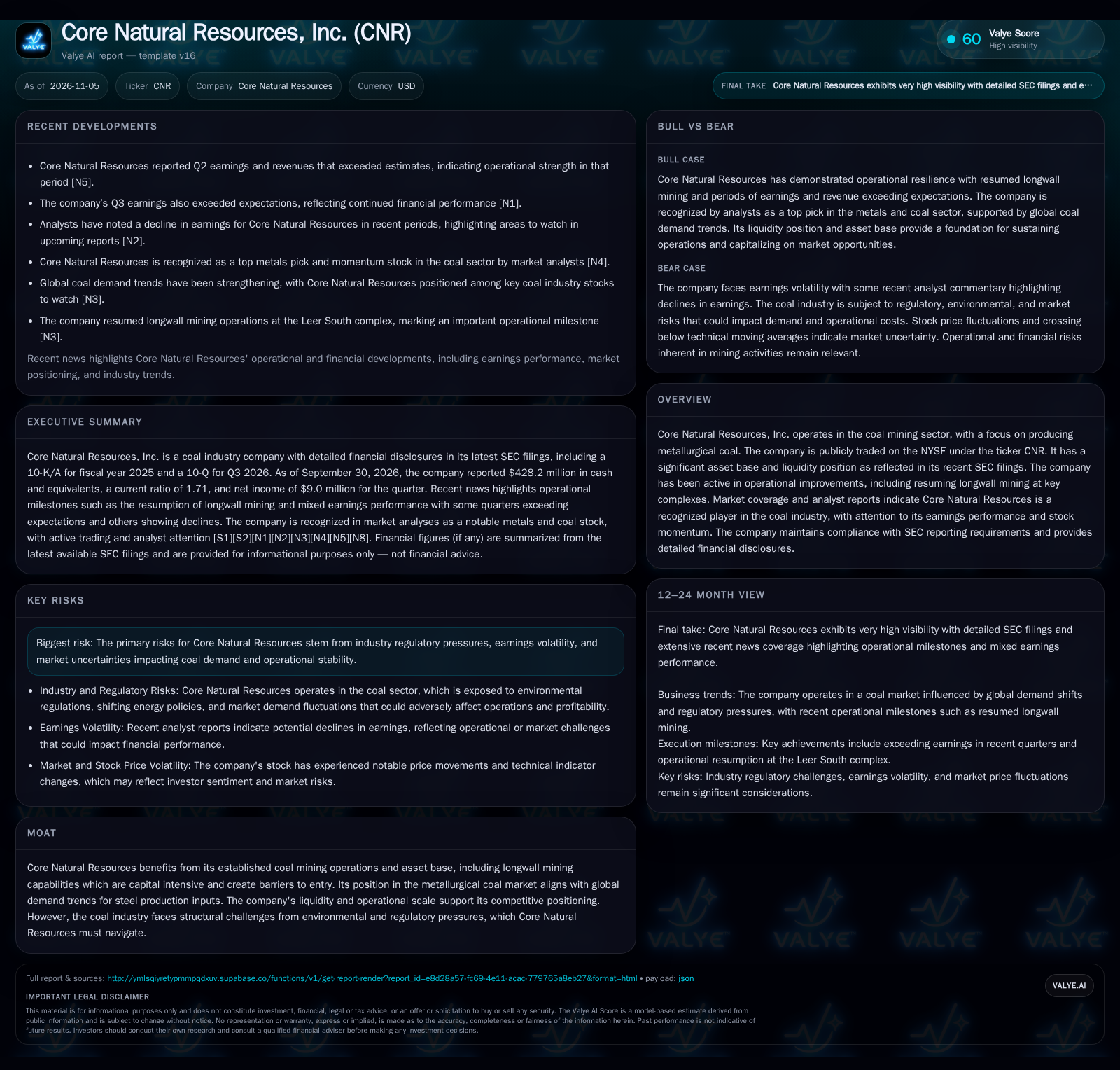
Core Natural Resources (CNR) operates as a major metallurgical coal producer, recently resuming longwall mining and reporting $428.2 million in cash as of September 2026. The critical issue is whether recent operational improvements will drive sustained profitability as the coal sector faces structural headwinds and commodity cycle uncertainty. [S2] [N2] [N5]
Core Natural Resources, Inc. is navigating the shifting terrain of the metallurgical coal market, with its substantial cash reserves and the restart of longwall mining operations positioning it as a notable player in the sector. Despite moments of earnings outperformance, recent analyst commentary underscores the volatility inherent in coal markets, where operational gains can be offset by commodity price swings and regulatory pressures. [S2] [N2] [N5]
Operational Recovery and Financial Position Define the 2026 Landscape
As of September 30, 2026, Core Natural Resources reported $428.2 million in cash and equivalents and a current ratio of 1.71, reflecting a reported liquidity position. The company's Q3 2026 net income of $9.0 million marks a positive result, while earlier in the year, CNR reported Q2 earnings and revenues that exceeded analyst estimates, signaling operational momentum at that time. However, subsequent analyst coverage has flagged declining earnings in more recent periods, highlighting the persistence of volatility. The resumption of longwall mining at key complexes represents a material operational milestone that could improve production volumes and cost efficiency, but the sustainability of these gains remains uncertain given the broader market context. [S2] [N2] [N5]
For instance, if accounts receivable turnover improves alongside inventory management, this could indicate enhanced operational efficiency that supports liquidity. Additionally, the timing and magnitude of capital expenditures relative to depreciation and amortization would clarify whether the company is maintaining, expanding, or contracting its asset base, which in turn impacts future production capacity and cost structure.
How Metallurgical Coal Economics Shape Core’s Profitability
Core Natural Resources generates revenue primarily through the production and sale of metallurgical coal, a critical input for steelmaking. The company’s economics are heavily driven by coal pricing, which is inherently cyclical and influenced by global steel demand, supply disruptions, and trade policies. Fixed costs are significant, especially given the capital intensity of longwall mining operations, creating high operating leverage: marginal changes in volume or realized price can dramatically impact profitability. Variable costs include labor, energy, maintenance, and royalties, while capital expenditures are required for mine development and equipment upkeep. If operational improvements from resumed longwall mining translate to higher volumes and lower per-ton costs, margin expansion is possible. However, exposure to regulatory compliance costs and potential environmental liabilities is a persistent counterweight.
The interplay between fixed and variable costs in metallurgical coal production means that operational scale can significantly influence unit economics. If the company can increase throughput without proportionally increasing fixed costs, the resulting operating leverage would enhance profitability. However, this advantage is conditional on stable or rising coal prices; in a downturn, high fixed costs could exacerbate margin compression. Moreover, the potential for cost inflation in labor, energy, and regulatory compliance introduces uncertainty into the cost base. The company's ability to implement productivity enhancements or adopt new technologies that reduce per-unit costs will be critical to offsetting these pressures and sustaining margins over time.
Asset Scale and Operational Capability Versus Structural Industry Headwinds
CNR’s established asset base and the capital-intensive nature of longwall mining create barriers to entry that help insulate incumbent producers from new competition. Within the metallurgical coal segment, competition comes from both domestic and international mining firms, many of which also target steelmakers as primary customers. The company’s ability to resume and sustain longwall mining operations is a source of potential advantage in terms of production efficiency and cost optimization. However, the broader coal industry faces mounting structural challenges: environmental regulations, decarbonization policies, and the risk of demand substitution from alternative steelmaking technologies or recycled materials. While CNR is recognized as a top momentum stock by analysts, this status is sensitive to shifts in market sentiment and commodity cycles. The company’s scale and liquidity may allow it to navigate downturns better than smaller peers, but its exposure to global policy changes and steel industry trends is a persistent vulnerability.
In evaluating Core Natural Resources' competitive position, it is important to consider the potential impact of technological innovation and alternative steelmaking methods on demand for metallurgical coal. Should electric arc furnace (EAF) steel production or hydrogen-based steelmaking gain broader adoption, the structural demand for coking coal could diminish, altering the competitive landscape. The company’s scale and operational expertise may provide some buffer, but long-term viability depends on adaptability to evolving market requirements. Furthermore, geopolitical factors affecting trade flows and tariff regimes could influence competitive dynamics by altering the cost competitiveness of domestic versus international coal producers, thereby impacting market share and pricing power.
Operational Leverage Unlocks Earnings if Coal Markets Stabilize
A favorable scenario for Core Natural Resources would see the company capitalize on resumed longwall mining to drive higher production volumes at lower unit costs, just as metallurgical coal prices stabilize or improve. In this context, CNR’s high operating leverage could translate into significant earnings growth, especially if global steel demand remains robust and regulatory headwinds are less severe than feared. Confirmation of this scenario would come from sequential increases in production volumes, margin expansion in quarterly results, and further periods of earnings outperformance relative to analyst expectations. Additional evidence would include successful contract renewals with key customers, limited regulatory cost escalation, and signs that global steelmakers are not rapidly substituting away from coal-based inputs. Sustained analyst upgrades and positive revisions to forward earnings estimates would further validate this upside pathway.
Navigating Cyclical Fluctuations: Volatility Remains the Norm
The most plausible scenario is that Core Natural Resources continues to experience earnings volatility, driven by the unpredictable interplay of coal prices, steel demand, and regulatory developments. Operational improvements from longwall mining may help offset some cost pressures, but pricing power is likely to remain limited in the face of global supply dynamics and demand uncertainty. Evidence confirming this view would include continued swings in quarterly earnings, a mix of analyst upgrades and downgrades, and ongoing sensitivity to commodity price movements. Falsification would require a sustained period of earnings stability and clear margin improvement, which would indicate a structural shift in either market dynamics or the company's cost structure.
Regulatory and Demand Shocks Could Undermine Recent Progress
A negative scenario would be triggered if global decarbonization policies accelerate, leading to a swift decline in metallurgical coal demand or price. Alternatively, significant regulatory changes—such as stricter emissions standards or higher compliance costs—could compress margins and force production curtailments. Operationally, setbacks in longwall mining (such as equipment failures or safety incidents) could drive up costs and erode profitability. Confirmation of this downside would include sharp declines in coal prices, negative earnings surprises, increased regulatory expenditures, and a retrenchment in analyst sentiment. Prolonged periods of negative free cash flow or an erosion of the company’s liquidity buffer would further reinforce a bearish outlook.
Testing the Core Natural Resources Thesis: Metrics and Milestones That Matter
Sequential production volumes and cost-per-ton data, if disclosed, would help assess the impact of resumed longwall mining and operational efficiency.
Quarterly gross and operating margin trends will indicate whether operational improvements are translating into sustainable profitability.
Updates on contract renewals, pricing mechanisms, and customer concentration would clarify revenue visibility and pricing power.
Regulatory disclosures or commentary on compliance costs and potential environmental liabilities would illuminate downside risk.
Trends in global steel production and metallurgical coal import/export data will provide external validation of demand conditions.
Analyst estimate revisions and commentary will reflect changing market sentiment and may foreshadow inflection points in performance.
Disclaimer: This is research-only, informational analysis and not investment advice. It may include AI-generated interpretation and general industry context. Always verify important details using primary sources.

Comments