
Zenas BioPharma: Clinical Progress, Immunology Ambitions, and the Long Road to Commercialization
With positive late-stage trial results for its lead antibody and a cash-rich balance sheet, Zenas BioPharma is advancing toward regulatory filings in autoimmune disease. Yet, the company faces the classic clinical-stage challenge: converting pipeline promise and differentiated mechanisms into sustainable revenue in a crowded and rapidly evolving field.
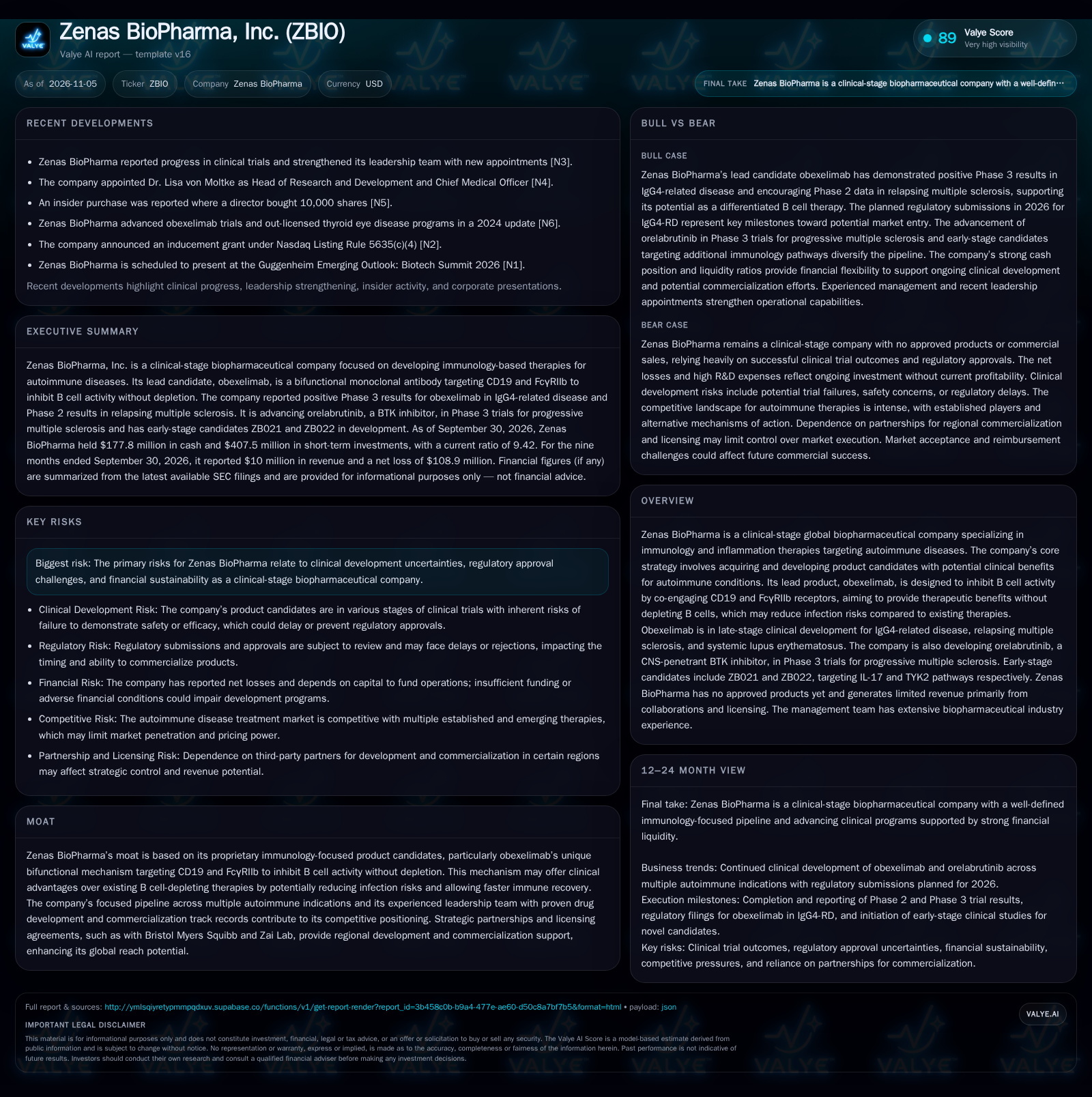
Zenas BioPharma has reported positive Phase 3 results for obexelimab in IgG4-related disease and strong interim Phase 2 data in relapsing multiple sclerosis, positioning it for regulatory filings in 2026. The company remains pre-commercial, with no approved products and ongoing net losses. Its substantial cash and investments may support near-term development, but the ultimate value hinges on successful approvals, market adoption, and competitive positioning in the immunology space. Watch for regulatory milestones, early commercial signals, and data from both lead and pipeline programs as critical inflection points. [S1] [S2]
Zenas BioPharma, Inc. stands at a familiar but pivotal juncture for clinical-stage biotechs. With late-stage clinical wins for its lead immunology candidate obexelimab and a reported cash position, the company is poised to seek regulatory approvals in markets with significant unmet need. Yet, the journey from clinical validation to commercial impact is fraught with uncertainty. The company must navigate regulatory hurdles, execute on commercialization, and differentiate itself within a fiercely competitive autoimmune therapeutics landscape—all while managing ongoing losses and development risk. The next 18 months will test whether Zenas can convert scientific and financial assets into durable shareholder value.
Clinical Milestones and Financial Foundation: Where Zenas Stands Now
The most consequential recent development for Zenas BioPharma is the positive topline readout from its Phase 3 INDIGO trial of obexelimab in IgG4-related disease (IgG4-RD). The study met its primary and key secondary endpoints, with a favorable safety profile, establishing proof of concept in a rare autoimmune indication with limited approved therapies. This result underpins Zenas’s plans to submit regulatory filings—both a Biologics License Application (BLA) to the FDA and a Marketing Authorization Application (MAA) to the EMA—in 2026. [S1]
In parallel, the company’s Phase 2 MoonStone trial in relapsing multiple sclerosis (RMS) demonstrated a 95% reduction in new gadolinium-enhancing lesions at 12 weeks, with sustained effect at 24 weeks. While promising, this remains interim Phase 2 data and may not fully predict registrational success or market adoption. [S1]
Despite these clinical advances, Zenas remains pre-commercial. For the first nine months of 2026, it reported $10 million in revenue (likely from licensing or collaborations) and a net loss of $108.9 million, reflecting the capital-intensive nature of late-stage development. [S2]
From Pipeline to P&L: Economics of a Clinical-Stage Immunology Portfolio
Zenas BioPharma’s current business economics are defined by high R&D investment, minimal revenue, and the absence of marketed products. The company’s reported net loss of $108.9 million for the first nine months of 2026 reflects ongoing spend on clinical trials, regulatory preparation, and early pipeline discovery. [S2]
If obexelimab secures approval in IgG4-RD, initial commercialization would likely target a rare-disease market, where high annual pricing per patient is common but volumes are modest due to prevalence. This could allow for strong gross margins if manufacturing and specialty distribution are efficiently managed. However, the transition from clinical-stage to commercial-stage typically brings a surge in fixed commercial infrastructure costs—sales force build-out, market access, and pharmacovigilance—potentially eroding initial profitability until scale is achieved.
Future economics depend on pipeline breadth. Success in RMS or SLE would open larger markets, but also subject Zenas to intense pricing competition, payer scrutiny, and the need for robust real-world evidence. The company’s ability to secure favorable reimbursement terms, differentiate on safety and efficacy, and expand indications will be crucial to moving from milestone-driven financials to sustainable operating leverage.
With over $585 million in cash and investments as of Q3 2026, Zenas appears funded through several clinical and regulatory milestones. However, the burn rate and the long path to meaningful revenue mean that additional capital raises (dilution or partnerships) remain plausible if timelines extend or commercial ramp is slower than expected. [S2]
Mechanistic Differentiation and the Immunology Arms Race
Zenas’s core competitive thesis centers on obexelimab’s bifunctional mechanism: co-engagement of CD19 and FcγRIIb to inhibit B cell activity without depleting B cells. This approach could offer clinical advantages over B cell-depleting agents (such as rituximab or ocrelizumab) by reducing infection risk and allowing faster immune recovery. The key question is whether this mechanistic differentiation translates into superior real-world outcomes, payer acceptance, and prescriber preference—especially as the autoimmune space is crowded with both established biologics and emerging small molecules. [S1]
In multiple sclerosis, the competitive landscape is particularly intense. Multiple monoclonal antibodies, oral S1P modulators, and BTK inhibitors (from large-cap pharma and biotechs alike) are in late-stage development or already marketed. Zenas’s orelabrutinib, a CNS-penetrant BTK inhibitor, must demonstrate clear advantages in efficacy, safety, or convenience to carve out share.
The company’s early-stage programs (targeting IL-17 and TYK2 pathways) face similar competitive headwinds, as these are popular axes of innovation in immunology. Partnerships—such as the out-licensing of ZB001 to Zai Lab for Greater China—may offer capital and regional reach but also cede some strategic control and long-term economics.
How Zenas Could Outperform: Clinical, Regulatory, and Commercial Dominoes Fall Into Place
The most compelling upside scenario involves a successful regulatory approval for obexelimab in IgG4-RD, rapid market adoption supported by strong differentiation on safety and efficacy, and early signs of payer acceptance at premium pricing. The company would then leverage clinical data and real-world experience to expand the label into additional autoimmune indications, including RMS and SLE, compounding addressable market size and revenue streams.
Further upside could come if orelabrutinib’s Phase 3 trials in progressive MS demonstrate clear benefit over current standards, positioning Zenas as a leader in difficult-to-treat segments. Strategic partnerships or licensing deals for non-core geographies could provide non-dilutive capital and validate platform potential.
Early-stage candidates (ZB021, ZB022) progressing smoothly into proof-of-concept studies would reinforce the pipeline’s depth, supporting a durable growth narrative.
Evidence that would confirm this scenario includes: regulatory approvals in major markets; rapid initial sales ramp in IgG4-RD; positive Phase 3 data in RMS or progressive MS; and new pipeline deals or partnerships reflecting strong external confidence.
Most Likely Trajectory: Incremental Progress, Gradual Validation, and Persistent Uncertainty
The base case for Zenas BioPharma is a measured progression through regulatory submissions and launches, with moderate adoption of obexelimab in IgG4-RD following approval. Commercial uptake may be steady but not explosive, reflecting the need for education, payer negotiations, and prescriber experience. The company continues to invest in broader indications for obexelimab and advances orelabrutinib and early-stage candidates, but faces both scientific and commercial setbacks typical of immunology portfolios.
Partnerships provide validation but also share economics.
Confirmation of this scenario would be regulatory approvals with moderate launch performance, a slow but steady pipeline cadence, and manageable dilution or non-dilutive funding events. Falsification would come from either a major trial failure or an unexpectedly strong commercial inflection.
Where the Wheels Could Come Off: Clinical Setbacks or Commercial Disappointment
The principal downside scenario is failure to secure regulatory approval for obexelimab in IgG4-RD, whether due to unforeseen safety issues, regulatory concerns, or insufficiently convincing efficacy data. Even with approval, slow uptake—driven by payer resistance, entrenched competitors, or lack of prescriber enthusiasm—could result in disappointing revenue and an extended period of operating losses.
Pipeline setbacks (e.g., negative Phase 3 data for orelabrutinib, or stalled early-stage programs) would further erode the growth narrative and could force asset sales, restructurings, or highly dilutive financings. If cash burn exceeds expectations and external funding conditions tighten, Zenas could face financial distress before reaching commercial sustainability.
Evidence confirming this scenario would include regulatory rejections or delays, withdrawal of partnership interest, negative pivotal data, or guidance indicating slower-than-expected launches. A sharp increase in capital raising or cost-cutting initiatives would also be a warning sign.
Milestones and Metrics That Will Determine Zenas BioPharma’s Value Trajectory
Timing and outcome of FDA and EMA filings for obexelimab in IgG4-related disease; approval or major regulatory feedback will be pivotal. [S1]
Initial sales and prescriber uptake in IgG4-RD post-approval, if disclosed, will provide early signals of commercial potential.
Progress and readouts from Phase 3 orelabrutinib trials in progressive MS, including efficacy and safety relative to competitors. [S1]
Advancement of early-stage assets (ZB021, ZB022) into clinical proof-of-concept; initiation and completion of Phase 1 trials would help test pipeline depth. [S1]
Updates on payer coverage, reimbursement negotiations, and formulary positioning for obexelimab, as these will shape realized net pricing and market access.
Any material safety signals or post-marketing surveillance findings that could affect label, adoption, or regulatory standing.
Disclaimer: This is research-only, informational analysis and not investment advice. It may include AI-generated interpretation and general industry context. Always verify important details using primary sources.

Comments