
Vistance Networks’ Transformation: Portfolio Focus, Industry Shifts, and the Stakes of Execution
After a multi-year transformation marked by divestitures and targeted acquisitions, Vistance Networks stands with a sharpened infrastructure portfolio, strong reported earnings, and ambitions to capitalize on global connectivity trends. The challenge: sustaining margin expansion and growth as industry dynamics shift and operational complexity lingers.
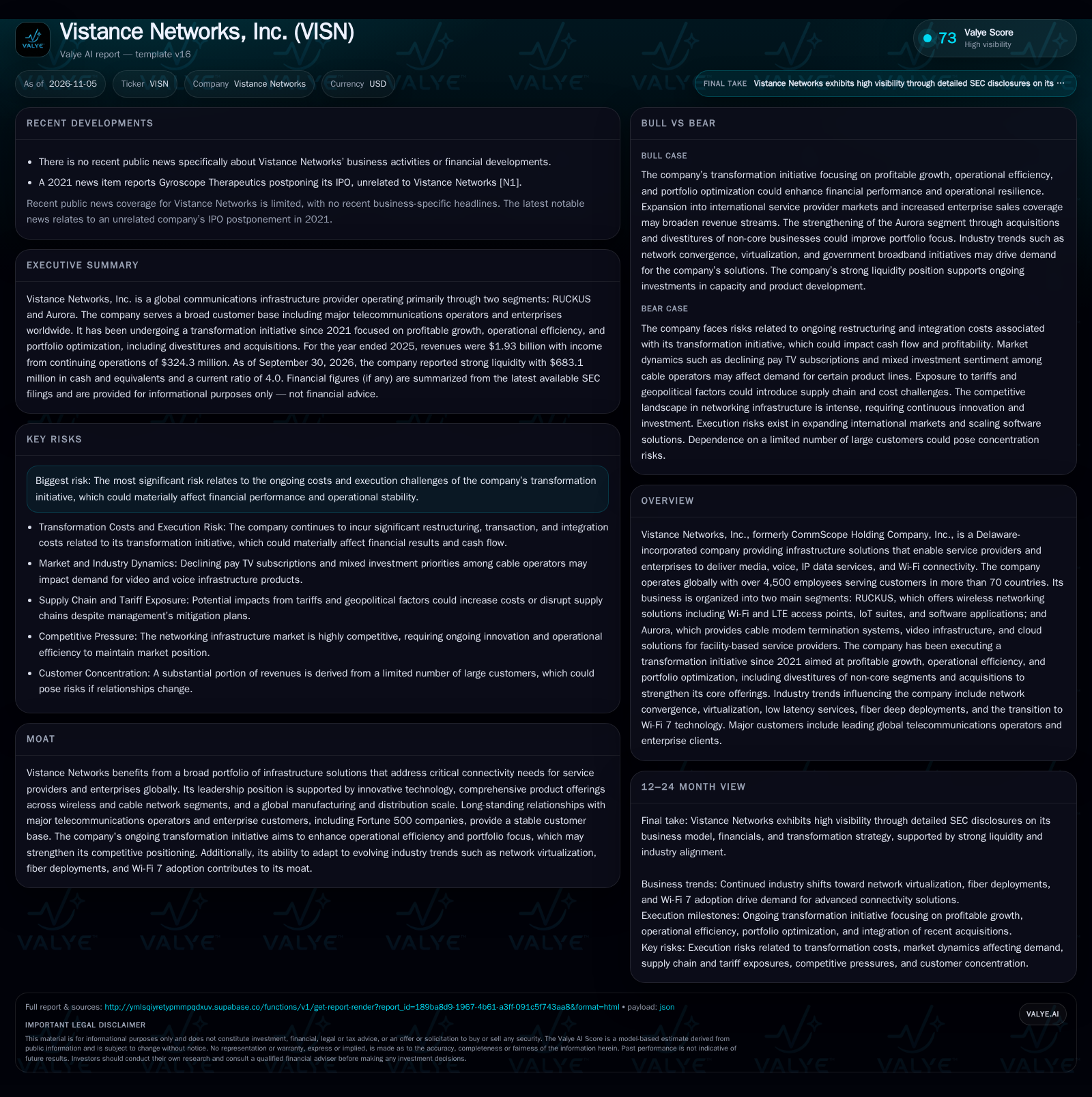
Vistance Networks has emerged from a sweeping transformation with $1.93 billion in 2025 revenue and $324.3 million in income from continuing operations, backed by $683.1 million in cash as of Q3 2026. The company’s focus is now on scaling its RUCKUS and Aurora segments, expanding internationally, and leveraging industry tailwinds like network virtualization and Wi-Fi 7. Execution risks remain around restructuring, customer concentration, and the need for continued innovation in a highly competitive infrastructure market. [S2]
Vistance Networks, Inc. has undergone a significant metamorphosis since 2021, refocusing its business through divestitures, targeted acquisitions, and a sharpened emphasis on core connectivity infrastructure. With $1.93 billion in 2025 revenue and a robust Q3 2026 balance sheet, the company is positioned to ride industry trends like virtualization, fiber deepening, and Wi-Fi 7 adoption. Yet, as it seeks to expand internationally and deepen enterprise penetration, Vistance must navigate the lingering costs and execution risks of its transformation, a demanding competitive field, and evolving customer needs. The next phase will test whether its leaner portfolio and operational focus can deliver durable growth and margins in a rapidly changing network landscape. [S2]
Transformation Yields Focused Portfolio and Strong Reported Earnings
Vistance Networks recently completed a multi-year transformation, divesting several non-core segments—including CCS, OWN, DAS, OneCell, and Home—while acquiring Casa Systems assets to strengthen its Aurora segment. For the year ended December 31, 2025, the company reported $1.93 billion in revenues and $324.3 million in income from continuing operations. In the quarter ended September 30, 2026, net income was $1.03 billion, with a cash balance of $683.1 million and a current ratio of 4.0. These results reflect progress in portfolio optimization and operational efficiency, providing the company with the financial resources to pursue further investment and expansion. The transformation has positioned Vistance as a more focused provider of infrastructure solutions for service providers and enterprises, with a global customer base spanning over 70 countries. [S2]
How Vistance Networks’ Revenue Model Faces Shifting Industry Economics
Vistance Networks generates revenue through the sale of hardware, integrated systems, and, increasingly, software and cloud-based solutions across its RUCKUS and Aurora segments. The RUCKUS segment addresses enterprise and service provider needs for indoor/outdoor Wi-Fi, LTE access points, and networking software, while Aurora focuses on cable modem termination systems, video infrastructure, and cloud-managed solutions for facility-based operators. Revenue mix is likely influenced by large, lumpy orders from major telecom and cable customers, with some recurring revenue potential from software, support, and cloud services—though the report does not specify contract structures.
Gross margins in infrastructure businesses tend to be under pressure from hardware commoditization, but Vistance’s operational efficiency drive and portfolio shift may help defend margins if software and cloud solutions scale. Operating leverage could materialize if revenue growth in higher-margin segments outpaces fixed cost increases, but ongoing restructuring and integration costs remain a drag. The company’s ability to transition from hardware-centric sales to greater software and services adoption will be pivotal for long-term margin improvement.
Competitive Edge in a Crowded, Evolving Connectivity Market
Vistance Networks competes in a global market crowded with both legacy and emerging infrastructure providers. Its main advantages include a broad portfolio that spans wireless, cable, and cloud-managed solutions, long-standing relationships with major global telecom and enterprise customers, and a presence in over 70 countries. The divestiture of non-core businesses and acquisition of Casa Systems assets reflect a strategic focus on segments with higher growth or defensibility.
However, competitive pressures are intense. Large incumbent networking providers, regional players, and new entrants leveraging virtualization and software-defined networking are all vying for share. Customer switching costs may be moderate for hardware but higher if Vistance can deepen software integration and cloud service adoption. The rapid evolution of technologies—such as Wi-Fi 7, fiber deployments, and network virtualization—creates both opportunity and threat, as the company must continuously innovate to maintain relevance. The risk of customer concentration is material, as a substantial portion of revenue comes from a limited set of large operators, making Vistance vulnerable to shifts in their procurement or technology strategies.
If Portfolio Focus and Industry Tailwinds Drive Margin Expansion
The most favorable scenario for Vistance Networks is that its streamlined portfolio and operational discipline enable it to capture a disproportionate share of growth from global network upgrades, fiber deployments, and Wi-Fi 7 rollouts. As governments and service providers invest in broadband expansion and low-latency services, Vistance could see sustained demand for both its hardware and emerging software/cloud solutions.
Confirmation would come from sustained revenue growth in international markets, a rising mix of software/cloud sales (if disclosed), and evidence of margin expansion as higher-value offerings scale. An expanding backlog of orders for next-generation products, successful integration of acquired assets, and growing enterprise penetration would further validate the scenario. Falsification would be seen if reported margins stagnate or decline, new product launches fail to gain traction, or international expansion stalls despite industry growth.
Steady Progress Amid Industry Shifts and Execution Demands
A plausible middle path is that Vistance maintains steady revenue growth and profitability by serving both telecom operators and enterprise customers with a balanced mix of hardware and incremental software/cloud solutions. The company benefits from ongoing industry trends—network convergence, fiber deepening, and virtualization—but faces offsetting pressures from competitive pricing, customer concentration, and the need for continuous investment in product development.
In this scenario, restructuring and integration costs persist into the medium term but are offset by operational efficiencies and portfolio optimization. Revenue gains are tempered by customer churn or slower-than-expected adoption of new technologies. Confirmation would include stable gross margins, moderate top-line growth, and successful execution of new product launches. Falsification would occur if restructuring costs consistently outpace savings, or if customer loss or competitive displacement erodes the revenue base.
When Transformation Costs and Market Headwinds Overwhelm Growth
The adverse scenario materializes if the ongoing costs and complexities of transformation erode profitability and cash flow, or if market dynamics—such as a sharp decline in pay TV subscriptions or reduced operator infrastructure spending—undercut demand for key product lines. Customer concentration risk could crystallize if a major telecom or cable customer shifts spend to a competitor or in-house solution, leading to a significant revenue gap.
Confirmation would be seen in rising restructuring charges, declining cash balances despite reported liquidity, or the need for additional financing. Substantial margin compression, loss of major contracts, or failure to keep pace with technological change (e.g., lagging in Wi-Fi 7 or virtualization offerings) would further validate the downside. Falsification would be evident if the company sustains profitability and cash generation despite restructuring, or if new customer wins offset any major losses.
Milestones That Will Shape Vistance Networks’ Next Chapter
Revenue mix between hardware, software, and cloud solutions—if disclosed—would clarify the margin trajectory and recurring revenue potential.
Gross margin trends and segment-level profitability, especially as new products and international sales scale.
Progress on international market expansion, including customer wins and growth outside North America.
Magnitude and duration of restructuring and integration costs, and whether they taper as the transformation matures.
Customer concentration metrics—such as the percentage of revenue from top customers or any disclosed contract wins/losses—that could impact revenue stability.
Adoption rates for new technologies (e.g., Wi-Fi 7, virtualization, fiber deep deployments) and Vistance’s share of these upgrade cycles.
Working capital and inventory management efficiency, especially as supply chain or demand volatility persists.
Any updates on backlog, order book, or pipeline for high-demand products, if disclosed, to gauge forward visibility.
Disclaimer: This is research-only, informational analysis and not investment advice. It may include AI-generated interpretation and general industry context. Always verify important details using primary sources.

Comments