
Acadian Asset Management: Systematic Investing, Asset Flows, and the Realities of Fee-Based Volatility
As Acadian Asset Management leans into systematic strategies and profit-sharing to attract institutional capital, the firm’s fortunes remain tied to the ebbs and flows of global markets. With significant operational momentum and a disciplined capital return program, the question is whether product breadth and talent alignment can offset the inherent cyclicality of asset-based revenues.
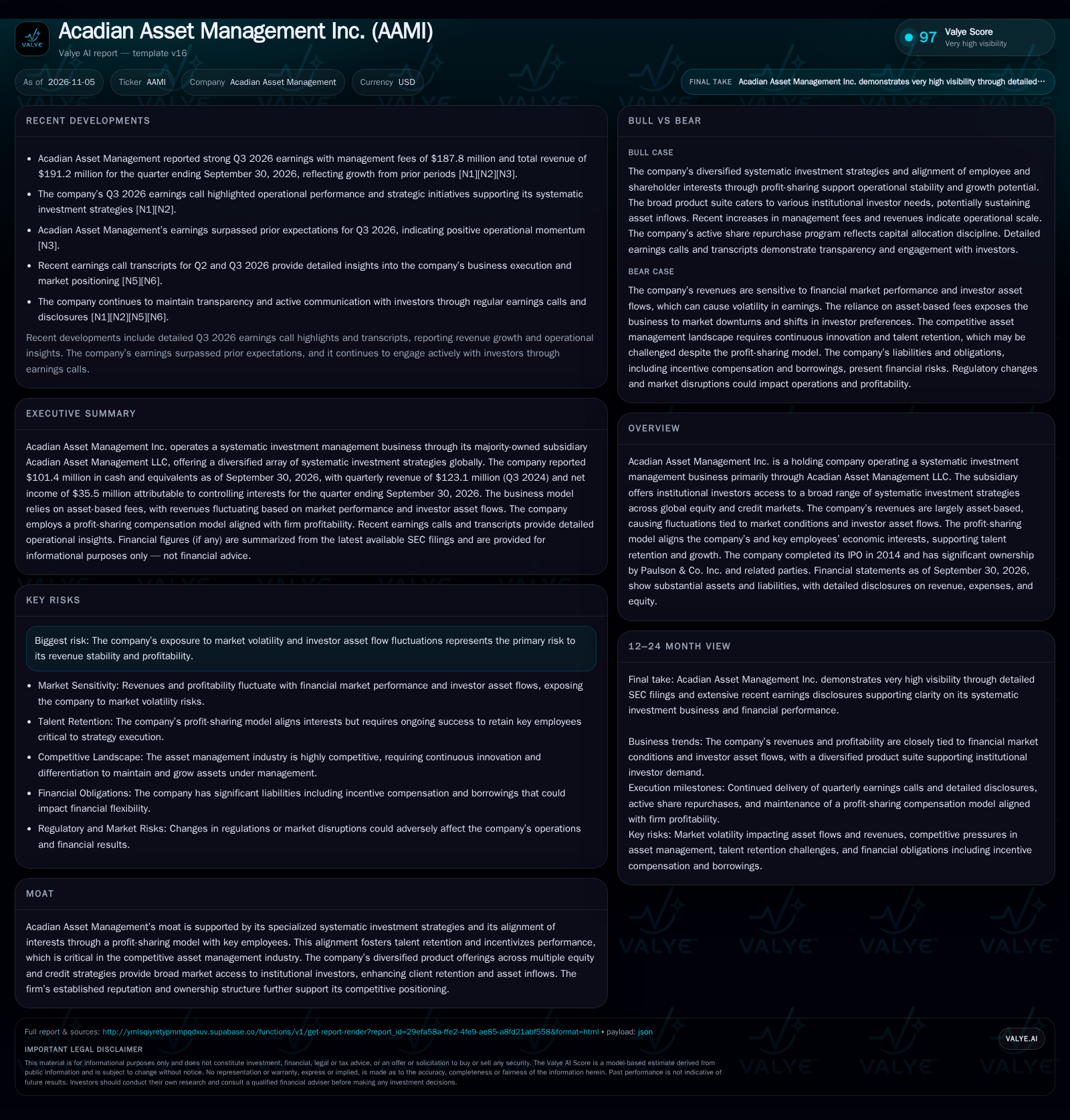
Acadian Asset Management’s Q3 2026 results highlight strong operating income, robust communication with investors, and ongoing share repurchases. The firm’s systematic investment platform, broad product suite, and profit-sharing model help attract and retain institutional clients, but revenue volatility remains tied to market swings and investor flows. The challenge is whether Acadian’s diversification and alignment mechanisms can buffer the business against industry-wide fee pressures and market downturns. [S2] [N1] [N2] [N3]
Acadian Asset Management Inc. enters late 2026 with tangible operational momentum and a deliberate approach to capital allocation, as evidenced by its Q3 earnings beat and active share repurchases. The firm’s core business—systematic investment strategies for institutional clients—offers global diversification and a profit-sharing model designed to attract and retain top talent. Yet, Acadian’s reliance on asset-based fees means its revenues and earnings remain exposed to the unpredictable tides of global markets and investor sentiment. The central question is whether the company’s product breadth, incentive alignment, and transparency can sustainably counterbalance the industry’s fee compression and cyclical volatility.
Recent Performance Signals Operational Strength, but Market Sensitivity Endures
Acadian Asset Management reported operating income of $50.5 million for Q3 2026, supported by cash and cash equivalents of $101.4 million as of September 30, 2026. The company’s total assets stood at $899.1 million, with liabilities of $698.6 million and equity plus redeemable non-controlling interests totaling $200.5 million. During the first nine months of 2026, Acadian repurchased 246,314 shares for $15.3 million, retiring all repurchased shares. Paulson & Co. Inc. and affiliates maintained a 16.5% ownership stake at quarter-end. These figures highlight both near-term operational effectiveness and a commitment to capital return, while also underscoring the company’s continued exposure to asset-based revenue volatility tied to market conditions and investor flows. [S2]
How Asset-Based Fees and Profit-Sharing Shape Acadian’s Earnings Profile
Acadian’s core revenue engine is asset-based fees generated from institutional clients across a spectrum of systematic strategies. This model delivers operating leverage when markets and net flows are positive, as incremental assets typically require limited additional fixed costs. However, this same structure amplifies downside risk during market drawdowns or periods of net outflows, as revenues can decline more rapidly than expenses can adjust—especially with fixed compensation and infrastructure costs.
The company’s profit-sharing compensation plan ties employee pay directly to firm profitability, aiming to align incentives and control fixed costs. In theory, this should help Acadian flex its cost base downward in tougher years, though the efficacy of such models often depends on the depth of cost cuts and the ability to retain critical talent through cycles.
Capital requirements in asset management are relatively modest compared to other financial services, but seed investments, technology upgrades, and regulatory compliance can create episodic funding needs. Acadian’s active share repurchase program suggests confidence in free cash generation, but as with peers, the sustainability of distributions depends on stable asset levels and fee rates.
Systematic Strategies, Product Breadth, and the Battle for Institutional Mandates
Acadian’s competitive positioning is built on its diversified suite of systematic strategies—including global and emerging equities, systematic credit, and alternatives—targeted at institutional investors. This breadth may help buffer the firm from single-strategy downturns and enables cross-selling opportunities with existing clients.
However, the systematic and quantitative investing space is crowded, with established competitors ranging from independent quant boutiques to large multinational asset managers with in-house quant teams. Fee compression and the commoditization of some quantitative approaches have raised the stakes for innovation and differentiation. Acadian’s reputation, long history, and alignment of interests through profit-sharing may support client and talent retention, but persistent outperformance and ongoing product innovation are essential to defend against client churn and margin erosion.
Switching costs for institutional clients can be moderate—driven more by perceived manager skill, operational reliability, and relationship depth than by technical or contractual lock-ins. Acadian’s challenge is to maintain a performance and service edge that keeps mandates sticky in an era of rising transparency and demanding procurement processes.
When Diversification and Incentive Alignment Drive Sustained Inflows
A favorable outcome for Acadian would see global markets remain resilient, with institutional appetite for systematic and alternative strategies continuing to grow. In this environment, Acadian’s broad platform could attract steady net inflows, supporting operating leverage and enabling reinvestment in technology and talent.
Evidence confirming this scenario would include multi-quarter trends of rising assets under management (AUM) across multiple product lines, sustained or rising fee rates, and expansion into new geographies or investor segments. Continued low turnover among key investment professionals and visible client wins would also strengthen the case. If disclosed, metrics such as net inflows, mandate wins by channel, and client retention rates would provide concrete support for this trajectory.
Navigating Market Cycles with Product Breadth but Enduring Fee Pressure
The most plausible trajectory for Acadian is one of cyclical but stable progression: asset-based revenues fluctuate in line with market performance and investor sentiment, while the firm’s diversified strategies provide some insulation from single-factor shocks. Fee compression and competitive intensity remain ongoing challenges, offset in part by product expansion and operational discipline.
In this scenario, Acadian maintains profitability through a mix of stable legacy mandates, selective new business wins, and disciplined cost management enabled by its profit-sharing model. Quarterly operating income may oscillate, but the firm avoids material erosion of its client base or fee structure. Confirmation would come from relatively stable AUM, consistent operating margins, and continued share repurchases. Early warning signs would include sustained net outflows, declining fee rates, or high turnover among senior staff.
Market Shocks and Outflows Expose the Fragility of Fee-Linked Revenues
A negative scenario would unfold if global equity and credit markets experience a material downturn, triggering net outflows from institutional clients and compressing Acadian’s AUM. Asset-based fees would decline, potentially at a faster rate than costs can be adjusted, pressuring profitability and curtailing capital return programs.
Additional risk comes from a loss of key investment professionals, either due to insufficient incentive alignment or poaching by competitors, which could further destabilize client relationships. Regulatory changes or reputational events could also amplify outflows. Concrete evidence for this scenario would be reported net outflows, a sharp drop in operating income, or announcements of significant client or personnel losses. If disclosed, reductions in share repurchases or dividend suspensions would further corroborate a stress scenario.
What Will Determine Acadian’s Resilience in the Face of Asset Management Cyclicality?
Trends in assets under management (AUM) by strategy and geography—if disclosed—would provide direct evidence of Acadian’s market position and the stickiness of institutional mandates.
Net inflows/outflows by quarter would clarify whether product breadth is translating into durable client demand or if market volatility is driving redemptions.
Fee rate changes, especially in core systematic strategies, would help test the thesis around pricing power versus industry-wide fee compression.
Operating income margin trends—if disclosed—would reveal the effectiveness of the profit-sharing model in flexing costs through market cycles.
Share repurchase activity in future quarters, including dollar amounts and share counts, would indicate ongoing capital return discipline and management’s confidence in free cash flow.
Retention rates for key investment professionals and senior leadership, if disclosed or discussed in earnings calls, would shed light on talent risk and organizational stability.
Any disclosed client wins, mandate extensions, or losses in earnings transcripts or filings would provide tangible signals of competitive positioning and client satisfaction.
Disclaimer: This is research-only, informational analysis and not investment advice. It may include AI-generated interpretation and general industry context. Always verify important details using primary sources.

Comments