
Pyxis Oncology: ADC Ambitions, Clinical Milestones, and the Stakes of Capital Allocation in Head and Neck Cancer
With a novel antibody-drug conjugate targeting a distinct tumor microenvironment marker and fresh capital from a major offering, Pyxis Oncology is at a clinical and strategic crossroads. The company’s ability to translate early promise in recurrent/metastatic head and neck cancer into durable value will hinge on trial outcomes, partnership dynamics, and execution in a crowded, high-stakes oncology landscape.
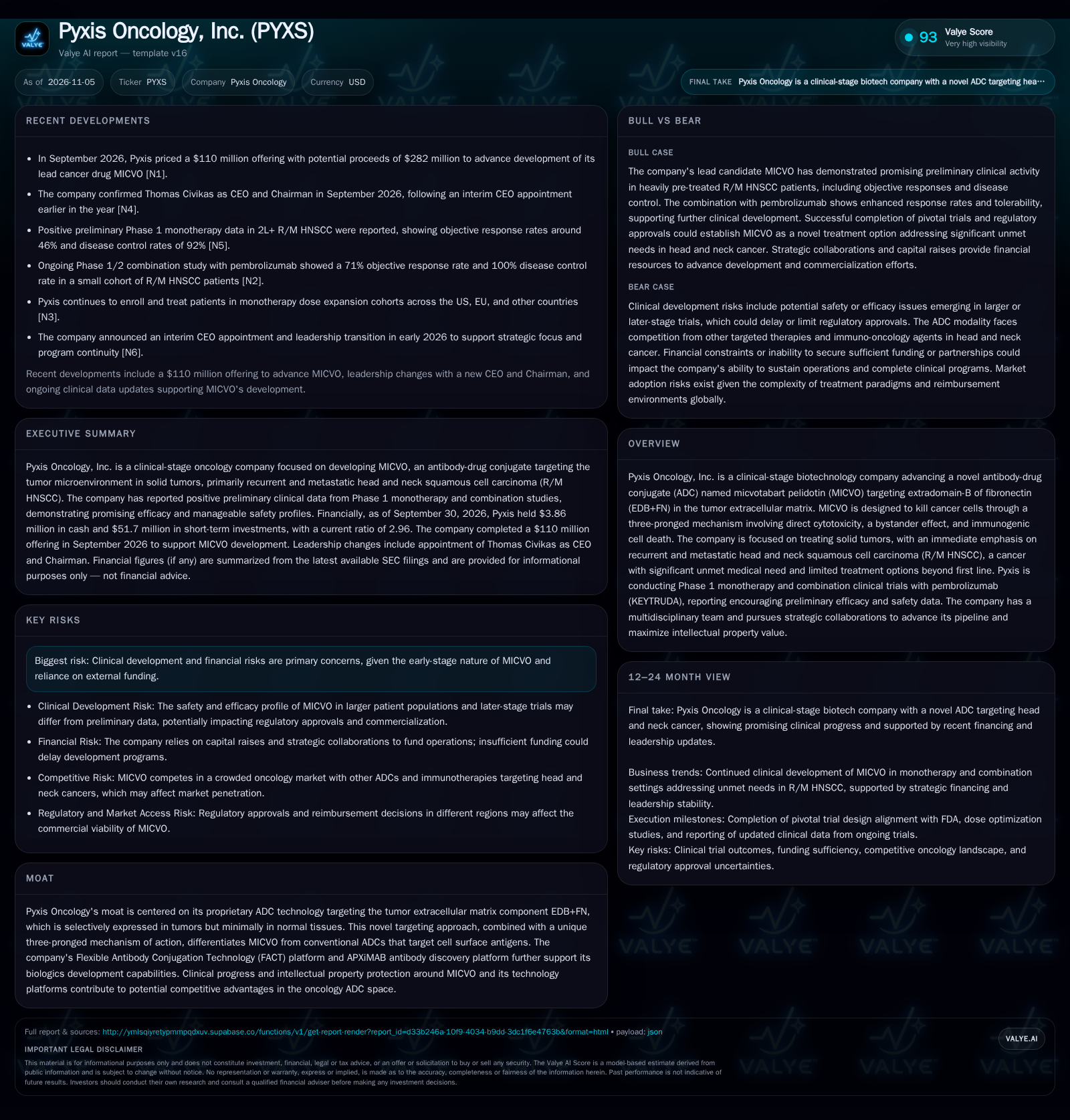
Pyxis Oncology is advancing MICVO, a novel ADC targeting EDB+FN for difficult-to-treat head and neck cancers. A recent $110 million offering and leadership stabilization position the company to pursue pivotal clinical milestones, but long-term value will depend on clinical differentiation, competitive dynamics, and prudent capital deployment in an environment where ADCs face both opportunity and risk. [S2] [N1] [N4]
Pyxis Oncology stands at a pivotal moment as it advances micvotabart pelidotin (MICVO), a next-generation antibody-drug conjugate targeting the extradomain-B of fibronectin in the tumor microenvironment—a departure from conventional cell-surface ADC targets. With a fresh $110 million capital infusion and new leadership in place, the company is poised to accelerate clinical development in recurrent/metastatic head and neck squamous cell carcinoma (R/M HNSCC), a disease area with persistent unmet need. Yet, as the clinical-stage biotech landscape grows more crowded and capital-intensive, Pyxis must not only generate compelling clinical data but also navigate the intricate economics and competitive pressures of modern oncology drug development. [S2] [N1] [N4]
Recent Capital Raise and Leadership Reset Shape Pyxis Oncology’s Near-Term Trajectory
Pyxis Oncology’s most material recent developments include a $110 million offering priced in September 2026, with potential proceeds up to $282 million, aimed squarely at advancing its lead ADC, MICVO, through clinical development in R/M HNSCC and potentially other solid tumors. This capital injection significantly bolsters the company’s resources, supplementing a previously reported $3.86 million in cash and $51.7 million in short-term investments as of September 30, 2026. Concurrently, the company formalized its leadership with the confirmation of Thomas Civikas as CEO and Chairman, following an interim period earlier in the year. These moves set the operational and financial foundation for the next phase of Pyxis’s clinical and strategic execution. [S2] [N1] [N4]
On the clinical front, MICVO continues to enroll and treat patients in U.S. and international expansion cohorts. The company remains focused on recurrent and metastatic head and neck squamous cell carcinoma, a high-need oncology segment where current options are limited beyond first-line therapy and outcomes remain poor. [N3] [S2]
ADC Economics: Capital Intensity, Operating Leverage, and the Path to Value Creation
The economics of antibody-drug conjugate (ADC) development are fundamentally shaped by high upfront R&D costs, lengthy clinical timelines, and binary risk around pivotal trial outcomes and regulatory decisions. Pyxis’s near-term financial profile—net loss of $19.98 million for the first nine months of 2026 and a cash ratio of 2.79—reflects the cash burn typical of a clinical-stage biotech before revenue generation. [S2]
If MICVO demonstrates compelling efficacy and safety, the commercial opportunity could be significant, particularly given the high unmet need in R/M HNSCC. Pricing for novel ADCs in oncology can be robust, especially for therapies demonstrating survival benefit in underserved indications. However, the ultimate revenue potential is constrained by the size of the addressable patient pool, payer willingness to reimburse, and the competitive mix of approved and emerging therapies.
Operating leverage is achievable if MICVO progresses to approval and commercialization, as fixed R&D costs would be amortized over future sales. However, further clinical investment, potential manufacturing scale-up, and commercialization buildouts will require careful capital allocation. Pyxis’s stated pursuit of partnerships suggests an intent to share risk and potentially access broader commercial infrastructure, but such deals often dilute economics and may impose milestone-driven funding triggers.
Differentiation in a Crowded Oncology ADC Field: Moat or Mirage?
Pyxis Oncology’s core proposition rests on the premise that targeting EDB+FN—a component of the tumor extracellular matrix—offers a novel and potentially more selective approach than ADCs directed at cell-surface antigens. This could theoretically allow MICVO to attack cancer cells and disrupt the tumor microenvironment with reduced off-target toxicity, leveraging direct cytotoxicity, bystander effects, and immunogenic cell death.
However, the competitive landscape for ADCs in solid tumors is intense. Numerous biotech and pharma companies are advancing ADCs and other targeted modalities for head and neck cancers, including immunotherapies (e.g., anti-PD-1 agents), alternative ADC platforms, and next-generation antibody formats. Larger incumbents may have commercial scale, deeper pipelines, and established relationships with oncologists and payers.
Pyxis’s FACT and APXiMAB platforms offer potential for pipeline expansion and IP protection, but the real test will be clinical differentiation—showing that MICVO can improve outcomes where current agents do not. Should other ADCs or immunotherapies demonstrate superior efficacy, safety, or convenience, Pyxis may struggle to gain traction in a market where switching costs are low and payer scrutiny is high.
If MICVO Delivers Clear Clinical Benefit, Pyxis Could Attract Partnerships and Accelerate Market Entry
The favorable scenario for Pyxis Oncology envisions MICVO demonstrating statistically and clinically meaningful efficacy in pivotal R/M HNSCC trials, with a differentiated safety profile versus existing standards. This could drive regulatory alignment, fast-track designations, and strong interest from commercial partners or acquirers seeking exposure to novel ADC mechanisms.
Confirmation would come from robust, peer-reviewed clinical data showing durable objective responses, improved progression-free or overall survival, and tolerability in both monotherapy and combination settings. Additional evidence would include the announcement of strategic partnerships, licensing deals, or co-development agreements—validating both the science and the commercial potential.
In this scenario, Pyxis could leverage its expanded capital base to accelerate pipeline progression, invest in manufacturing capabilities, and expand into additional tumor types. Rapid value creation would depend on maintaining first-mover advantage, securing IP, and navigating regulatory milestones without major delays or setbacks.
Most Likely Outcome: Incremental Progress Amid Clinical, Financial, and Competitive Uncertainties
The most plausible trajectory for Pyxis Oncology is measured clinical progress, punctuated by the typical volatility of early-stage oncology development. MICVO is likely to advance through ongoing dose expansion and combination cohorts, generating interim data readouts that inform pivotal trial design and partnership discussions.
Evidence confirming this scenario would include timely enrollment updates, target engagement and safety data, and regulatory feedback supporting continued development. Financially, the recent $110 million offering provides an extended runway, but further capital raises or partnership inflows will likely be required before commercialization.
Risks remain substantial: clinical setbacks (e.g., unexpected toxicities, lack of efficacy), delays in trial execution, or unfavorable competitive readouts could dampen momentum. The company’s ability to convert scientific promise into sustainable value will depend on execution, capital discipline, and adaptability to evolving competitive and regulatory landscapes.
Clinical or Funding Setbacks Could Force Restructuring or Strategic Alternatives
A negative scenario would be triggered if MICVO fails to meet efficacy or safety endpoints in ongoing or pivotal trials, particularly if adverse events or lack of differentiation become evident as the patient pool broadens. Such outcomes would jeopardize both regulatory prospects and the company’s ability to attract partners or acquirers.
Confirmation of this downside could come from early clinical discontinuations, material adverse safety signals, or public disclosures of trial delays, enrollment challenges, or capital constraints. In this scenario, Pyxis may be forced to restructure, shelve pipeline programs, or seek strategic alternatives (including asset sales or M&A at distressed valuations).
Given the capital-intensive nature of ADC development and the company’s reliance on external funding, an inability to secure additional financing—particularly after a clinical setback—would accelerate strategic review and, potentially, value destruction for existing stakeholders.
Milestones and External Factors That Will Define Pyxis Oncology’s Next Chapter
Interim and pivotal clinical readouts for MICVO in R/M HNSCC, especially objective response rates, progression-free survival, and safety/tolerability data, will be decisive.
Updates on patient enrollment pace and geographic expansion of ongoing dose expansion cohorts will indicate execution strength and trial feasibility.
Announcements of regulatory interactions (e.g., FDA meetings, fast-track or breakthrough designations) would validate the clinical path and potential for accelerated approval.
Evidence of strategic collaborations, licensing deals, or co-development partnerships would demonstrate external validation and risk-sharing.
Cash burn rate and updated guidance on financial runway, especially in light of the recent $110 million offering, will be critical for assessing funding sufficiency.
Competitive developments in the ADC and immunotherapy landscape for head and neck cancers—such as new approvals or positive late-stage data—could reshape the market opportunity.
Patent updates, IP litigation, or disclosures regarding the FACT/APXiMAB platforms would clarify the durability of Pyxis’s technological moat.
Disclaimer: This is research-only, informational analysis and not investment advice. It may include AI-generated interpretation and general industry context. Always verify important details using primary sources.

Comments