
Palvella Therapeutics: Late-Stage Pipeline, Rare Disease Focus, and the Stakes of Clinical Execution
Palvella Therapeutics’ substantial cash reserves and expanded rare disease pipeline set the stage for a pivotal transition, but the company’s continued net losses underscore its dependence on regulatory milestones and future product launches to unlock commercial viability.
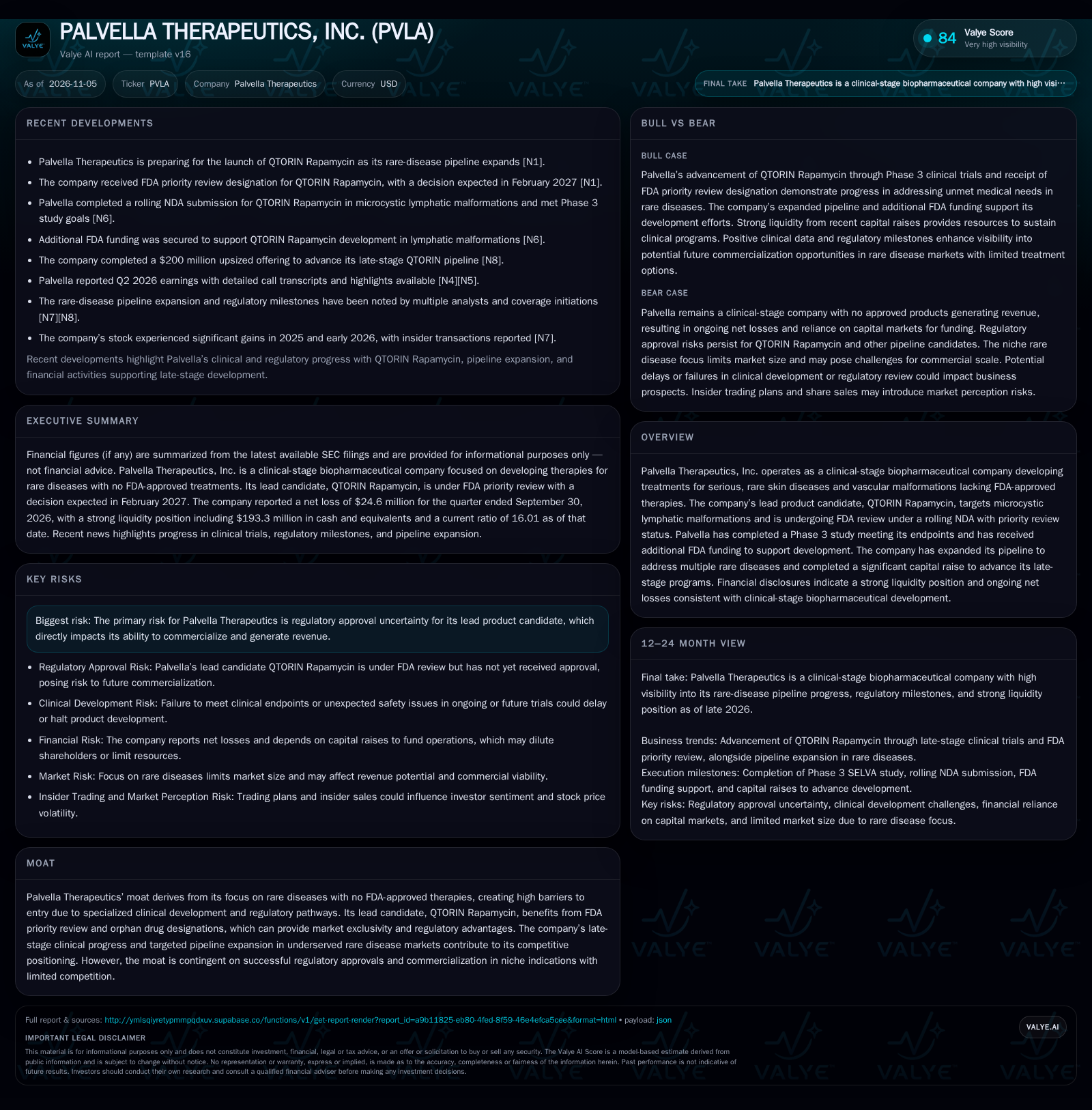
Palvella Therapeutics is advancing a late-stage rare disease pipeline led by QTORIN Rapamycin, supported by a recent $200 million capital raise and a reported liquidity position. As of September 2026, the company reported $193.3 million in cash and equivalents but remains pre-revenue with ongoing net losses. The next phase hinges on successful regulatory outcomes and the ability to translate clinical advances into commercial traction. [S2] [N1] [N8]
Palvella Therapeutics stands at a critical juncture as it advances its late-stage rare disease pipeline, highlighted by the QTORIN Rapamycin program targeting microcystic lymphatic malformations and other underserved indications. However, with no approved products and persistent net losses, Palvella’s future increasingly hinges on the successful transition from clinical promise to market execution, where rare disease economics and the realities of niche market commercialization will be tested.
Pipeline Expansion and Financial Position Define Palvella’s 2026 Landscape
Palvella Therapeutics has expanded its rare disease pipeline beyond QTORIN Rapamycin and is preparing for a potential launch as late-stage clinical programs progress. The company completed a $200 million upsized offering in 2026, significantly strengthening its balance sheet. As of September 30, 2026, Palvella reported $193.3 million in cash and cash equivalents, $43.4 million in short-term investments, and a current ratio of 16.01, reflecting a reported liquidity position. However, Palvella remains a pre-commercial, clinical-stage biopharmaceutical company, reporting a net loss of $24.6 million for the quarter and continuing to depend on external capital to fund operations. Regulatory approval for QTORIN Rapamycin in multiple rare indications will be the near-term catalyst for commercial transformation. [S2] [N1] [N8]
Commercialization Pathways and the Economics of Rare Disease Therapeutics
Palvella’s economic model is currently rooted in R&D investment, with no product revenue to offset operating expenses. The company’s long-term revenue potential is tied to successful approval and commercialization of QTORIN Rapamycin and subsequent pipeline assets. In rare disease therapeutics, pricing power is often substantial—driven by high unmet need, limited alternatives, and regulatory incentives such as orphan drug exclusivity. However, the addressable patient pool for each indication is inherently small, necessitating high per-patient pricing to achieve commercial viability.
Fixed costs are dominated by clinical development, regulatory, and public company expenses. If commercialization is achieved, variable costs—such as manufacturing, specialty distribution, and targeted sales—could remain modest relative to revenue, supporting attractive gross margins typical in orphan indications. This model can deliver substantial operating leverage if even a modest patient population is captured, but the flip side is that any delay, failure to secure approval, or slow uptake directly threatens sustainability. The capital-intensive nature of late-stage development means Palvella’s current reported cash balance is essential, but further capital needs could arise if timelines slip or pipeline breadth expands unexpectedly.
Assessing Moat Potential: Orphan Exclusivity, Pipeline Breadth, and Competitive Pressures
Palvella’s competitive posture in rare dermatologic and vascular diseases is shaped by several factors. Orphan drug development offers the possibility of regulatory exclusivity (typically seven years in the U.S.), which can protect pricing and market share in the absence of direct competition. The QTORIN platform’s targeting of indications with few or no approved therapies further reduces immediate competitive pressure and may enable first-mover advantages.
However, the rare disease ecosystem is increasingly attractive to both established and emerging biopharmaceutical players, resulting in a steady flow of pipeline entrants and potential substitutes. The risk of off-label use of existing therapies, as well as future entrants leveraging novel modalities (e.g., gene editing, RNA therapeutics), cannot be discounted. Additionally, while Palvella’s pipeline breadth has expanded, commercial success will depend on the ability to secure payer coverage and physician adoption in tightly defined specialty markets. The company’s moat is thus contingent on regulatory outcomes, clinical differentiation, and execution in a complex, evolving competitive landscape.
Accelerated Approvals and Niche Market Penetration Could Drive Disproportionate Value Creation
If Palvella secures timely FDA approval for QTORIN Rapamycin in multiple rare disease indications, and launches are met with rapid physician adoption and favorable payer coverage, the company could achieve outsized revenue and margin expansion relative to its cost base. Early uptake in microcystic lymphatic malformations and related disorders would validate the platform and provide a template for subsequent pipeline assets, potentially supporting premium pricing and expansion into adjacent rare indications.
Evidence for this scenario would include positive regulatory decisions, robust initial demand signals (e.g., patient enrollment or prescription rates, if disclosed), and clear communication of coverage decisions by major payers. A rapid ramp in specialty pharmacy distribution and the announcement of additional pipeline expansions or partnerships would further support this trajectory. The upside is amplified by the high fixed-cost leverage inherent in rare disease models—modest sales volumes can translate to significant profitability if commercial execution is strong.
Navigating Clinical, Regulatory, and Commercial Hurdles in a Crowded Orphan Landscape
The most plausible scenario is that Palvella advances QTORIN Rapamycin through the regulatory process and obtains approval for at least one initial indication, with launch occurring in a competitive, reimbursement-sensitive environment. Uptake may be gradual as the company builds clinical awareness, negotiates with payers, and addresses barriers to patient identification and treatment initiation. Revenues may begin to offset development expenses, but meaningful profitability could lag as commercial infrastructure is built out and additional pipeline assets are advanced.
Confirmation of this scenario would come from timely regulatory filings and approvals, measured but positive initial sales figures (if disclosed), and evidence of managed cash burn consistent with a staged commercial build. Falsification would be signaled by regulatory setbacks, persistent delays in launch, or difficulty securing payer reimbursement and patient access.
Regulatory or Clinical Setbacks Could Reignite Funding Pressure and Test Pipeline Optionality
Should Palvella encounter regulatory delays, negative clinical data, or safety concerns in late-stage trials, the company’s path to revenue generation would be prolonged—potentially necessitating further dilutive capital raises or pipeline reprioritization. In this scenario, the company’s reported cash position would provide only temporary insulation, as continued net losses would erode reserves and market confidence.
This outcome could be confirmed by FDA complete response letters, adverse trial readouts, or management guidance signaling extended timelines or reduced commercial expectations. Additional warning signs would include an accelerated cash burn rate, shrinking pipeline activity, or unfavorable changes in competitive dynamics (e.g., new entrants or superior therapies gaining traction). The risk of market size overestimation, payer pushback on pricing, or limited physician adoption would further compound downside pressure.
Milestones That Will Determine Whether Palvella’s Model Can Deliver on Its Clinical Promise
The timing and outcome of FDA regulatory decisions for QTORIN Rapamycin in microcystic lymphatic malformations and other lead indications.
Initial prescription rates and patient uptake in the first 12 months post-launch, if disclosed.
Updates on payer coverage and reimbursement negotiations for QTORIN Rapamycin and future pipeline assets.
Cash burn trajectory and quarterly net loss figures, especially as commercial infrastructure investments ramp up.
Pipeline progress updates, including advancement of QTORIN pitavastatin and any new IND-enabling programs.
Clinical data releases or conference presentations that could influence physician and investor perception of clinical benefit.
Emergence of new competitors or alternative therapies targeting the same rare disease indications.
Disclaimer: This is research-only, informational analysis and not investment advice. It may include AI-generated interpretation and general industry context. Always verify important details using primary sources.

Comments