
Cyclerion Therapeutics: Merger, Cash Reserves, and the Stakes of CNS Drug Development
Cyclerion sits at a strategic inflection point: a cash-rich, pre-revenue CNS biotech aiming to merge with Korsana Biosciences. With no product revenue and a history of net losses, the company’s future depends on clinical execution, merger integration, and the ability to translate scientific expertise into pipeline progress amid sector volatility.
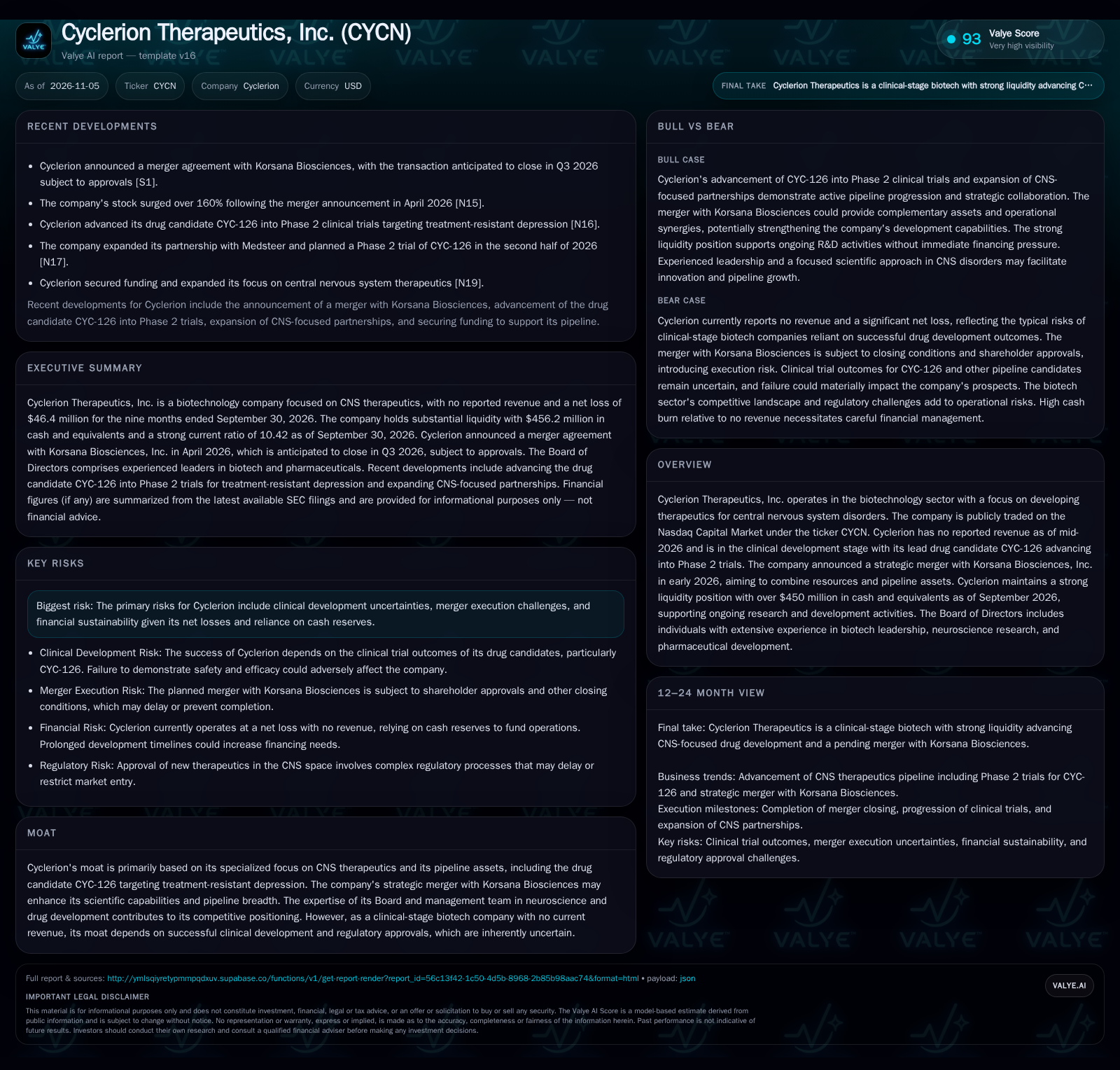
Cyclerion Therapeutics has over $450 million in cash but no revenue, and is pursuing a merger with Korsana Biosciences. The company’s next phase hinges on executing clinical milestones in central nervous system therapeutics, managing cash burn, and successfully integrating the merger to advance its pipeline.
Cyclerion Therapeutics, Inc. occupies a familiar but precarious position in the biotech value chain: flush with cash but entirely pre-revenue, it faces the dual challenge of advancing unproven CNS drug candidates while integrating a pending merger with Korsana Biosciences. As the merger approaches, investors and stakeholders must focus on clinical progress, merger integration, and the evolving economics of CNS therapeutics.
Merger, Cash Position, and the Absence of Revenue: Cyclerion’s Present Reality
Three developments define Cyclerion’s current context: a substantial cash reserve of $456.2 million as of September 30, 2026; a complete lack of revenue year-to-date; and the announced merger with Korsana Biosciences, expected to close in Q3 2026 subject to approvals [S1] [S2]. The company reported a net loss of $46.4 million for the first nine months of 2026, underscoring the persistent cash burn inherent to clinical-stage biotech operations [S2]. The pending merger signals a strategic pivot, potentially broadening the pipeline and integrating Korsana’s assets and expertise in neurodegenerative diseases. These factors collectively set the stage for a high-stakes transition: Cyclerion’s future will be shaped by its ability to deploy cash efficiently, deliver clinical milestones, and manage the risks and opportunities that come with merging two pre-commercial biotech entities.
Beyond the immediate financial and strategic considerations, the merger introduces complexities related to organizational culture and operational integration that could materially affect Cyclerion’s trajectory. The alignment of research priorities, harmonization of clinical development timelines, and consolidation of overlapping functions require disciplined project management and clear governance structures. Failure to effectively integrate Korsana’s teams and assets could lead to inefficiencies, duplicated efforts, or delays in decision-making. Conversely, a well-executed integration could unlock synergies by combining complementary expertise, accelerating candidate selection, and optimizing resource allocation across the expanded CNS portfolio.
Funding R&D on a Pre-Revenue Model: Economics and Capital Needs
Cyclerion’s economic engine is currently powered entirely by its cash reserves, with no revenue from product sales, partnerships, or royalties [S2]. The firm’s cost structure is dominated by R&D expenses—clinical trials, drug manufacturing, and regulatory preparation—alongside general and administrative costs. In this pre-commercial phase, fixed costs are relatively modest compared to the variable and milestone-driven expenses of clinical development. The company reported cash and liquidity metrics for the period; these figures do not by themselves establish operating runway, investment capacity, financial flexibility, or financing capacity. [S2] The merger with Korsana is likely to increase both the pipeline breadth and the aggregate cash burn, as the combined entity advances multiple CNS candidates, including Korsana’s KRSA-028 for Alzheimer’s disease. In the absence of licensing deals or non-dilutive funding, the company’s survival and ability to scale depend on careful portfolio prioritization, clinical success, and eventual access to commercial or partnership revenue streams.
The pre-revenue model inherently amplifies the importance of cash flow forecasting and scenario planning. With no incoming revenue streams, the company’s financial health is highly sensitive to the timing and cost of clinical milestones. Variability in patient enrollment rates, trial design modifications, or regulatory feedback can significantly alter expenditure profiles. Additionally, the potential need for future capital raises introduces dilution risk, which must be balanced against the urgency to fund high-priority programs and preserve long-term value for shareholders.
Specialization in CNS Disorders: Expertise, Differentiation, and Sector Headwinds
Cyclerion’s competitive proposition is rooted in its specialized focus on central nervous system therapeutics and the scientific expertise of its board and management team [S1]. The CNS drug market is exceptionally challenging, characterized by high failure rates, complex clinical endpoints, and a crowded landscape of large pharma and emerging biotechs. While the merger with Korsana could enhance differentiation—especially if KRSA-028’s design overcomes the limitations of prior anti-amyloid beta therapies for Alzheimer’s—the true test will be in clinical outcomes and regulatory navigation. The sector’s dynamics favor companies with breakthrough clinical data, robust intellectual property, and the ability to secure lucrative partnerships. However, the lack of current revenue and the need to demonstrate meaningful advances in notoriously difficult indications mean Cyclerion operates in a position of potential rather than established advantage.
In the CNS therapeutic space, intellectual property (IP) protection and patent life are pivotal to commercial viability. Cyclerion’s ability to secure and defend robust IP rights will influence its attractiveness to partners and investors alike. Moreover, the company must navigate the evolving regulatory environment, which increasingly emphasizes biomarker-driven patient stratification and adaptive trial designs. Success in these areas could enhance differentiation by demonstrating precision in targeting complex CNS disorders. However, the high capital intensity and protracted timelines inherent in CNS drug development mean that even differentiated candidates face substantial hurdles before reaching commercialization, underscoring the necessity of disciplined pipeline management and strategic prioritization.
How Clinical Success and Merger Synergy Could Unlock Value
The most favorable scenario for Cyclerion is a successful integration with Korsana that accelerates pipeline development and produces positive clinical data in CNS indications such as treatment-resistant depression and Alzheimer’s disease. If clinical milestones are met—such as submitting a Clinical Trial Notification (CTN) or Investigational New Drug (IND) application, enrolling patients, and achieving early proof-of-concept results—investor confidence could rise, enabling the company to attract non-dilutive funding, partnerships, or premium licensing deals. The emergence of validated therapeutic candidates could shift the company from a cash-burning R&D story to a platform with commercial optionality. Confirmation of this scenario would require clear, positive clinical trial readouts, regulatory progress, and evidence of operational integration post-merger.
Advancing the Pipeline With Measured Progress and Persistent Risks
The most plausible outcome is that Cyclerion, post-merger, advances multiple CNS candidates through early- to mid-stage clinical development, incurring continued losses but maintaining operations via its sizeable cash reserves. The combined entity may achieve incremental clinical milestones, such as initial human data for KRSA-028 and continued development of legacy Cyclerion assets, but without near-term revenue or late-stage data, the valuation remains sensitive to both scientific progress and sector sentiment. Conversely, delays in trial initiation, unexpected safety signals, or higher-than-expected expenses would signal a drift toward a less favorable trajectory.
When Clinical Setbacks and Integration Risks Accelerate Value Erosion
The most adverse outcome is a combination of clinical trial failures or significant safety concerns in the lead CNS candidates, coupled with operational disruptions or inefficiencies stemming from the merger integration. The absence of revenue magnifies the impact of negative clinical news, and sector-wide volatility could further constrain access to capital. Confirmation would come from failed or inconclusive clinical readouts, missed development milestones, rising operational costs post-merger, or any indications that the cash runway is shortening faster than anticipated.
What Will Determine Cyclerion’s Next Chapter in CNS Therapeutics?
Progression of clinical trials for lead CNS candidates, including initiation, patient enrollment, and interim data readouts—especially for KRSA-028 and CYC-126.
Timely and successful completion of the Korsana merger, including shareholder approval, regulatory clearance, and integration of teams and pipelines.
Cash burn rate and updated financial disclosures post-merger, especially if disclosed by quarter or tied to specific development milestones.
Regulatory submissions (CTN/CTA/IND) and feedback from authorities in target geographies, marking advancement toward human trials.
Ability to secure non-dilutive funding, partnerships, or licensing agreements that could extend runway or validate clinical potential.
Early safety and efficacy signals from clinical trials—any adverse events or lack of efficacy would materially impact the investment case.
Board and management changes, particularly any departures or additions with direct relevance to CNS drug development or business integration.
Disclaimer: This is research-only, informational analysis and not investment advice. It may include AI-generated interpretation and general industry context. Always verify important details using primary sources.

Comments