
Loar Holdings: Financial Strength, Analyst Optimism, and the Search for Durable Competitive Edges
Loar Holdings enters late 2026 with reported liquidity position, consistent profitability, and increased analyst attention, but limited public detail on its business model and industry specifics raises key questions about the sustainability and drivers of its performance.
Loar Holdings shows strong financial health with a substantial cash reserve and reported current ratio as of September 2026, alongside positive net income and analyst buy ratings. While earnings have exceeded expectations in recent quarters, the lack of public detail on its business model or industry focus leaves open questions about the durability of its competitive position and future growth drivers. Analyst optimism is clear, but deeper visibility into Loar’s operational mechanics and market context will be critical to assess whether its current momentum is sustainable [S2] [N3] [N6] [N7].
Loar Holdings stands out in late 2026 for its combination of financial strength and rising market attention.With a sizable cash reserve, a reported current ratio, and earnings that consistently outpace expectations, the company has attracted buy and overweight ratings from major analysts. Yet, the absence of detailed public information about its core business activities and industry focus makes it difficult to assess whether Loar’s current momentum is the product of lasting competitive advantages or more transient factors. This analysis explores the mechanisms that could underpin Loar’s economics, the scenarios that could unfold, and the concrete markers that would clarify its trajectory.
Recent Financial Outcomes Signal Strength, but Details Remain Sparse
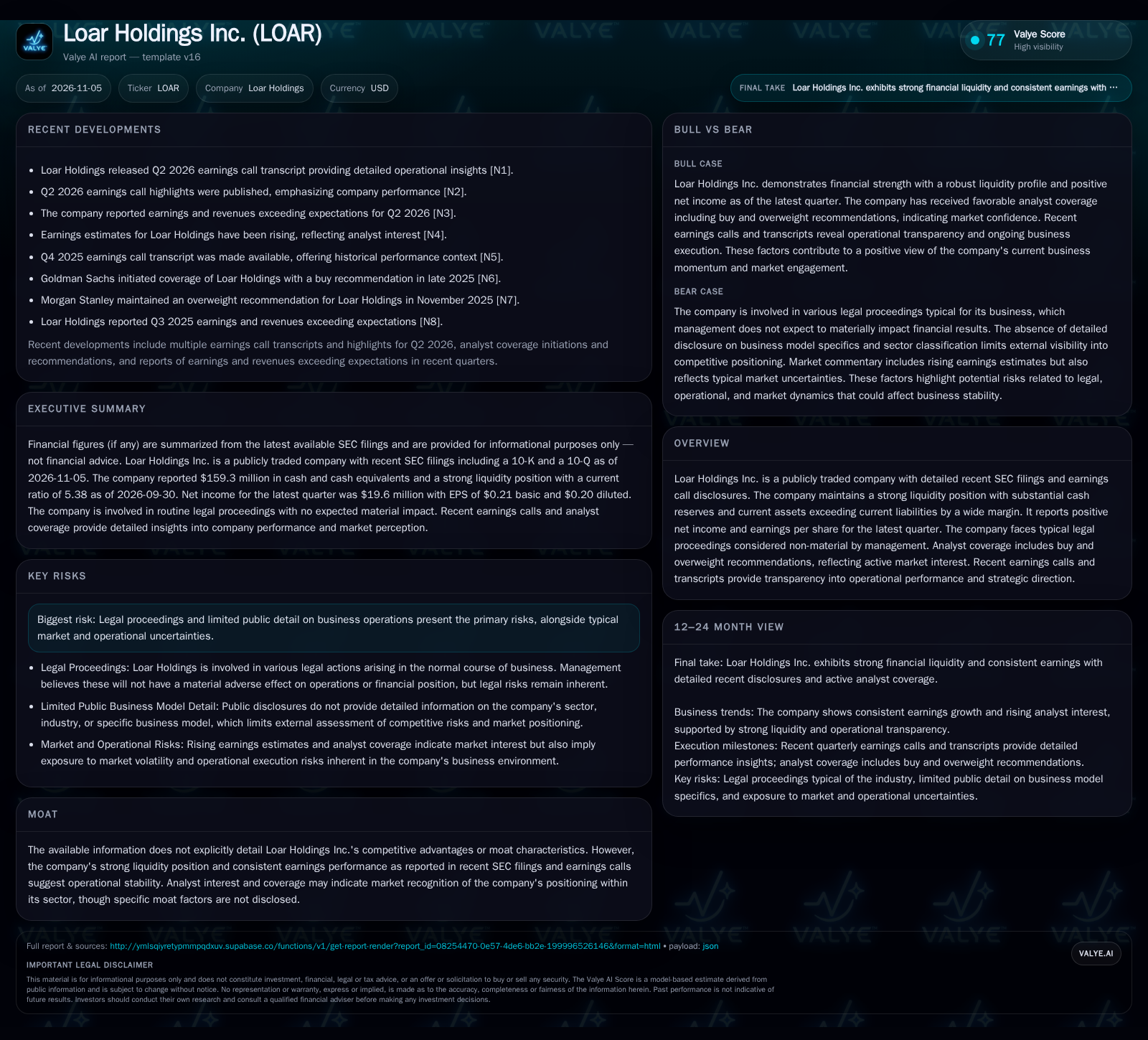
As of September 30, 2026, Loar Holdings reported $159.3 million in cash and cash equivalents, with total current assets of $417.0 million against $77.5 million in current liabilities—yielding a current ratio of 5.38 and a cash ratio of 2.06 [S2]. The company also delivered $19.6 million in net income for the latest quarter, translating to basic EPS of $0.21 and diluted EPS of $0.20 [S2]. This profitability, combined with repeated beats on earnings and revenue estimates in Q3 2025 and Q2 2026, has led to positive analyst sentiment, including buy and overweight recommendations from institutional coverage [N3] [N6] [N7].
Despite these positive financial signals, Loar’s public disclosures do not specify the sectors, industries, or core business lines that drive these results. Management asserts that ongoing legal proceedings are not material to its operational or financial health, reinforcing a picture of stability, but the lack of business-model transparency is a significant caveat for deeper thesis-building.
Profitability Drivers Depend on Unspecified Product Mix and Commercial Model
Loar Holdings’ ability to generate positive net income and maintain high liquidity suggests a business model with either healthy gross margins, disciplined cost control, or both. However, without public information on its primary sectors, revenue streams, or customer base, the underlying economics remain opaque. If Loar operates in sectors like aerospace components, industrial manufacturing, or specialized engineering (where similar financial profiles are common), its revenue could be driven by a mix of long-cycle contracts, recurring aftermarket sales, or high-value engineered products.
Pricing power would depend on the degree of product differentiation, regulatory barriers, or criticality to customer operations. High fixed-cost leverage is plausible if the company runs capital-intensive facilities, but could also mean greater sensitivity to volume swings. Alternatively, a more service- or software-heavy model would suggest lower capital needs and steadier margins. The large cash reserve and low current liabilities could indicate either prudent cash management or an anticipation of capital deployment for growth or acquisitions.
The absence of segment disclosure leaves open whether Loar’s current profitability is sustainable or vulnerable to competitive pricing, input cost inflation, or cyclical demand. Investors would benefit from clarity on product mix (OEM vs. aftermarket vs. service), revenue recognition practices, and customer concentration to better map out the company’s economic defensibility.
Assessing Moat Potential: Analyst Confidence vs. Unknown Competitive Landscape
Analyst enthusiasm, as reflected in buy and overweight recommendations, may indicate confidence in Loar’s market position, but the lack of disclosed peers or competitive context makes it difficult to assess whether this is due to true competitive advantages or simply solid execution in a favorable cycle [N6] [N7]. If Loar operates in a niche industrial, aerospace, or engineered-component market, potential moat sources could include proprietary technology, regulatory certification, entrenched customer relationships, or scale in manufacturing.
However, without explicit disclosure, it is unclear if Loar enjoys switching-cost advantages, network effects, or barriers to entry. The risk is that the company’s recent outperformance is tied to transient market demand, contract timing, or one-off operational efficiencies rather than sustainable differentiation. The legal proceedings disclosed appear routine, suggesting Loar is not embroiled in existential IP or regulatory disputes, but the absence of detailed product or market information means competitive threats from either established incumbents or new entrants cannot be fully gauged.
Structural Advantages Emerge as Loar Leverages Cash and Analyst Support
The most favorable scenario for Loar Holdings is that the company’s reported liquidity position and consistent profitability are underpinned by structural competitive advantages—such as high switching costs, proprietary technology, or regulatory barriers—that are currently underappreciated by the market due to limited disclosure. In this scenario, Loar could deploy its cash for strategic acquisitions, capacity expansion, or product innovation, reinforcing its position in a defensible market segment.
Confirmation would come from future disclosures that clarify Loar’s end markets and reveal high-margin, recurring revenue streams, or long-term contracts with blue-chip customers. Sustained earnings beats, low customer churn (if disclosed), and the announcement of multi-year contract wins would further validate the thesis. Analyst upgrades and continued buy recommendations would likely follow as visibility improves.
Falsification would occur if future filings reveal that Loar’s profitability was driven by one-off events, non-recurring gains, or exposure to commoditized, low-margin segments. A sudden decline in gross margin, increased legal or regulatory risk, or the loss of key customers would also undermine the upside scenario.
Solid Execution Delivers Stability, but Growth Hinges on Market Clarity
The most plausible outcome is that Loar Holdings continues to execute well, maintaining profitability and reported liquidity position, but without a clear, durable moat. The company benefits from management discipline and possibly favorable end-market dynamics, but its long-term growth rate remains moderate, tied to economic cycles, contract wins, and operational efficiency.
If the company gradually provides more detail on its business mix and sector focus, it may attract a broader investor base, but the absence of clear structural advantages would limit valuation expansion.
The scenario would be challenged if Loar’s results begin to show greater volatility, if analyst sentiment turns more cautious in the absence of disclosure, or if legal or operational risks escalate beyond management’s current assessment.
Opaque Operations Mask Vulnerabilities to Market or Competitive Shocks
On the downside, Loar’s lack of business-model transparency could conceal underlying vulnerabilities. The company may be benefiting from temporary demand spikes, non-recurring contract revenue, or cost deferrals that are not sustainable. If Loar is exposed to cyclical end markets—such as industrial capital goods or aerospace/defense—an industry downturn or loss of a major customer could quickly erode profitability.
Confirmation of this scenario would include a sharp decline in earnings, negative surprises in future quarters, deterioration in cash flow, or the emergence of material legal or regulatory issues previously undisclosed. Analyst downgrades and a reversal of buy/overweight ratings would likely follow. The base of support from investors could weaken rapidly if the lack of operational transparency persists and negative surprises accumulate.
If, however, subsequent disclosures reveal a more defensible and diversified business model, or if the company weathers market shocks with minimal impact, this downside thesis would be weakened.
What Will Clarify Loar Holdings’ Strategic Trajectory?
Disclosure of operating segments, end markets, or principal product lines—these details would help test the durability and diversity of Loar’s revenue base.
Gross margin trends and their drivers (if disclosed) would illuminate whether profitability is rooted in pricing power, cost discipline, or favorable mix.
Customer concentration metrics, such as the proportion of revenue from top 1-5 customers (if disclosed), would clarify the company’s exposure to contract risk.
Any future announcements of large, multi-year contract wins or renewals would be strong evidence of revenue visibility and customer stickiness.
Capital allocation plans—such as M&A, dividends, or share repurchases—would reveal management’s confidence in organic vs. inorganic growth.
Updates on legal proceedings, especially if any become material or reflect broader regulatory risk, would test management’s assessment of legal exposure.
Sustained analyst coverage, changes in consensus estimates, and the tone of future earnings calls will serve as market sentiment barometers.
Disclaimer: This is research-only, informational analysis and not investment advice. It may include AI-generated interpretation and general industry context. Always verify important details using primary sources.

Comments