
Holley Inc.: Innovation, Brand Strength, and the Realities of Aftermarket Competition
Holley Inc. leverages a century-old brand portfolio, deep enthusiast engagement, and expanding product categories to defend and potentially grow share in a fragmented and evolving automotive aftermarket.
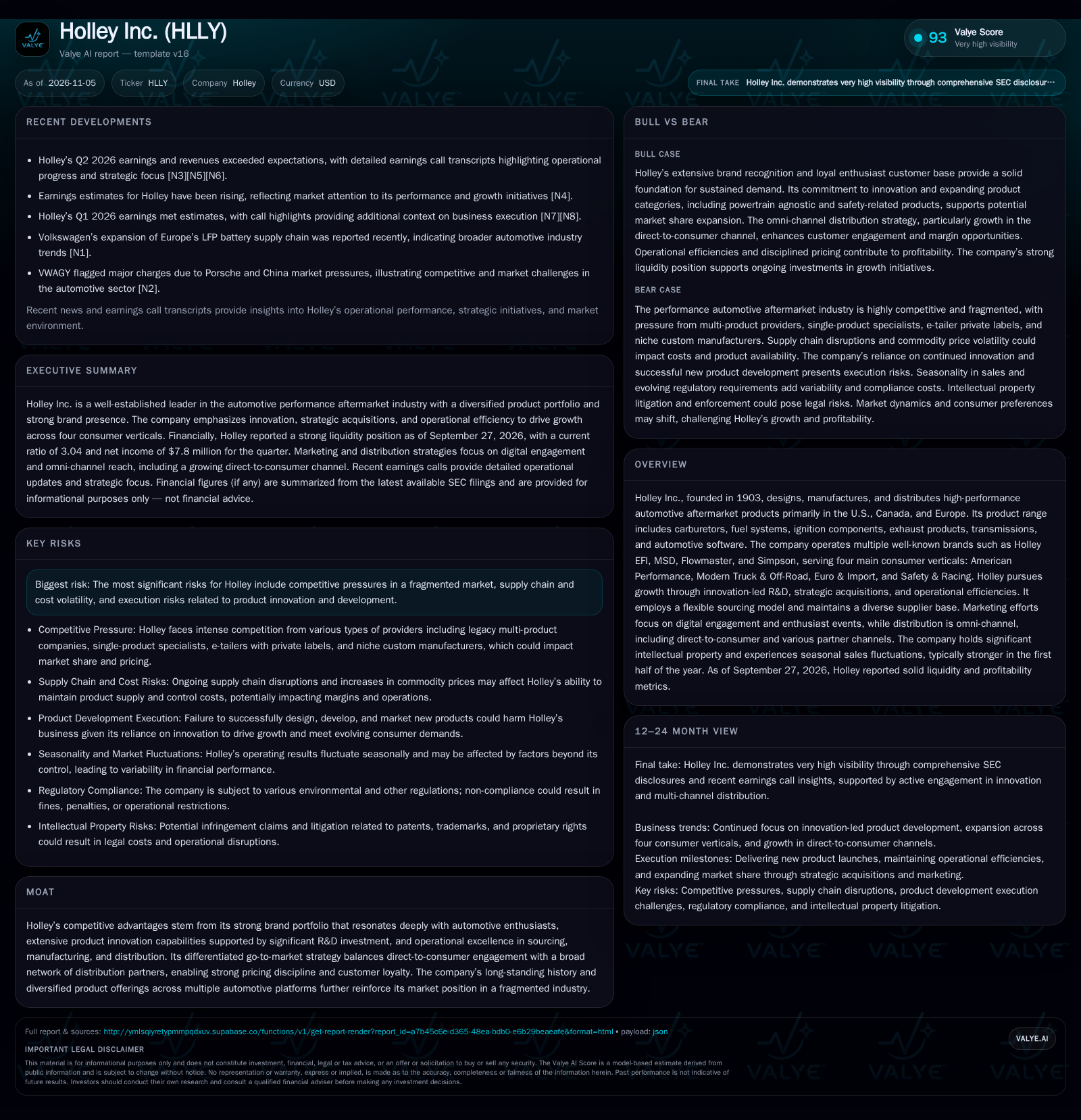
Holley Inc. reported net income of $7.8 million for the September 2026 quarter, supported by a reported current ratio of 3.04 and a diversified product and brand portfolio spanning multiple automotive aftermarket segments. The company continues to invest heavily in R&D and digital marketing while expanding direct-to-consumer sales. Its ability to sustain growth will depend on successful product innovation, managing competitive pressures, and navigating supply chain and regulatory risks. [S1] [S2]
Holley Inc. stands at a strategic crossroads in the automotive aftermarket, blending its storied legacy with a push into new, innovation-led product categories. As Holley doubles down on direct-to-consumer engagement and expands into adjacent segments like safety and braking, its long-term trajectory will depend on converting R&D investments into defensible revenue streams and fending off a diverse array of competitors. Execution on these fronts will shape the company’s ability to maintain pricing power, grow share, and weather industry uncertainties. [S1] [S2]
Recent Results Show Profitability and Balance Sheet Strength, But Execution Remains in Focus
Holley reported net income of $7.8 million for the quarter ending September 27, 2026, with basic and diluted EPS of $0.07 and $0.06, respectively. The company’s current assets stood at $304.8 million versus current liabilities of $100.3 million, yielding a current ratio of 3.04 and a cash ratio of 0.5. These metrics reflect a business operating with significant headroom to meet near-term obligations. Notably, Holley’s top five brands accounted for 49% of 2025 sales, highlighting both the strength and concentration of its core franchise. [S1] [S2]
Recent earnings calls and analyst commentary point to Holley’s ongoing focus on innovation-led growth and operational efficiency. The company’s marketing spend of $14.7 million in 2025 (2.3% of gross sales) and R&D investment averaging $23.7 million annually since 2020 underscore its commitment to product development and digital engagement, both critical to sustaining relevance in a competitive aftermarket landscape. [S1] [N3] [N4] [N5] [N6] [N7] [N8]
Mix Shift, Channel Strategy, and Margins: How Holley Makes Money
Holley’s revenue model is anchored in a broad portfolio of high-performance automotive aftermarket products, ranging from traditional carburetors and exhaust components to advanced fuel injection systems and safety equipment. Gross margins are influenced by product mix (with newer, higher-tech products and DTC sales typically commanding better margins), disciplined pricing policies, and operational leverage from scale sourcing and manufacturing. The company’s flexible sourcing model—balancing in-house production with global suppliers—helps mitigate cost volatility but may also expose Holley to fluctuating input prices and logistics risks.
The omni-channel approach—spanning direct-to-consumer (DTC), e-tailers, warehouse distributors, and jobber/installers—diversifies revenue streams and customer touchpoints. DTC sales, in particular, offer the potential for higher margin capture, greater control over brand messaging, and valuable first-party data. However, this channel requires sustained investment in e-commerce infrastructure, digital marketing, and customer support. Marketing and R&D spend, while supporting innovation and engagement, represent ongoing fixed costs that require sufficient volume growth to drive operating leverage. Holley’s annual R&D outlays and steady marketing investments suggest a business model that seeks to balance innovation-driven top-line growth with margin discipline. [S1]
Brand Heritage, Innovation, and Channel Reach: Assessing Holley’s Defenses and Exposures
Holley’s competitive position is built on a century-old brand heritage and a product portfolio that resonates with automotive enthusiasts. The company’s multi-brand architecture—anchored by names like Holley, MSD, Flowmaster, and Simpson—enables it to target distinct segments across four consumer verticals. This breadth provides some insulation from single-product commoditization and fosters customer loyalty, especially among hobbyists and performance tuners.
However, the aftermarket remains highly fragmented, with competition from both established multi-product players and nimble niche specialists. E-commerce platforms and e-tailer private labels have lowered barriers to entry, increasing price transparency and challenging legacy distribution advantages. Holley’s disciplined pricing policies and IP protection efforts help defend margins, but the risk of commoditization and channel disintermediation persists. The company’s ongoing move into adjacent segments—such as safety, suspension, and braking—could broaden its competitive moat if it can establish brand credibility and technical differentiation in these newer categories. [S1]
If R&D Yields New Category Wins and DTC Deepens, Margin Expansion Could Accelerate
In a favorable scenario, Holley’s sustained R&D investment translates into successful new product launches in high-growth categories like performance suspension, braking, and powertrain conversion systems. If these products gain traction with both enthusiasts and mainstream consumers, the company could expand its addressable market beyond traditional hot-rodding and racing niches. Growth in the DTC channel—supported by exclusive products, customization options, and digital engagement—would allow Holley to capture higher margins and build direct customer relationships, generating valuable data for targeted marketing and cross-selling.
Evidence confirming this scenario would include accelerating sales from new categories, rising DTC contribution as a share of revenue, and expanding gross margins. Successful integration of recent acquisitions, positive feedback from enthusiast communities, and continued upward revisions in earnings estimates would further support the upside case. [S1] [N4]
Core Brands Sustain Share Amid Industry Cyclicality and Gradual Channel Evolution
The most plausible outcome is that Holley’s legacy product lines and established brands continue to anchor steady demand among core enthusiast segments. Incremental gains in new categories and the DTC channel may offset moderate headwinds from competition and channel disruption, but the overall growth rate likely remains tied to broader industry trends and economic cycles. Seasonality persists, with stronger results in the first half of the year, and gross margins remain stable as disciplined pricing balances input cost pressures.
If disclosed, moderate increases in DTC penetration and product mix diversification would further validate this middle path. [S1] [S2]
Execution Stumbles or Competitive Erosion Could Pressure Margins and Growth
In a less favorable scenario, Holley’s innovation efforts fail to produce compelling new products or the company struggles to gain traction in new categories. Intensified price competition—driven by e-tailer private labels, discounting by rivals, or weak enforcement of pricing discipline—could erode margins. Supply chain disruptions or commodity cost spikes may further compress profitability, while regulatory or IP-related setbacks could add compliance costs or legal liabilities.
Evidence supporting this downside would include declining sales in core product lines, shrinking gross margins, or a marked increase in inventory and receivables (suggesting channel resistance or demand softness). Rising legal expenses or negative outcomes in IP disputes would reinforce the risk case. [S1] [S2]
Milestones That Will Reveal Holley’s Ability to Defend and Grow Its Aftermarket Franchise
Trends in DTC sales as a percentage of total revenue—if disclosed—would clarify the pace of channel shift and margin potential.
Growth rates in newly launched product categories, such as performance suspension, braking, and safety, would help assess R&D effectiveness.
Gross margin trajectory, particularly in relation to product mix and channel evolution, would indicate pricing power and cost management.
Inventory turnover and working capital changes would provide early warning of demand shifts or supply chain bottlenecks.
Market share data in core and adjacent verticals—if available—would test the strength of Holley’s competitive moat.
Updates on material legal or regulatory proceedings, especially related to intellectual property, would highlight risk exposure.
Quarterly commentary on input cost trends and sourcing flexibility would illuminate supply chain resilience.
Customer retention and repeat purchase rates in the DTC channel—if disclosed—would signal brand loyalty and long-term engagement.
Disclaimer: This is research-only, informational analysis and not investment advice. It may include AI-generated interpretation and general industry context. Always verify important details using primary sources.

Comments