
Wheels Up’s Premium Pivot: Fleet Modernization, Member Growth, and the Challenge of Capital Discipline
Wheels Up has retired its legacy fleet and now focuses on Bombardier Challenger and Embraer Phenom jets, with over 1,500 members in its premium programs.
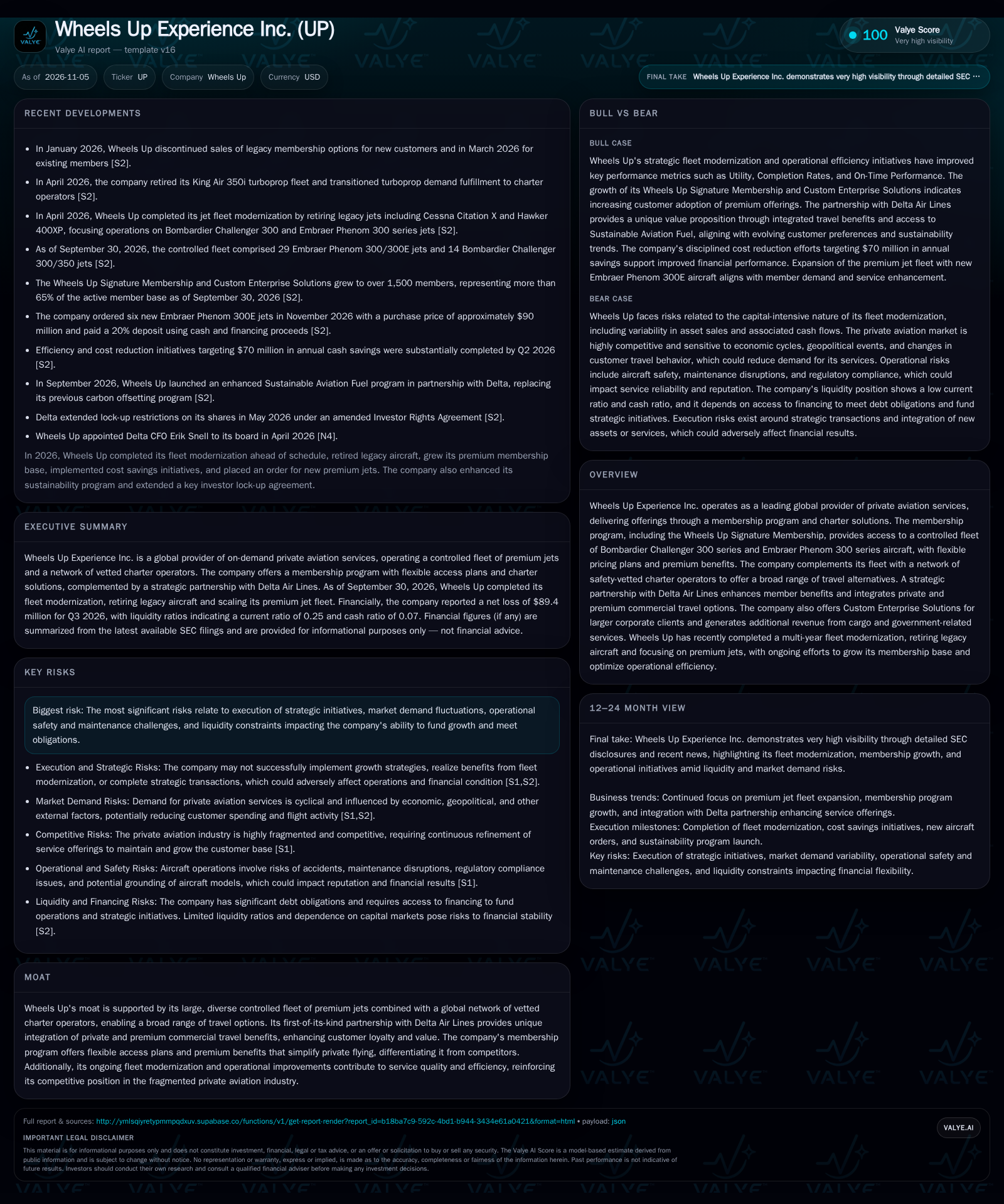
Wheels Up has retired its legacy fleet and now focuses on Bombardier Challenger and Embraer Phenom jets, with over 1,500 members in its premium programs. While operational metrics and cost savings have improved, the company’s low cash and current ratios highlight continued dependence on financing. The Delta partnership and new aircraft order signal a differentiated offering, but strategic execution and liquidity remain critical junctures for the business.[S2]
Wheels Up Experience Inc., a global provider of private aviation services, has executed a rapid transition to a premium jet fleet, growing its high-value membership products and deepening its integration with Delta Air Lines. The company’s future now pivots on its ability to convert operational gains into sustainable economics while maintaining access to external capital.[S2]
Fleet Modernization and Membership Growth Reshape the Core Business
As of September 30, 2026, Wheels Up has fully modernized its controlled fleet, now operating 29 Embraer Phenom 300/300E jets and 14 Bombardier Challenger 300/350 jets after retiring all legacy jets in April, 18 months ahead of schedule.[S2] This shift to a premium fleet coincides with over 1,500 members enrolled in Signature Membership and Custom Enterprise Solutions, accounting for more than 65% of the member base.[S2] The company’s recent order for six additional Embraer Phenom 300E jets at a $90 million purchase price further deepens its commitment to premium service, though it heightens capital intensity.[S2]
Financially, Wheels Up reported a net loss of $89.4 million for Q3 2026, with cash and equivalents at $51.8 million, current assets of $191.2 million, and current liabilities of $754.5 million. [S2]
How Wheels Up’s Revenue Model and Cost Structure Shape Its Path to Profitability
Wheels Up’s core revenue streams arise from its membership program—particularly the Signature Membership and Custom Enterprise Solutions—and from on-demand charter flights. Members pay upfront for access to discounted or fixed hourly rates, while charter customers pay as they go, allowing the company to capture both recurring and transactional revenue.[S1] The focus on premium jets enables higher hourly pricing and potentially greater contribution margins per flight, especially as the company targets affluent individuals and corporate clients willing to pay for flexibility, exclusivity, and time savings.
However, the business is inherently capital-intensive, requiring substantial investment in aircraft acquisition, maintenance, and regulatory compliance. The recent order for six new jets and the retirement of legacy aircraft suggest a deliberate move to reduce long-term operating costs and improve asset utilization, but also increase near-term capital needs.[S2] Fixed costs—including fleet leases, depreciation, pilot salaries, and hangar expenses—dominate the cost structure, while variable costs are driven by flight hours, fuel, and maintenance. Wheels Up’s efficiency initiatives targeting $70 million in annual cash savings may deliver operating leverage if flight volumes and membership revenue scale, but ongoing net losses and thin liquidity limit the company’s buffer to absorb shocks or fund further growth without external capital.
Differentiation via Premium Fleet and Delta Partnership, but Intense Competition Persists
Wheels Up’s competitive position rests on its premium, controlled jet fleet, flexible membership models, and an exclusive partnership with Delta Air Lines. The Delta integration uniquely allows members to earn elite status and use Membership Funds for discounted Delta flights, blurring the line between private and commercial premium travel and potentially increasing customer loyalty and share of wallet.[S1]
Despite these advantages, the private aviation market remains highly fragmented, with competition from other membership-based providers, charter brokers, fractional ownership programs, and emerging digital-first platforms. Many competitors also access similar aircraft types through owned or managed fleets, and price-sensitive or infrequent flyers may be more easily swayed by promotions or alternative platforms. Additionally, Wheels Up’s reliance on charter operators to fulfill turboprop demand and the discontinuation of legacy memberships may create openings for rivals targeting entry-level or regional customers.[S2]
Switching costs are moderate; while the integrated member benefits and service quality improvements could drive retention, customers can often compare alternatives and shift providers with minimal friction, especially in economic downturns or periods of service disruption.
Operational Gains and Premium Demand Could Unlock Margin Expansion—If Financing Holds
If Wheels Up’s premium fleet and membership focus continue to resonate, the company could see accelerated growth in high-value member adoption, improved aircraft utilization rates, and higher contribution margins per flight. The completion of fleet modernization, combined with $70 million in cost savings, could drive a step-change in operating leverage—allowing incremental revenue growth to flow through to the bottom line. The Delta partnership, if further activated (for example, deeper integration of loyalty programs or joint marketing), could help attract new members from Delta’s premium customer base and drive cross-sell synergies.
Key evidence confirming this scenario would include sustained growth in premium memberships, higher fleet utilization, visible margin improvement, and a successful absorption of the new jet order without liquidity distress. Signs of robust member retention, increased use of Delta integration features, and positive operating cash flow would further validate the upside pathway.
Fleet and Membership Growth Offset by Ongoing Losses and Funding Needs
The most plausible outcome is that Wheels Up sustains moderate growth in premium memberships and flight volumes, with operational improvements offsetting some—but not all—of the drag from high fixed costs and interest expenses. The new aircraft order may boost service quality and member appeal, but also strains liquidity and increases dependence on external financing. Cost savings initiatives help narrow losses, but economic sensitivity and competitive pricing pressure limit margin expansion.
Evidence supporting this scenario would include continued membership and utilization growth, but with persistent net losses and periodic capital raises or asset sales to cover working capital and fleet investments. Modest improvements in operational KPIs without a decisive move to profitability or a material strengthening of the balance sheet would confirm this middle path.
Liquidity Constraints and Demand Shocks Threaten Business Continuity
In an adverse scenario, Wheels Up could face a combination of weak demand (due to economic slowdown or competitive encroachment), underutilized fleet assets, and mounting liquidity pressure. If new premium member growth stalls or churn accelerates, the company may struggle to cover fixed costs and debt service, especially after its recent capital outlays. Failure to secure additional financing or monetize assets quickly could force service cutbacks, further fleet downsizing, or distressed asset sales.
Evidence for this scenario would include declining membership counts, stagnant or falling utilization rates, negative operating cash flow, and tightening supplier or lessor terms. Signs of delayed fleet investments, emergency capital raises under unfavorable terms, or adverse changes to the Delta partnership would further validate the downside risk.
Milestones That Will Determine If Wheels Up’s Premium Strategy Delivers Sustainable Value
Quarterly growth in Signature Membership and Custom Enterprise Solutions enrollment, as well as the proportion of total members in premium tiers, if disclosed.
Trends in fleet utilization, completion rates, and on-time performance—particularly as the new Embraer Phenom 300E jets are integrated into operations.
Operating cash flow and EBITDA progression, as these will indicate whether operational improvements are translating into sustainable financial performance.
Net member retention and churn rates, which would clarify whether the enhanced service and Delta partnership are driving durable customer loyalty.
Progress on further divestitures of legacy aircraft and realization of proceeds to support premium fleet expansion.
Cost per available flight hour and other unit cost metrics, if disclosed, to test whether modernization is yielding the targeted cost savings.
Access to new financing or capital raises, including the terms and timing relative to upcoming obligations and growth investments.
Any changes to the Delta partnership scope, exclusivity, or integration features, which could materially affect the company’s competitive differentiation and cross-sell potential.
Disclaimer: This is research-only, informational analysis and not investment advice. It may include AI-generated interpretation and general industry context. Always verify important details using primary sources.

Comments