
Victory Capital’s Integrated Boutique Model: Scale, Flows, and the Realities of Asset Management Expansion
Victory Capital’s latest quarter underscores the potential and complexity of its hybrid approach—combining boutique investment franchises with centralized distribution and operations. While net inflows and acquisition-driven scale are evident, the challenge remains to sustain organic growth and margin resilience in a competitive and fee-sensitive market.
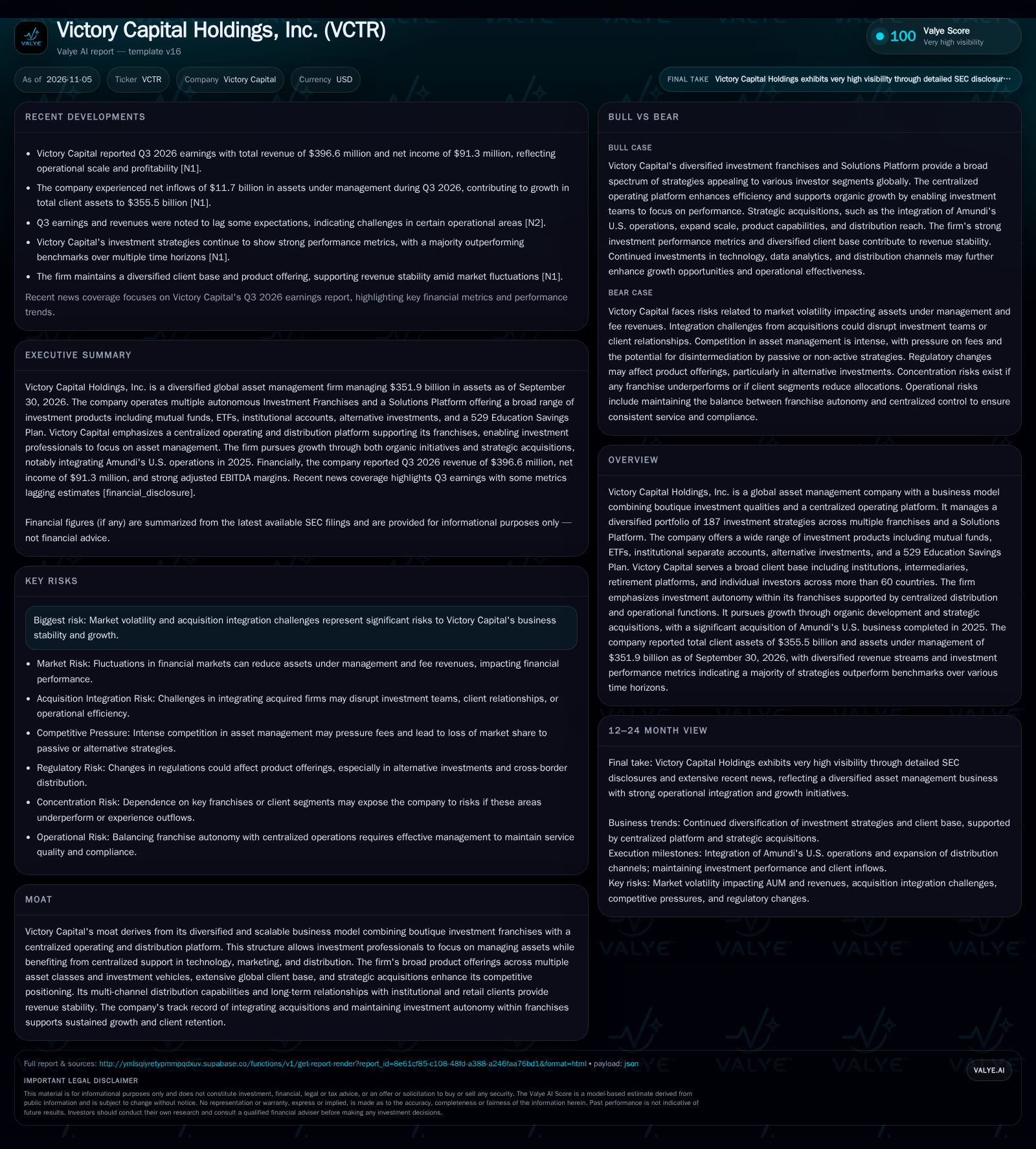
Victory Capital Holdings reported $351.9 billion in AUM and net inflows of $11.7 billion for Q3 2026, driven by both organic growth and the integration of Amundi’s U.S. business. The firm’s model blends franchise autonomy with centralized support, targeting both institutional and retail segments. This approach has delivered scale and product breadth, but the asset management landscape remains intensely competitive, with ongoing fee pressure and integration risks.
Victory Capital Holdings stands at a pivotal juncture in the asset management sector, having recently crossed the $350 billion mark in assets under management. The company’s strategy—melding the specialized focus of boutique franchises with the efficiency of a centralized platform—has enabled significant scale, not least through the integration of Amundi’s U.S. business. Yet, while recent net inflows and a wide-ranging product suite point to commercial momentum, the asset management industry’s structural pressures on fees and the complexities of acquisition integration pose ongoing tests to Victory Capital’s growth and margin ambitions.
Recent Flows, Scale, and Earnings: What the Latest Quarter Reveals
Victory Capital reported assets under management (AUM) of $351.9 billion as of September 30, 2026, up $9.4 billion sequentially, driven by net inflows of $11.7 billion in the third quarter. This continued growth follows the integration of Amundi’s U.S. operations, now rebranded as Pioneer Investments, which significantly expanded Victory’s scale and product reach [S2] [N1].
Despite these inflows and a broadening client asset base ($355.5 billion in total client assets), Q3 2026 earnings and revenues fell short of some external estimates, suggesting that margin expansion and operational leverage are not guaranteed even with headline AUM growth [N2].
The company’s adjusted EBITDA margin remains robust at 53.5%, with Q3 revenue of $396.6 million and net income of $91.3 million, but the gap between inflows and earnings expectations highlights the persistent drag of fee compression and integration costs [S2].
How Victory Capital Monetizes Flows: Fee Mix, Margins, and Operating Leverage
Victory Capital’s core economics hinge on management and performance fees derived from a diversified mix of investment vehicles: mutual funds, ETFs, institutional separate accounts, alternatives, and 529 plans. The company’s ability to command higher margins depends on product mix—actively managed strategies and alternatives typically offer higher fees than passive or rules-based products, while institutional mandates often exert downward pressure on pricing.
Operating leverage is a central feature of Victory’s model: centralized operations and distribution allow the firm to scale new franchises and strategies with incremental cost efficiencies. The 53.5% adjusted EBITDA margin in Q3 2026 signals significant fixed-cost absorption, but the sustainability of this margin will depend on continued net inflows, product mix favoring higher-fee strategies, and successful integration of acquired franchises [S2].
Capital requirements in asset management are relatively modest compared to other financial sectors, but integration initiatives and technology investments (e.g., for distribution and reporting) can be substantial, especially following major acquisitions. The company reported cash and liquidity metrics for the period; these figures do not by themselves establish operating runway, investment capacity, financial flexibility, or financing capacity. [S2]
Competing for Flows: Boutique Autonomy Meets Scale in a Fee-Pressured World
Victory Capital’s structure—autonomous investment franchises supported by centralized operations—aims to capture the best of both worlds: the agility and specialization of boutiques with the distribution muscle and cost advantage of a large platform. This is intended to appeal to both institutional consultants and retail allocators, who increasingly demand differentiated performance and cost efficiency.
However, the competitive landscape is fierce. Large diversified asset managers, passive index providers, and specialist boutiques all vie for institutional and retail mandates. Industry-wide, fee compression remains a structural headwind, as low-cost passive vehicles continue to gain share and investor scrutiny on value-for-fee intensifies.
Victory’s diversification across 187 strategies and broad distribution channels (institutional, retail, direct, international) provides some insulation from single-product or single-channel risk, but the challenge is to maintain performance and client retention across this portfolio while integrating new acquisitions without disruption [S1] [S2].
When Scale and Integration Drive Superior Growth and Margins
The favorable scenario for Victory Capital is one where its hybrid model delivers both organic and inorganic asset growth, while maintaining or expanding margins. This would require: (1) sustained net inflows into higher-fee actively managed and alternative strategies, (2) successful integration of new franchises such as Pioneer Investments without client or talent attrition, and (3) continued investment outperformance relative to benchmarks, reinforcing the firm’s value proposition.
Evidence that would support this upside: acceleration in net inflows (especially in active and alternative products), improvement or stability in average fee rates despite industry pressure, and margin expansion in future quarters. Additionally, organic growth in international or direct investor channels—leveraging the Amundi partnership—could further diversify and strengthen the business [S1] [S2].
Potential falsifiers include persistent fee compression, outflows from key franchises, or integration setbacks leading to higher-than-expected costs or performance slippage.
Sustaining Scale in a Competitive, Fee-Compressed Environment
The most plausible trajectory is that Victory Capital continues to grow moderately, with net inflows offsetting market volatility and ongoing fee erosion. The integration of Pioneer Investments and other acquired franchises gradually yields cost and distribution synergies, but margin expansion is limited by industry-wide pricing pressure.
Revenue and earnings growth likely track asset growth, with product mix shifts (toward lower-fee passive and institutional mandates) capping upside on average fee rates. Operational efficiency gains from centralized functions help offset some incremental integration expense, but any missteps in franchise management or client retention could quickly erode gains.
Confirmation would come from quarter-on-quarter stability in net inflows, maintenance of EBITDA margins around current levels, and absence of major outflows or integration disruptions. Conversely, a sharp drop in organic flows, negative performance drift in flagship franchises, or unanticipated integration costs would falsify this scenario.
How Integration or Market Shocks Could Derail the Growth Story
The adverse scenario is characterized by a combination of market-driven AUM declines (e.g., sharp equity or fixed income selloffs), persistent fee compression, and internal disruption from acquisition integration. Large, rapid outflows—especially from institutional clients or recently acquired franchises—could trigger negative operating leverage, as fixed costs would be difficult to shed quickly.
If integration of Pioneer Investments or other franchises leads to talent departures, client loss, or subpar investment performance, the intended benefits of scale and diversification could unravel. Regulatory changes affecting product structures (such as alternatives or cross-border vehicles) could also reduce addressable market and revenue streams.
Evidence of this scenario would include a reversal to net outflows, margin compression below historical norms, loss of key personnel or clients, or publicized integration failures. Early warning signs could also surface in deteriorating investment performance metrics or negative rating actions on flagship products.
Tangible Markers for Victory Capital’s Hybrid Asset Management Thesis
Quarterly net inflows versus outflows across both active and passive product lines, especially within recently acquired franchises such as Pioneer Investments.
Trends in average fee rates and revenue yield per AUM, especially as product mix evolves and fee pressures persist.
Progress on integration milestones for major acquisitions—employee retention, client retention, and cost synergies—if disclosed.
Performance persistence of flagship strategies relative to benchmarks across 1-, 3-, 5-, and 10-year horizons.
Distribution channel growth, particularly in international and direct investor segments following the Amundi partnership.
Margin trends—sustained or improved adjusted EBITDA margin as a proxy for successful operating leverage and cost discipline.
Any regulatory or structural changes impacting product offerings, distribution, or cross-border client access.
A useful metric would be franchise-level asset and revenue concentration, to gauge exposure to single-strategy or single-client risk.
Disclaimer: This is research-only, informational analysis and not investment advice. It may include AI-generated interpretation and general industry context. Always verify important details using primary sources.

Comments