
Aemetis, Inc.:, Segment Diversification, and the Challenge of Scaling Renewable Fuels
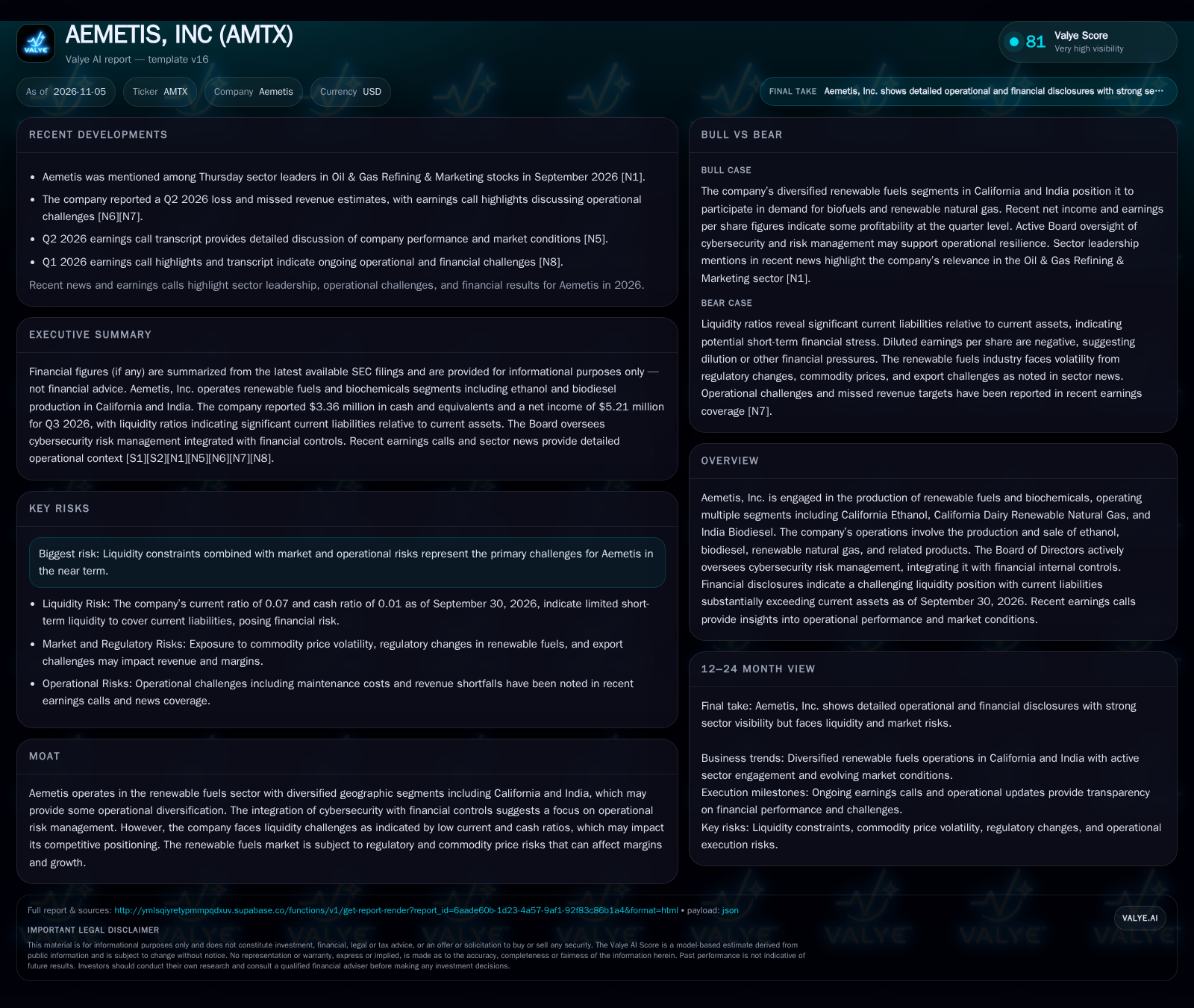
Although the company posted a quarterly net income of $5.21 million, operational and market challenges persist, as reflected in missed revenue estimates and recent earnings call discussions.
Although the company posted a quarterly net income of $5.21 million, operational and market challenges persist, as reflected in missed revenue estimates and recent earnings call discussions. Segment diversification across ethanol, biodiesel, and renewable natural gas offers exposure to global renewable fuel demand, but the company’s financial posture raises questions about its capacity to sustain operations and invest in growth initiatives. Ongoing oversight of cybersecurity and risk management is integrated into financial controls, but sector volatility and execution risks remain material.
Segment diversification across ethanol, biodiesel, and renewable natural gas theoretically positions Aemetis to benefit from global decarbonization trends, but persistent operational challenges and sector volatility threaten to overwhelm these advantages. The central question is whether Aemetis can bridge its current financial gap long enough to realize the potential of its platform.
Liquidity Crisis and Mixed Profitability Shape the Present
Aemetis, Inc. reported cash and cash equivalents of $3.36 million as of September 30, 2026, with current assets totaling $29.13 million and current liabilities ballooning to $439.82 million. [S2]
While the company posted net income of $5.21 million for the quarter, the diluted earnings per share was negative (-$0.02), pointing to either dilution or underlying financial pressures despite the positive basic EPS [S2].
Recent earnings calls and sector news reinforce the picture of a company grappling with operational challenges and missed revenue estimates, underscoring the financial tightrope Aemetis must walk [N5] [N6] [N7] [N8].
[S1]
Segment Economics and the Realities of Capital Intensity in Renewable Fuels
Aemetis’s business model is anchored in the production and sale of renewable fuels—ethanol, biodiesel, and renewable natural gas—across U.S. (California) and Indian operations. These segments expose the company to multiple revenue streams, but also to region-specific regulatory regimes and commodity price fluctuations.
The economics of renewable fuel production are inherently capital-intensive, with significant fixed costs for plant operations, maintenance, and regulatory compliance. Margins are sensitive to feedstock costs (such as corn for ethanol or palm/soy oil for biodiesel), energy inputs, and the value of renewable credits (e.g., RINs in the U.S.). Variable costs can be volatile, and pricing power is limited by global commodity benchmarks and government-set blending mandates.
While segment diversification can buffer against localized market shocks, it also raises complexity and working capital needs. The sharp mismatch between current assets and liabilities suggests that Aemetis may be relying on short-term creditors or delayed payables to bridge cash flow gaps, a strategy that is unsustainable without operational cash generation or external financing.
To achieve meaningful operating leverage, Aemetis must grow volumes or improve mix toward higher-margin products (such as renewable natural gas with premium credits). However, with liquidity so constrained, the company’s ability to invest in efficiency upgrades, capacity expansions, or margin-enhancing projects is severely limited unless new funding is secured.
Diversification, Regulatory Exposure, and the Limits of Scale Advantage
Aemetis participates in a fiercely competitive landscape that includes large integrated energy firms, pure-play renewable producers, and regional players across North America and India. The company’s geographic and product diversification theoretically reduces single-market risk, but it also means exposure to a patchwork of regulatory environments and currency risks.
In California, the Low Carbon Fuel Standard (LCFS) and federal Renewable Fuel Standard (RFS) create opportunities for producers with low-carbon intensity fuels, but they also subject margins to regulatory adjustments and credit price swings. In India, policy incentives and local feedstock availability influence the viability of biodiesel operations, and export opportunities are shaped by trade policy and logistics.
Aemetis’s scale is modest compared to industry leaders, limiting its ability to negotiate feedstock contracts, absorb input cost volatility, or influence policy outcomes. Unless the company can demonstrate superior technology, integration, or cost structure, it may struggle to defend margins against both larger incumbents and agile new entrants.
Cybersecurity and operational risk management are increasingly important differentiators, particularly as critical infrastructure becomes more digitized. Aemetis’s board-level focus here is prudent but unlikely to confer a lasting competitive moat absent sustainable financial and operational advantages.
Liquidity Bridge and Favorable Market Tailwinds Unlock Growth
If market conditions turn favorable, with rising renewable fuel credit prices and stable or declining feedstock costs, the company could expand margins and generate enough cash to reduce its reliance on short-term liabilities.
Segment execution would be critical: ramping up California Dairy Renewable Natural Gas operations, capturing premium LCFS and RIN credits, and leveraging the India Biodiesel platform to tap export markets or participate in local blending mandates. Successful delivery of these initiatives could drive both top-line growth and operating leverage.
Evidence that would confirm this scenario includes: a disclosed financing event or strategic partnership that materially improves the balance sheet; sustained positive net income with improving cash flow from operations; and publicized commercial wins or capacity expansions in premium segments.
Operational Scramble Amidst Financial Tightrope
The most plausible near-term trajectory is a continued operational scramble—Aemetis manages to keep core facilities running and service key contracts, but liquidity remains acutely constrained. The company may resort to cost-cutting, deferring maintenance, or negotiating with creditors to buy time. Revenue fluctuates with commodity cycles and regulatory changes, and profitability is inconsistent across quarters.
External financing is possible but may come at high cost or with dilutive terms, further pressuring shareholder value.
A shift toward a more constructive or adverse scenario would be signaled by a material change in the balance sheet—either a successful refinancing or a liquidity event, or conversely, a covenant breach, missed payments, or asset sales under distress.
Liquidity Exhaustion Triggers Restructuring or Asset Sales
If Aemetis is unable to secure new financing or generate sufficient operational cash flow, liquidity exhaustion becomes a near-term risk. In this scenario, the company may be forced to curtail production, enter restructuring negotiations, or pursue fire-sale asset dispositions to meet obligations.
Operational disruptions—such as feedstock supply interruptions, major regulatory setbacks, or plant outages—would accelerate this outcome. The inability to pay creditors, suppliers, or employees on time could result in lawsuits, loss of key contracts, or even bankruptcy proceedings.
Confirmation of this scenario would include: a further deterioration in liquidity ratios, public disclosures of missed payments or covenant breaches, abrupt changes in management, or regulatory filings indicating going-concern doubts.
Falsification would require evidence of a successful refinancing, asset sale at favorable terms, or a turnaround in operational cash flow that stabilizes the balance sheet.
Milestones and Metrics That Will Determine Aemetis’s Trajectory
Operating margins by segment (California Ethanol, Dairy RNG, India Biodiesel), which would clarify where value is being created or eroded.
Updates on capacity utilization rates and production volumes in premium segments like Dairy Renewable Natural Gas, which would signal scaling success or operational bottlenecks.
Any regulatory changes to LCFS, RFS, or Indian biofuel mandates that materially impact revenue opportunities or compliance costs.
Disclosures of overdue payments, covenant breaches, or going-concern warnings in SEC filings or earnings communications.
Evidence of significant customer wins, multi-year contracts, or strategic partnerships that improve revenue visibility or provide non-dilutive capital.
Board and management turnover, especially in finance or operations, which could indicate either renewal or distress.
Disclaimer: This is research-only, informational analysis and not investment advice. It may include AI-generated interpretation and general industry context. Always verify important details using primary sources.

Comments