
SolarEdge Technologies: Strategic Shifts, Tax Incentives, and the High-Stakes Economics of Solar System Integration
SolarEdge is navigating a complex landscape of regulatory changes, shifting market demand, and operational risks by streamlining its portfolio, focusing on revenue-generating solutions, and leveraging U.S. manufacturing for tax advantages. Recent financials reveal both resilience and persistent challenges as the company adapts to evolving industry economics.
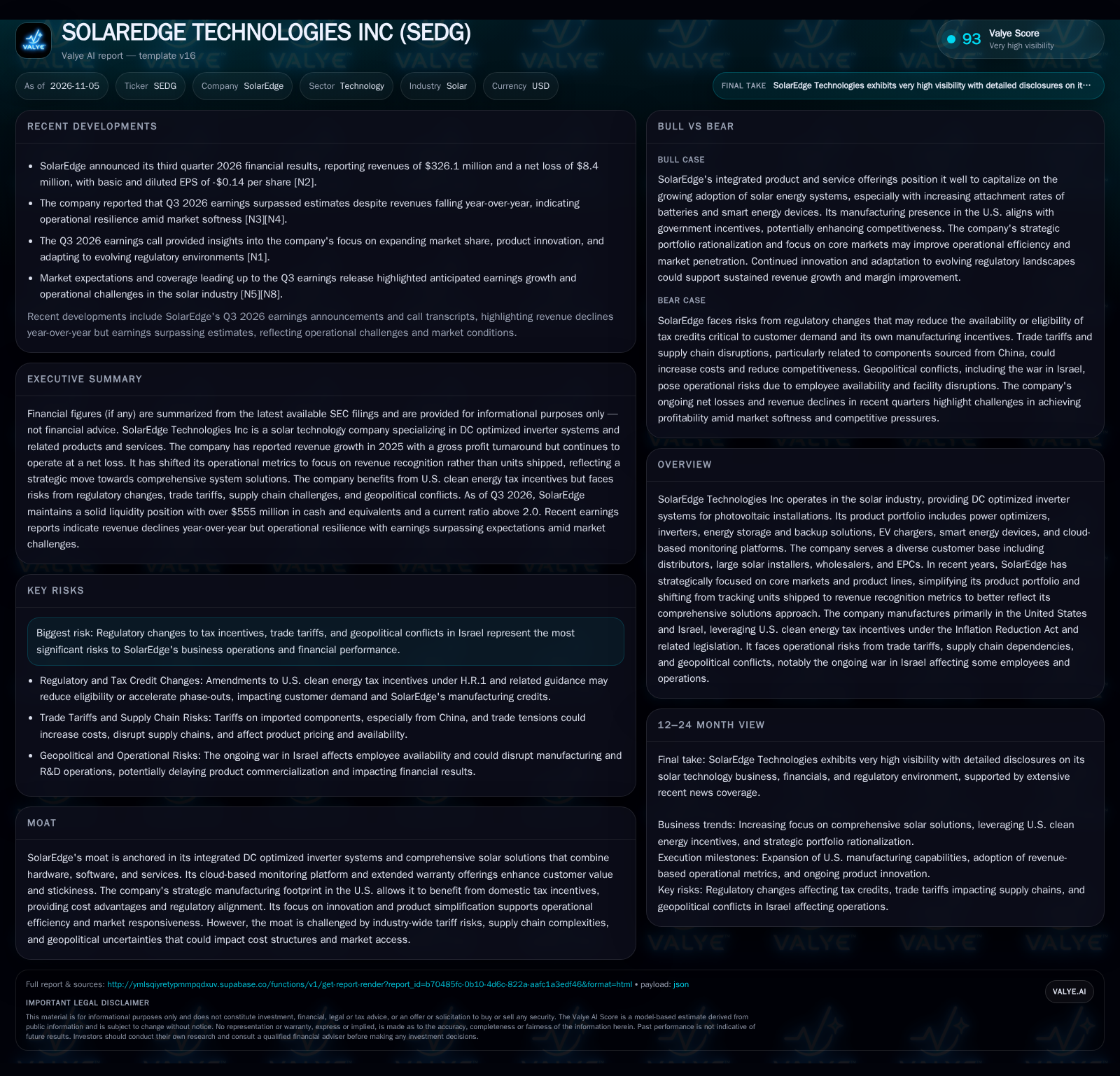
SolarEdge is transitioning from a product-based to a solutions-based revenue model, simplifying its offerings and focusing on U.S.-based manufacturing to capture tax incentives. While its Q3 2026 earnings exceeded expectations, year-over-year revenue declined and losses remain material. The company's outlook hinges on regulatory clarity around clean energy incentives, competitive responses, and the ability to defend margins amid supply chain and geopolitical headwinds.[S2] [N3] [N4]
SolarEdge Technologies stands at a junction of opportunity and risk as it redefines its business model to emphasize comprehensive solar solutions, U.S. manufacturing, and regulatory alignment. While Q3 2026 earnings beat expectations and net losses narrowed substantially, revenue contraction and ongoing market volatility highlight persistent challenges. The company's future now hinges on its ability to leverage tax incentives, defend its competitive position, and manage external risks ranging from policy uncertainty to global supply chain shocks.[S2] [N3] [N4]
Recent Performance and Strategic Realignment Set the Stage
SolarEdge reported a net loss of $405.4 million for the year ended 2025, a significant improvement from the previous year’s $1.8 billion loss. Despite this progress, the company’s Q3 2026 revenues declined year-over-year, even as earnings surpassed Wall Street expectations, signaling operational resilience but also persistent demand-side challenges.[S2] [N3] [N4]
The company has overhauled its commercial model, shifting from tracking units shipped to recognizing revenue from comprehensive solution deployments, reflecting a pivot toward system integration and value-added services. This transition is accompanied by a streamlined product portfolio, with a move to Single SKU offerings aimed at operational efficiency and market focus.[S2]
Manufacturing has been realigned to the U.S. and Israel, allowing SolarEdge to capture benefits from U.S. clean energy tax credits under the Inflation Reduction Act and related legislation. However, amendments under H. R. 1 have created new eligibility hurdles and accelerated phase-outs, introducing fresh uncertainty into the demand calculus for both SolarEdge and its customers.[S2]
Evolving Revenue Model and the Complex Economics of Solar Integration
SolarEdge’s business model has evolved from discrete hardware sales to a solutions-based approach, where revenue is recognized not on shipment but on the delivery and integration of comprehensive solar systems. This shift could drive higher average deal values and recurring service opportunities, but it also complicates revenue predictability and working capital management as project cycles lengthen and become more complex.
The move to a Single SKU concept and portfolio simplification may reduce overhead, streamline inventory, and improve gross margins if operational execution matches intent. However, the economics of system integration typically involve higher fixed costs in R&D and customer support, with variable costs tied to installation, logistics, and after-sales service.
SolarEdge’s U.S.-centric manufacturing supports eligibility for advanced manufacturing production tax credits (AMPTCs) and other incentives, potentially offsetting domestic cost inflation and import tariffs. However, the durability of these benefits is uncertain given recent legislative changes. The company’s capital needs remain elevated due to ongoing innovation, capacity investments, and the need to buffer against supply chain shocks and geopolitical risks.[S2]
Defending Share in a Crowded Field of Solar System Providers
SolarEdge’s integrated inverter systems, cloud-based monitoring, and extended warranties create a sticky ecosystem, but the solar value chain remains fiercely competitive. Rivals include both pure-play inverter makers and vertically integrated solar solution providers, many of whom are also pursuing U.S. manufacturing and seeking to leverage federal incentives.
The company’s focus on solutions rather than components may help differentiate it in markets where installers and EPCs value end-to-end reliability, monitoring, and support. However, this approach exposes SolarEdge to competition from both high-end system integrators and low-cost module/inverter assemblers, as well as the risk of technological substitution if alternative architectures (such as microinverters or AC-coupled systems) gain traction.
Regulatory alignment and domestic production could provide a temporary edge in the U.S., but this advantage may erode as competitors adjust supply chains and as tax credit eligibility narrows. The company’s ability to sustain premium pricing and defend margins will depend on its pace of innovation, execution in supply chain management, and the stickiness of its installed base.
Integrated Solutions and Policy Tailwinds Accelerate Market Share Gains
In a favorable scenario, SolarEdge leverages its streamlined product suite and U.S. manufacturing to capture outsized benefits from remaining tax incentives, driving robust demand from installers seeking integrated, compliant solutions. The company’s focus on system-level value, coupled with innovation in storage and energy management, could increase attachment rates for high-margin services and software.
Confirmation of this scenario would come from sustained revenue growth despite regulatory headwinds, expanding gross margins as operational efficiencies materialize, and evidence that SolarEdge is gaining share in core markets—even as competitors adapt to new tax credit rules. Additional proof would include increased adoption of storage and smart energy add-ons, and a rising proportion of revenue from recurring service or software contracts.
Navigating Policy Volatility and Margin Pressures in a Maturing Market
The most plausible path is one in which SolarEdge manages to stabilize revenue and gradually improve margins as it adapts to a less favorable incentive environment. Incremental improvements in operating efficiency from portfolio simplification and manufacturing realignment help offset some, but not all, of the cost headwinds from tariffs and supply chain risk.
Evidence supporting this scenario would include modest sequential revenue growth, stable or improving gross margins, and steady market share in its core geographies. Signs of success would be SolarEdge maintaining or modestly expanding its installed base, controlling operating expenses, and demonstrating resilience to policy and geopolitical shocks. Conversely, persistent revenue declines, margin compression, or share loss to both premium and low-cost competitors would weaken this thesis.
Regulatory Shocks and Supply Chain Disruptions Erode Demand and Margins
A bearish scenario could unfold if accelerated phase-outs and stricter eligibility for tax credits sharply curtail installer and EPC demand for SolarEdge’s solutions—especially if rivals find ways to undercut pricing or offer more flexible architectures. Simultaneously, renewed trade tensions or supply disruptions (e.g., from China or due to the Israel conflict) could drive up input costs and impair production, squeezing gross margins and potentially leading to further revenue declines.
Confirmation of this scenario would be seen in consecutive quarters of revenue contraction, declining gross and operating margins, and rising inventory or working capital needs. Additional warning signs would include customer defections, delayed or canceled projects, or new regulatory developments that further disadvantage SolarEdge relative to competitors. Material impacts to manufacturing continuity in Israel or the U.S. would further validate this risk.
Milestones and Metrics That Will Define the Next Phase for SolarEdge
Quarterly revenue growth or contraction, especially as recognized under the new solutions-based metrics, will test the efficacy of SolarEdge’s business model transition.[S2]
Gross margin trends, as a reflection of cost management, operational efficiency from portfolio simplification, and the net impact of tariffs and tax credits, will be critical.
The share of revenue from storage, smart energy, and software/service add-ons (if disclosed) would clarify the company’s success in moving up the value stack.
Market share or installer/EPC adoption rates in the U.S. and core international markets, if available, would help gauge SolarEdge’s competitive health.
Evidence of supply chain stability—such as inventory turns, days sales in inventory, or commentary on component sourcing—will be vital given ongoing global disruptions.
Updates on regulatory developments (especially related to the IRA, H. R. 1, and related tax credit eligibility) and management’s interpretation of their impact on demand.
Any disclosures on project delays, cancellations, or customer churn rates would help test the resilience of SolarEdge’s order book and installed base.
Operational updates on the impact of geopolitical risks, particularly in Israel, on manufacturing continuity and employee availability.
Disclaimer: This is research-only, informational analysis and not investment advice. It may include AI-generated interpretation and general industry context. Always verify important details using primary sources.

Comments