
Airship AI: Customer Concentration, Edge Data Ambitions, and the Stakes of Platform Transition
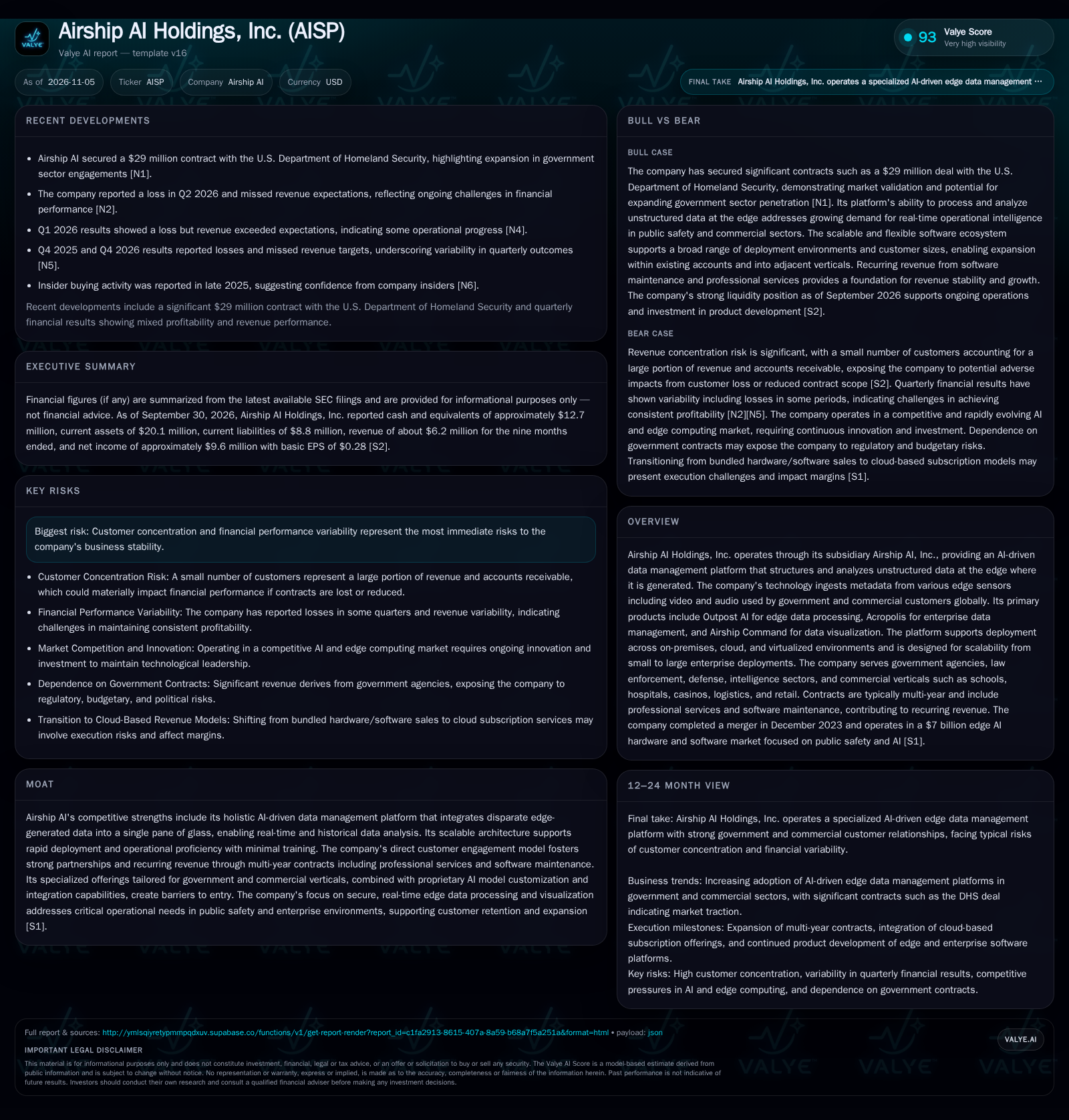
Airship AI Holdings, Inc. stands at the intersection of edge-based AI data management and public safety technology, with a flexible platform serving both government and commercial clients. However, a pronounced reliance on a handful of large customers, coupled with the challenge of shifting from bundled hardware/software to cloud-based subscriptions, will determine the company’s ability to achieve durable growth and margin expansion.
Airship AI’s platform for edge data management is gaining traction, particularly with government and public safety clients, but the company’s future will hinge on reducing customer concentration and successfully shifting to a more scalable, recurring subscription revenue model. Recent financials highlight strong gross profit growth on rising revenues, but the business remains exposed to contract volatility and execution risk around its evolving product mix. [S2]
Airship AI Holdings, Inc. is positioned as a specialized player in the rapidly evolving edge AI data management market, serving both government and commercial sectors with its integrated platform. Recent financial results reflect rapid revenue growth and improved gross profit, but the company’s heavy dependence on a small group of large customers exposes it to contract volatility and revenue swings. As Airship AI seeks to shift its business model toward more recurring, cloud-based subscription revenue, its ability to broaden its customer base and manage execution risk will be central to determining whether it can achieve sustainable profitability and capitalize on the expanding market for real-time, edge-driven operational intelligence.
Customer Concentration and Revenue Trajectory Shape Near-Term Risk and Opportunity
In the first nine months of 2026, Airship AI generated revenue from 103 customers, but four of these accounted for 80.7% of total revenue, and three customers represented nearly 85% of outstanding accounts receivable at quarter-end. This concentration has increased year-over-year, as the top two customers represented 68% of revenue in the same period of 2025. While total revenue and gross profit have surged—revenues for Q3 2026 were $6.2 million, up over 400% from the prior year—operating losses continue, reflecting ongoing investment in R&D and SG&A. The company’s liquidity position as of September 30, 2026, with $12.7 million in cash and a current ratio of 2.3, provides some operational headroom, but the business remains acutely exposed to fluctuations in a small number of key contracts. [S2]
Bundled Sales, Recurring Services, and the Challenge of Subscription Transition
Airship AI’s current revenue model is anchored in bundled hardware and software sales, often tied to multi-year contracts that include professional services, technical support, and software maintenance. This structure provides some recurring revenue but is inherently lumpy, as large deals can drive outsized results in specific quarters while leaving the company vulnerable to periods of softness if awards are delayed or lost. The company is seeking to shift toward a higher mix of cloud-based, subscription revenue, which typically offers better visibility, higher gross margins, and lower dependency on large, discrete contracts. However, this transition is non-trivial: it may require re-architecting parts of the platform, retraining sales teams, and renegotiating customer expectations—particularly for government clients accustomed to capital purchases or bespoke deployments. The economics of edge AI also tend to be capital-intensive, with significant upfront R&D and hardware costs, but can yield operating leverage if recurring software and service revenues scale.
Integrated Edge AI for Public Safety: Differentiation and the Intensity of Market Competition
Airship AI’s platform is designed to unify and analyze unstructured data—such as video, audio, and sensor streams—at the edge, enabling real-time insights for customers in public safety, defense, and commercial verticals. Its offering spans hardware (Outpost AI), enterprise data management (Acropolis), and visualization (Airship Command), with deployment flexibility across on-premises, air-gapped, and cloud environments. This full-stack approach, coupled with professional services and custom AI model training, represents a potential competitive advantage in complex, security-focused settings. However, the company faces formidable competition from established defense contractors, specialized AI platform vendors, and emerging startups, all of whom are chasing the same $7 billion addressable market. The competitive threat is amplified by rapid technological change, customer procurement cycles, and the risk of commoditization in edge hardware. Success will likely depend on Airship AI’s ability to sustain technological differentiation, deepen integration within customer workflows, and deliver measurable operational value.
Winning Larger Contracts and Scaling Recurring Revenue Could Transform Growth Profile
If Airship AI successfully expands its footprint within existing government and commercial accounts—potentially securing large-scale, multi-year contracts like the $29 million DHS deal referenced in industry coverage—it could establish a foundation for outsized growth and greater revenue stability. A successful transition to cloud-based subscription models would further enhance recurring revenue, improve gross margins, and reduce volatility tied to hardware-heavy contract cycles. Confirmation of this scenario would come from disclosures of new multi-year contract wins, a rising proportion of subscription and software maintenance revenue, and evidence of margin expansion. Sustained growth in customer count—particularly in commercial verticals—would also support the thesis that Airship AI’s platform is gaining broader market acceptance beyond a handful of large clients. [N1]
Gradual Diversification and Incremental Progress Amid Execution Risks
The most plausible trajectory for Airship AI is one of steady but uneven growth, as the company continues to serve large government and commercial clients while incrementally expanding its customer base and recurring revenue streams. Revenue may remain concentrated in a few major accounts, leaving the business exposed to renewal and procurement risk, but ongoing product development and customer engagement could yield moderate market share gains. Margins are likely to improve slowly as the company refines its software offerings and professional services, but the transition to a subscription-centric model will take time and could encounter resistance, particularly among public sector buyers. Evidence for this scenario would include stable or modestly increasing top-line growth, periodic large contract wins, and gradual improvement in gross margin and recurring revenue mix.
Contract Volatility and Execution Missteps Could Drive Revenue Swings and Margin Pressure
If Airship AI experiences the loss or downsizing of one or more major customer contracts—especially among its largest government clients—revenues could decline sharply, triggering cash flow pressures and limiting the company’s ability to invest in R&D or pursue new opportunities. Delays or failures in transitioning to subscription-based revenue could further exacerbate lumpy sales, while intensifying competition or technological shifts could erode pricing and compress margins. Confirmation of a downside scenario would be visible in declining revenue, reduced backlog, shrinking customer count, or a spike in accounts receivable tied to a distressed client. Persistent operating losses and failure to grow the recurring revenue base would further signal that the business is struggling to achieve scale and resilience.
Milestones and Metrics That Will Determine Airship AI’s Platform Trajectory
Quarterly customer concentration: Track the proportion of revenue and accounts receivable attributable to the top three to five customers, as persistent or increasing concentration heightens risk. [S2]
Mix of recurring versus one-time revenues: Monitor disclosures regarding the split between bundled hardware/software sales and subscription or software maintenance revenue, as a rising recurring mix would support margin and stability.
New large contract announcements: Watch for press releases or SEC filings detailing new multi-year contract wins, especially with marquee government or commercial customers.
Gross margin trend: Analyze quarterly gross margin as an indicator of pricing power, product mix shift, and the success of the platform transition.
Customer count and vertical diversification: Growth in the number of distinct customers served, and expansion into additional commercial verticals, would help reduce revenue volatility.
Progress on cloud-based product offerings: Look for updates on the development and adoption of cloud-delivered services, including any case studies or pilot deployments.
Accounts receivable aging: Watch for any signs of delayed payments or concentration of receivables with financially stressed customers, which could foreshadow cash flow issues.
Disclaimer: This is research-only, informational analysis and not investment advice. It may include AI-generated interpretation and general industry context. Always verify important details using primary sources.

Comments