
Wetour Robotics: Capital Structure Expansion and the Uncertainty of Operating Fundamentals
Wetour Robotics has executed a massive increase in authorized share capital, positioning for potential future financing or strategic maneuvers. Yet, with scant operational disclosure, persistent net losses, and tight cash dynamics, the company's long-term viability and business model remain open questions.
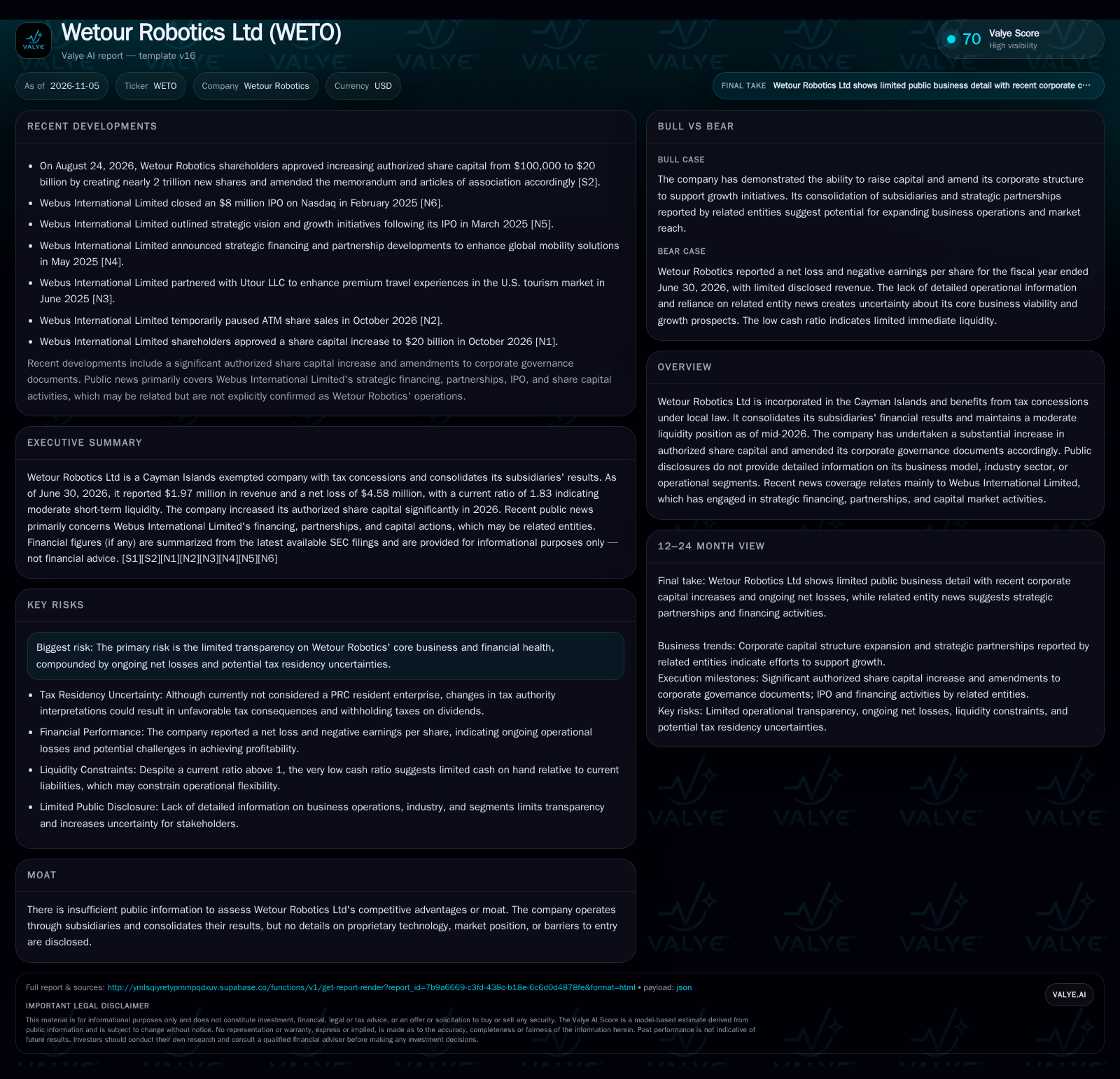
Wetour Robotics Ltd has dramatically expanded its authorized share capital and continues to consolidate subsidiary results, but faces ongoing net losses, reported cash balance, and sparse disclosure about its core operations or strategy. The company's ability to leverage its new capital structure will depend on clarifying its business model and demonstrating operational progress beyond corporate maneuvers. [S1] [S2]
Wetour Robotics Ltd stands at a crossroads defined more by financial engineering than by operational clarity. In 2026, the company authorized a near-unprecedented increase in share capital—leaping from $100,000 to $20 billion—potentially setting the stage for future capital raises, acquisitions, or strategic partnerships. Yet, beneath this bold move lies a company with modest revenue, persistent net losses, and a balance sheet that offers little comfort in the way of immediate liquidity. With little public detail about its core business activities or competitive positioning, the real test for Wetour Robotics will be whether this potential financial flexibility can be converted into tangible progress—or if it simply postpones more fundamental questions about the company's viability and strategy.
A Massive Capital Authorization Amid Ongoing Losses
The most striking recent development for Wetour Robotics is its extraordinary increase in authorized share capital, approved on August 24, 2026, which raised the ceiling from $100,000 to $20 billion and created nearly two trillion new shares. This move, coupled with amendments to the company's corporate governance documents, signals a desire for significant future flexibility—whether for equity fundraising, mergers, acquisitions, or other strategic initiatives. [S2]
At the operating level, the company reported $1,965,506 in revenue for the fiscal year ended June 30, 2026, while posting a net loss of $4,584,463. [S1]
Wetour Robotics is incorporated in the Cayman Islands and benefits from a 20-year tax concession, potentially reducing its exposure to certain cross-border tax risks. [S1]
Unpacking the Economics: High Uncertainty Around Revenue Drivers and Cost Structure
With only high-level financials disclosed, the core economics of Wetour Robotics remain opaque. The reported $1.97 million in revenue is modest and insufficient to offset operating costs, as evidenced by the net loss of $4.58 million in the most recent fiscal year. [S1] There is no breakdown of how revenue is generated—whether through robotics hardware, software, services, licensing, or other mechanisms—making it impossible to assess pricing power, volume trends, or margin structure.
The corporate structure—consolidating subsidiary results—could imply a multi-entity operation, but without segment detail, it's unclear whether the company has diversified offerings or is still in a pre-scale phase. The large net loss relative to revenue suggests high fixed costs and low operating leverage at present, or that early-stage R&D and commercialization expenses are dominating the P&L.
A deeper understanding of Wetour Robotics’ cost structure would be instrumental in evaluating its path to profitability. If fixed costs dominate, the company’s ability to scale revenue could lead to meaningful operating leverage, but this assumes a scalable product or service with market demand. Conversely, if variable costs are high or if the company faces significant ongoing R&D expenses without clear commercialization milestones, scaling may exacerbate losses. Furthermore, the lack of clarity on revenue recognition policies—such as whether revenue is recurring, project-based, or transactional—adds complexity to forecasting future cash flows and assessing financial sustainability.
Competitive Landscape: Unknowns Dominate Over Moat or Market Strength
There is no public disclosure of Wetour Robotics' core products, target markets, or technological differentiators, making it impossible to evaluate its competitive advantages or moat. The company could theoretically operate in any segment of the robotics value chain—manufacturing, automation solutions, AI-driven platforms, or service robotics—but the absence of detail means its position relative to established or emerging competitors remains a black box.
If Wetour is targeting high-barrier segments such as industrial automation or medical robotics, it would face entrenched multinational incumbents with substantial R&D, distribution, and regulatory expertise. In lower-barrier segments like consumer or educational robotics, price competition and rapid technology cycles dominate. The company's Cayman Islands domicile and apparent ability to consolidate multiple subsidiaries may offer some structural flexibility for cross-border partnerships or acquisitions, but this does not substitute for a clear operational edge.
Ultimately, the company's competitive posture—whether as a niche technology provider, a platform player, or a contract manufacturer—remains speculative until further operational specifics are disclosed.
The competitive dynamics within robotics are heavily influenced by innovation cycles, intellectual property protections, and ecosystem partnerships. Without insight into Wetour Robotics’ technology stack or patent portfolio, it is challenging to gauge its defensibility against competitors. If the company operates in a niche with proprietary technology, it could command pricing premiums or strategic partnerships; however, in commoditized segments, price pressure and rapid obsolescence may limit margins. Additionally, the company’s Cayman Islands incorporation could facilitate flexible international collaborations, but it also means navigating complex cross-border regulatory environments that could impact speed to market and cost structures.
How Capital Flexibility Could Enable Strategic Expansion—If Paired with Execution
The best-case scenario for Wetour Robotics is that its expanded authorized share capital enables significant equity fundraising, strategic partnerships, or acquisitions that accelerate growth and operational scale. If the company can deploy new capital into high-value product development, commercialization, or market entry—while keeping dilution and execution risk in check—it could begin to leverage fixed costs and approach breakeven.
Confirmation of this upside would require clear evidence of successful fundraising (e.g., large private placements or public offerings), announcements of material commercial contracts or partnerships, and disclosure of robust revenue growth driven by identifiable products or services. Operating leverage should improve, with net losses narrowing as revenue scales and gross margins stabilize or improve.
Falsification would occur if, despite the enlarged capital base, Wetour Robotics fails to attract new funding or commercial partners, or if revenue stagnates and net losses widen, indicating that the capital structure expansion was not matched by substantive business progress.
Strategic use of the expanded capital base could also enable Wetour Robotics to invest in building a robust go-to-market infrastructure, including sales, marketing, and customer support functions, which are critical for scaling revenue in technology-driven industries. If the company can demonstrate a clear product-market fit and secure anchor customers or partners, this would validate its business model and reduce execution risk. Moreover, the ability to pursue bolt-on acquisitions could accelerate access to complementary technologies or market segments, provided integration risks are managed effectively. Ultimately, the realization of this upside depends not only on capital availability but also on disciplined capital allocation and operational execution.
Business Model Ambiguity Persists as Corporate Restructuring Outpaces Operational Clarity
The most plausible near-term scenario is one of continued ambiguity: Wetour Robotics maintains its new capital structure and consolidates subsidiary results but does not provide the market with sufficient operational transparency. Revenue may grow incrementally, but without a clear articulation of business model, customer base, or product roadmap, the company struggles to attract significant outside capital or strategic partners.
Investors remain cautious, awaiting more granular disclosure on segment economics, customer traction, and competitive positioning.
This scenario would be confirmed by continued generic financial reporting without segment or product detail, ongoing net losses, and the absence of major fundraising, partnership, or commercialization announcements.
Risks of Prolonged Opacity: Liquidity Crunch and Erosion of Stakeholder Confidence
If Wetour Robotics is unable to translate its capital structure expansion into real-world capital raising or operational progress, the risk is that liquidity constraints become acute. [S1]
In this scenario, the absence of transparency—combined with ongoing net losses—could erode stakeholder confidence, making it even harder to attract capital or talent. Regulatory or tax setbacks (such as a change in PRC tax residency status) could further pressure cash flows and investor sentiment.
Evidence of this downside would include deteriorating current and cash ratios, rising payables, emergency or highly dilutive fundraising, layoffs, asset write-downs, or adverse regulatory disclosures.
Milestones That Will Clarify Wetour Robotics’ Strategic and Financial Trajectory
Disclosure of segment-level revenue, margin breakdowns, and customer concentration—if provided—would help clarify the company’s core business model and market focus.
Announcements of significant equity raises, private placements, or strategic investments would test whether the expanded authorized share capital is translating into real fundraising capacity.
Updates on major commercial contracts, partnerships, or product launches would offer insight into operational momentum and the company’s ability to win in the marketplace.
Trends in net loss, operating cash flow, and gross margin—if disclosed—would provide early signals of improving or worsening underlying economics.
Any change in the company’s tax residency status or adverse regulatory developments in its operating jurisdictions could materially impact its cost structure and investor appeal.
Disclosure of R&D pipeline, intellectual property holdings, or technology differentiation—if provided—would help assess competitive positioning.
Management commentary on capital allocation priorities, go-to-market strategy, or M&A intentions would be useful for understanding how the company plans to leverage its capital structure.
Disclaimer: This is research-only, informational analysis and not investment advice. It may include AI-generated interpretation and general industry context. Always verify important details using primary sources.

Comments