
Silgan Holdings: Margin Pressures, Portfolio Realignment, and the Economics of Essential Packaging
Silgan Holdings navigates modest top-line growth and margin compression in a shifting packaging landscape, with a $3.4 billion Trivium deal signaling a willingness to reshape its portfolio. The company’s ability to manage cost pass-throughs, rationalization, and acquisition execution remains central to its value proposition as it seeks to balance inflationary headwinds with operational scale.
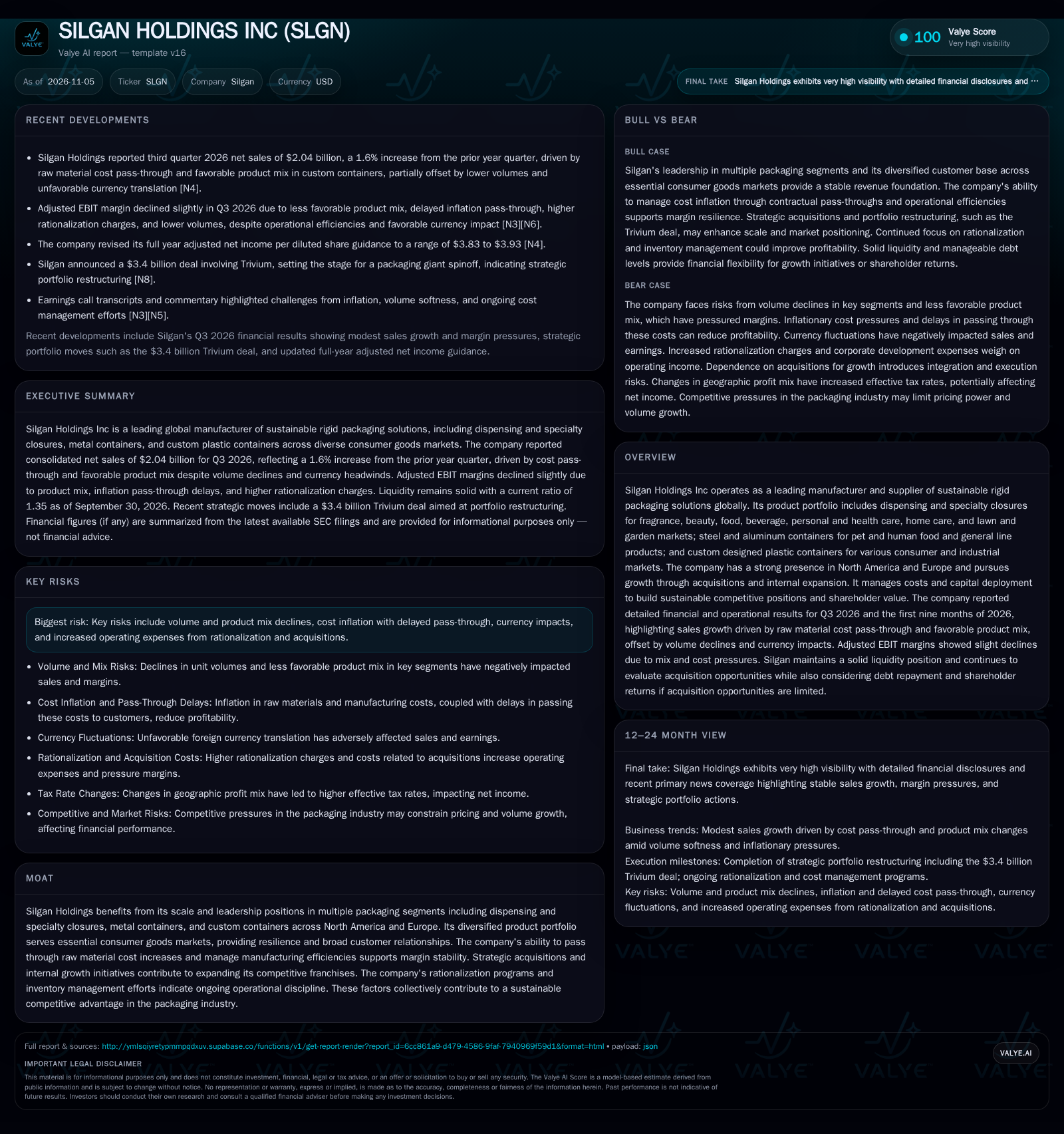
Silgan Holdings reported modest sales growth for Q3 2026, driven by raw material cost pass-through and favorable product mix, but continues to face declining volumes and margin pressure. A major $3.4 billion Trivium transaction signals a potential strategic pivot. The company’s core challenge is sustaining profitability through cost management, mix improvement, and successful portfolio restructuring in a competitive, inflation-prone market environment. [N3] [N4] [N5] [N6]
Silgan Holdings, a top provider of rigid packaging solutions for essential consumer goods, is contending with the realities of a maturing sector: modest sales growth, margin compression, and persistent volume declines. The company’s Q3 2026 results highlight the delicate balance between passing through rising input costs and defending profitability, all while executing a major $3.4 billion Trivium portfolio deal. As Silgan navigates inflationary pressures and evolving customer needs, its future will hinge on the interplay between operational discipline, portfolio strategy, and the underlying economics of a highly competitive packaging market.
Recent Results and Portfolio Actions Signal a Transitional Phase
Silgan Holdings reported Q3 2026 net sales of $2.04 billion, a 1.6% year-over-year increase, largely attributed to the pass-through of higher raw material costs and a more favorable product mix in custom containers. However, this growth masked underlying softness in unit volumes and unfavorable foreign currency effects. Gross profit margins edged down to 16.1% for the quarter, and income before interest and taxes fell to $191.7 million, with margin slipping to 9.4% from 9.9% in the prior year. These declines were linked to less favorable mix, higher rationalization charges, and inflation pass-through delays. [N4] [N6]
The company revised its full-year adjusted net income per diluted share guidance to $3.83–$3.93, reflecting these ongoing pressures. Notably, Silgan announced a $3.4 billion deal involving Trivium, positioning itself for a significant portfolio transformation and potentially altering its future strategic focus. [S2] [N4]
How Pass-Through Pricing and Mix Management Shape Silgan’s Profitability
Silgan’s core business model relies on manufacturing rigid packaging—dispensing and specialty closures, metal containers, and custom plastic containers—for essential consumer goods. The company’s ability to pass through raw material cost increases to customers is central to its economics, particularly in periods of commodity inflation. In practice, pass-through mechanisms can lag input cost spikes, exposing margins to short-term compression when input prices rise quickly.
Revenue growth in recent quarters has been driven more by cost pass-through and favorable mix in custom containers than by organic volume gains. This dynamic raises questions about the durability of top-line growth if volumes remain soft or mix deteriorates. Gross and EBIT margins are susceptible to less favorable mix, delayed inflation recovery, and increased rationalization charges, as seen in Q3 2026. Overhead leverage is limited in segments with flat or declining volumes, while operational discipline—inventory management, rationalization, and cost control—remains a key lever for margin defense.
Capital requirements are significant given the asset-intensive nature of large-scale packaging production. While reported liquidity position, future capital deployment will be influenced by the pace of acquisitions, rationalization costs, and portfolio initiatives such as the Trivium transaction. Return on invested capital will depend on the company’s ability to generate synergies, realize scale benefits, and avoid value-destroying integration pitfalls.
Scale, Customer Breadth, and the Realities of Packaging Industry Rivalry
Silgan’s competitive strength derives from its scale, broad product portfolio, and deep relationships with consumer goods customers in North America and Europe. Its leadership in dispensing and specialty closures, metal containers, and custom packaging provides some insulation from demand shocks in any one segment. However, the packaging industry remains highly competitive, with low switching costs for large customers and ongoing pressure from private label and lower-cost international producers.
While Silgan can partially mitigate raw material inflation through contractual pass-throughs, pricing power is limited by customer concentration and the commoditized nature of many packaging formats. Substitution risk is present as customers increasingly seek more sustainable, lighter-weight, or alternative-material solutions. Peer competition comes from global packaging conglomerates and regional specialists alike, with M&A activity frequently reshaping the landscape.
The company’s ability to defend share and margins depends on operational efficiency, innovation in sustainable packaging, and the successful integration of acquired businesses. Strategic moves, such as the Trivium deal, may enhance scale but also introduce execution risk and potential antitrust scrutiny if market overlap is significant.
Unlocking Value Through Successful Portfolio Restructuring and Efficient Cost Pass-Through
The most favorable scenario for Silgan involves executing the Trivium transaction smoothly, capturing synergies, and leveraging increased scale to negotiate better supplier and customer terms. If pass-through mechanisms keep pace with raw material inflation and the company maintains or improves product mix, margin recovery could follow even if volumes remain subdued.
Upside would be further supported by a return to volume growth in core segments, successful rationalization (reducing fixed costs), and new contract wins—especially in higher-margin custom or specialty packaging. Strong integration of acquired assets, with limited disruption and realization of cost savings, would confirm this scenario.
Evidence to watch would include rising EBIT margins, sequential volume stabilization or growth, disclosure of synergy targets and progress, and upward revisions to earnings guidance. Announcements of major new customer wins or innovative product launches in sustainable packaging would further validate the upside case.
Margin Management Amid Modest Growth and Persistent Cost Headwinds
The most plausible path is one of modest sales growth largely driven by continued cost pass-through, with volumes remaining flat or slightly declining as end-market demand stays tepid. Margin pressures may persist due to lagging inflation recovery, rationalization expenses, and a less favorable product mix, but operational discipline and incremental efficiency gains could prevent further material deterioration.
In this scenario, the Trivium deal is completed without major disruption but delivers only incremental financial improvement in the near term. Debt service and integration costs offset some anticipated synergy gains, and effective tax rates remain elevated due to geographic mix. Capital allocation is balanced between funding integration, cautious share repurchases, and maintaining a stable dividend if disclosed.
Confirming evidence would include stable or gradually improving EBIT margins, limited volume erosion, and the meeting (but not exceeding) of revised earnings guidance. Any significant acceleration in rationalization charges or further downward revisions to guidance would indicate a drift toward the downside.
Volume Erosion, Failed Integration, and Prolonged Margin Compression
A more adverse scenario unfolds if volume declines accelerate in key segments—due to weak consumer demand, substitution toward alternative packaging, or customer loss to competitors. If inflation outpaces Silgan’s ability to pass through costs, especially in a deflationary raw material environment where pass-through mechanisms reverse, margins could contract further.
Failure to realize expected benefits from the Trivium transaction—whether through integration missteps, operational disruption, or regulatory obstacles—would exacerbate pressure on earnings and cash flow. Higher-than-expected rationalization and acquisition expenses, coupled with persistent unfavorable product mix, could push EBIT margins below historical levels.
Signs of this scenario would include continued or accelerating margin declines, negative volume trends, unexpected increases in SG&A or rationalization charges, and further downward revisions to earnings guidance. Any material uptick in customer churn or loss of major contracts would further validate the downside thesis.
What Will Determine the Long-Term Value of Silgan’s Packaging Platform?
Quarterly volume growth or erosion across core packaging segments—especially dispensing and specialty closures—would clarify whether underlying demand is stabilizing or deteriorating.
Gross and EBIT margin trends, as well as the pace and effectiveness of cost pass-through, will indicate whether margin pressures are cyclical or structural.
Progress reports and synergy disclosures related to the Trivium transaction will show whether portfolio restructuring is accretive or value-destructive.
Rationalization and restructuring charges, if disclosed, will reveal the true cost of strategic transformation and operational efficiency drives.
Trends in customer concentration, contract renewal rates, and any major wins or losses would help test Silgan’s competitive resilience.
Product mix evolution—particularly growth in higher-margin custom or specialty packaging—would signal success in shifting toward more defensible niches.
Effective tax rate changes and their drivers, especially if related to geographic mix, could materially affect net income and cash flow.
Disclaimer: This is research-only, informational analysis and not investment advice. It may include AI-generated interpretation and general industry context. Always verify important details using primary sources.

Comments