
Lemonade’s AI-Powered Insurance: Momentum in Growth and the Journey Toward Profitability
Lemonade’s rapid in-force premium expansion and deep automation signal traction for its digital-first, vertically integrated insurance model. Yet, persistent losses and reliance on reinsurance highlight the unresolved tension between scale, risk transfer, and the ultimate profitability of AI-powered insurance.
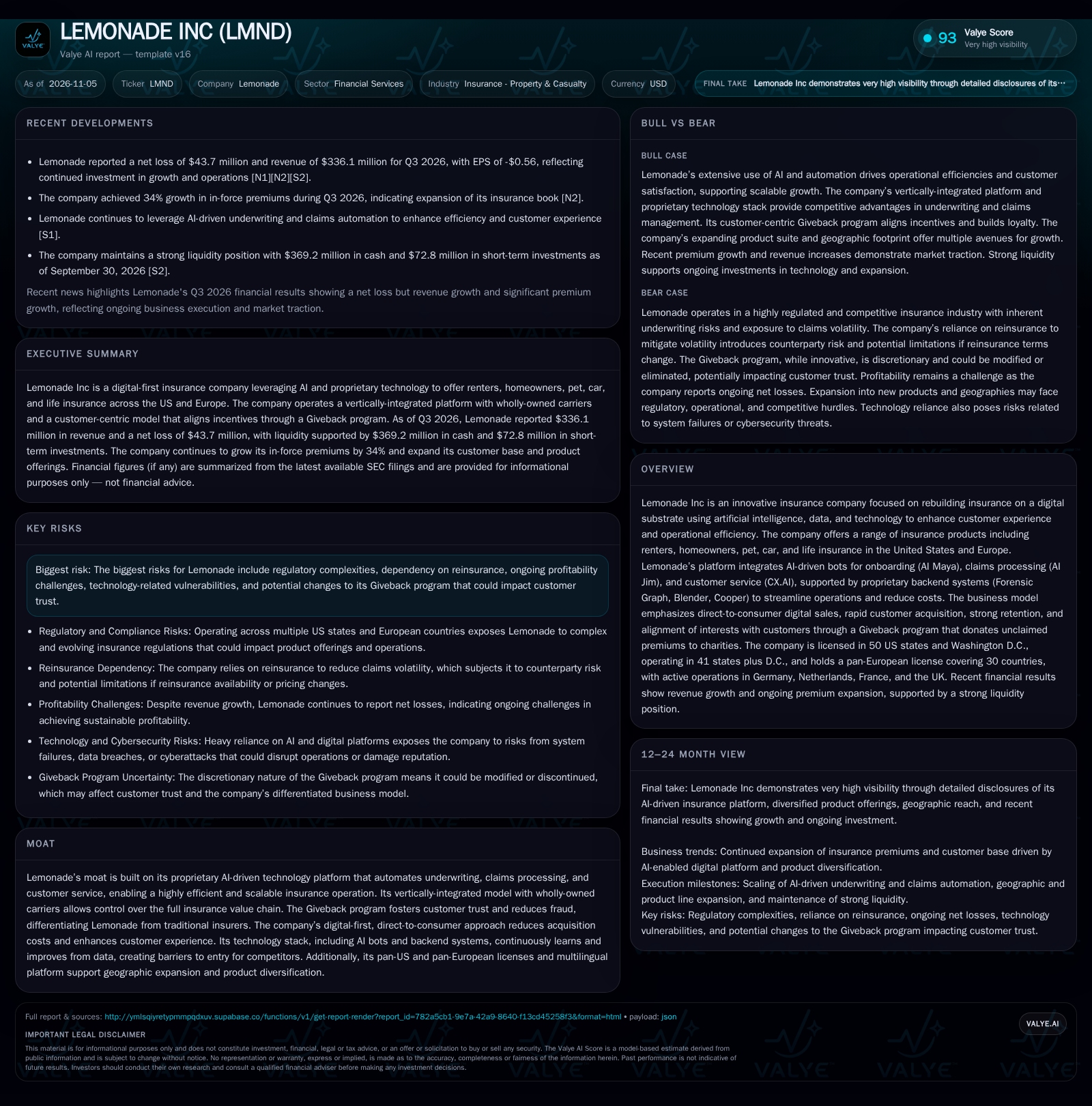
Lemonade reported Q3 2026 revenue of $336.1 million and net loss of $43.7 million, with 34% in-force premium growth and strong automation in underwriting and claims. The company’s direct-to-consumer, AI-driven platform is expanding across geographies and products, but profitability remains elusive, and reliance on reinsurance as well as regulatory complexity present ongoing challenges. Strategic focus now hinges on whether operational leverage from scale and technology can outpace claims volatility and acquisition costs to yield a sustainable business model. [S2] [N1] [N2]
Lemonade Inc’s latest results underscore the promise and pressure facing digital disruptors in insurance. The company’s 34% in-force premium growth and deepening AI integration highlight its ability to scale a direct-to-consumer, vertically integrated model across borders and product lines. However, persistent net losses and the unresolved challenge of underwriting profitability reveal that growth alone does not guarantee economic sustainability in this sector. The coming quarters will test whether Lemonade’s automation and data-driven approach can drive down acquisition and claims costs quickly enough to outpace the inherent volatility and expense of property and casualty insurance.
Lemonade’s 2026 Operating Environment Characterized by Growth and Ongoing Losses
Lemonade reported Q3 2026 revenue of $336.1 million and a net loss of $43.7 million, translating to an EPS of -$0.56. The company’s in-force premiums expanded by 34% year-over-year in the same period, underscoring ongoing customer acquisition and retention momentum. The company reported cash and liquidity metrics for the period; these figures do not by themselves establish operating runway, investment capacity, financial flexibility, or financing capacity. While these figures reflect robust top-line momentum and the company’s ability to attract and retain customers, the persistent net loss signals that scaling the platform has yet to deliver profitability, raising questions about the underlying economics of Lemonade’s model as it matures. [S2] [N1] [N2]
The Potential Impact of Lemonade’s Digital Platform on Insurance Economics
Lemonade’s business model is predicated on direct-to-consumer digital distribution, leveraging proprietary AI tools for onboarding, underwriting, claims processing, and customer service. This digital-first structure is designed to reduce fixed and variable labor costs, compressing traditional insurance operating expenses through automation. The company’s vertically integrated approach—with wholly owned carriers—enables it to capture a larger share of underwriting profits and exercise greater control over risk selection, pricing, and claims management than a broker or MGA.
Revenue is generated primarily from insurance premiums, with risk transfer to reinsurers used to reduce volatility. While this can stabilize results, it also limits upside from underwriting profits and exposes Lemonade to reinsurance pricing and availability. The Giveback program, which donates unclaimed premiums to customer-chosen charities, is intended to align incentives and reduce fraud, potentially lowering claims ratios over time. However, the program is discretionary and its long-term effect on loss ratios and retention is not independently established.
Operating leverage should, in theory, emerge as fixed platform and technology costs are spread over a larger premium base. However, insurance remains capital-intensive: regulatory capital requirements, claims reserves, and the need for substantial marketing investment to drive policy growth all impose significant funding needs. The challenge for Lemonade is whether its automation can sustainably outpace both claims volatility and customer acquisition costs to deliver positive underwriting margins and operating profits at scale.
Automation Sets Lemonade Apart Amid Intense Competition
Lemonade’s strongest differentiator is its proprietary AI stack, which automates customer interactions, underwriting, and claims—96% of first notices of loss were handled by AI Jim as of December 2025. This degree of automation, combined with a digital-native, mobile-centric user experience, sets Lemonade apart from legacy carriers still burdened by manual processes and siloed systems.
However, the property and casualty insurance landscape is highly competitive and regulated, featuring large incumbents with deep capital bases, sophisticated risk models, and entrenched distribution networks. Digital-only competitors and insurtech startups add further pressure, often targeting similar urban, tech-savvy customers. While Lemonade’s direct-to-consumer model may reduce distribution costs and enable rapid policy bundling, competitors can leverage scale, brand trust, and multi-line offerings to retain and cross-sell customers.
Moreover, the technology and data advantages Lemonade enjoys may narrow over time as larger carriers accelerate their own digital transformation. The open question is whether Lemonade’s pace of learning and automation can maintain a structural cost or experience advantage, or if it will be eroded as the industry catches up.
Profitability Prospects Improve if Automation Cuts Loss and Acquisition Expenses
Lemonade’s best-case trajectory depends on its ability to translate premium growth and automation into structurally lower loss and expense ratios than traditional insurers. If AI-driven underwriting proves more accurate at risk selection, and if automated claims processing continues to reduce fraud and administrative costs, the company could achieve a step-change in insurance operating margins.
Proof of this scenario would be a sustained improvement in gross loss and combined ratios, with in-force premium growth translating directly into improved operating leverage and narrowing net losses. Evidence would include declining customer acquisition costs, rising retention and policy bundling rates, and positive cash flow from core insurance operations even as the company continues to invest in expansion.
A durable advantage would be further confirmed if Lemonade can maintain or extend its automation lead while successfully launching new products and entering new geographies faster than legacy peers, without a meaningful increase in volatility or adverse selection.
Growth Continues, Yet Margin Gains Are Expected to Take Several Years
The most plausible path forward is continued premium and revenue growth driven by digital acquisition and product expansion, but with a gradual and uneven improvement in loss and expense ratios. Lemonade’s automation may deliver incremental operating leverage, but the core economics of property and casualty insurance—claims volatility, marketing expense, and regulatory capital needs—will likely keep the company in a loss-making position for several more quarters.
In this scenario, Lemonade’s market share grows among younger, tech-savvy consumers, and the company continues to build brand equity and data advantages. However, competitive pressures from both digital startups and modernizing incumbents compress pricing and limit near-term margin expansion. Progress is measured by modest improvements in underwriting performance and expense discipline, but not yet by consistent operating profitability or cash generation.
Confirmation of this scenario would be ongoing premium and revenue growth with only gradual narrowing of net losses and stable or slightly improving combined ratios, alongside continued investment in technology and geographic expansion.
Risks from Claims Variability, Reinsurance, and Customer Retention Could Challenge Growth
The adverse scenario for Lemonade is driven by a failure to demonstrate structural improvements in loss ratios or operating leverage. If claims frequency or severity rises—due to adverse selection, fraud, or weather events—the company may see gross loss ratios remain stubbornly high or even deteriorate as it scales. A change in reinsurance terms or capacity could expose Lemonade to greater volatility or require higher retention of risk, amplifying losses.
Customer acquisition costs could also rise if digital marketing channels become more expensive or less effective, while customer churn may increase if the Giveback program is modified or competitors match Lemonade’s digital experience. Technology or cybersecurity failures could erode trust and stall new business momentum.
This scenario would be confirmed by persistent or widening net losses, deteriorating loss and combined ratios, slowing premium growth, or any sign of strain in reinsurance relationships or regulatory compliance.
Critical Developments to Track in Lemonade’s AI Insurance Evolution
Gross loss ratio and combined ratio trends: sustained improvement would signal that automation is driving real underwriting and operational gains; deterioration would challenge the model’s economics, if disclosed.
Customer acquisition cost and retention rates: declining CAC and rising retention/bundling would confirm the efficacy and scalability of Lemonade’s digital growth engine.
Premium growth by product and geography: continued expansion, especially in new lines and markets, would validate the platform’s extensibility.
Reinsurance terms, capacity, and counterparty relationships: any changes here could materially impact volatility and profitability.
Giveback rate and customer participation: if disclosed, higher engagement and lower fraud rates would support the company’s claims of incentive alignment and trust.
Operating cash flow from core insurance activities: a shift to positive cash flow would mark a critical inflection point for business sustainability.
Frequency and impact of technology or cybersecurity incidents: material disruptions would challenge the company’s core automation advantage.
Disclaimer: This is research-only, informational analysis and not investment advice. It may include AI-generated interpretation and general industry context. Always verify important details using primary sources.

Comments