
ACI Worldwide: SaaS Payment Platforms, Margin Pressures, and the Stakes of Execution
ACI Worldwide’s Q3 earnings miss highlights execution and margin challenges amid a rapidly evolving payments landscape. The company’s SaaS and platform-driven model offers recurring revenue potential, but competitive intensity and liquidity metrics demand close scrutiny as the business adapts to sector shifts.
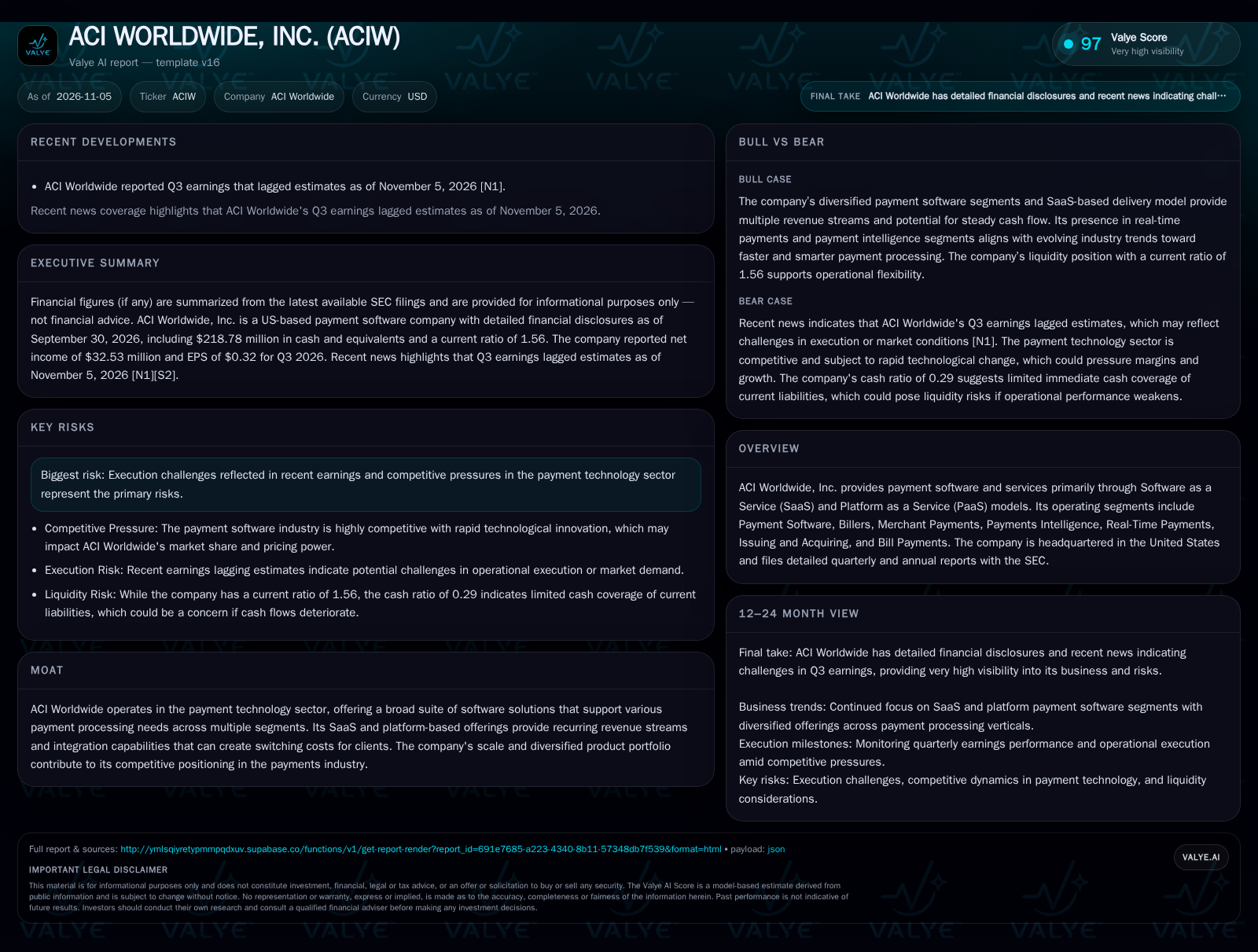
ACI Worldwide’s Q3 2026 earnings lagged expectations despite a diversified SaaS and platform-based payment software portfolio. As competition and technology shifts intensify, execution and margin resilience remain central to the outlook. [S2] [N1]
ACI Worldwide, Inc. faces a pivotal period as its Q3 2026 earnings miss spotlights the challenges inherent in the payment technology sector. With a broad suite of SaaS and platform-based offerings, the company is positioned to benefit from secular trends in digital payments and real-time transaction processing. However, a modest cash ratio and the realities of intensifying competition underscore the importance of execution and capital discipline. The next phase will test ACI’s ability to convert its diversified portfolio into resilient, profitable growth while managing liquidity and adapting to rapid industry change. [S2] [N1]
Earnings Miss, Liquidity Metrics, and Portfolio Breadth: The Current Snapshot
For the quarter ended September 30, 2026, ACI Worldwide reported net income of $32.53 million and basic/diluted EPS of $0.32, with results falling below market expectations as highlighted by recent news coverage [S2] [N1]. This underperformance brings execution into focus, raising questions about demand, cost control, or competitive dynamics. The company reported cash and liquidity metrics for the period; these figures do not by themselves establish operating runway, investment capacity, financial flexibility, or financing capacity. [S2] ACI’s business remains diversified across SaaS and PaaS offerings, spanning Payment Software, Billers, Merchant Payments, Payments Intelligence, Real-Time Payments, and Bill Payments, illustrating a multi-pronged approach to the payments market.
Recurring Revenue Mechanics and Margin Sensitivities in Payments Software
ACI Worldwide’s revenue generation is anchored in SaaS and PaaS models, where customers typically pay recurring fees for access to payment processing, billing, and transaction intelligence platforms. This approach, common in payment technology, offers the promise of revenue visibility and operational scalability as recurring contracts accumulate. However, the economics are highly sensitive to customer retention, pricing discipline, and transaction volumes—especially as clients demand integration and real-time capabilities.
Fixed costs—primarily R&D, platform infrastructure, and compliance—can be substantial, but the SaaS model creates operating leverage if customer growth outpaces cost increases. Variable costs include customer support, transaction processing, and partner revenue shares. Margin expansion depends on the company’s ability to onboard new clients and upsell existing relationships faster than incremental costs rise. Capital needs are moderate relative to hardware businesses, but ongoing investment in platform upgrades and cybersecurity is essential for relevance and regulatory compliance.
The modest cash ratio, while not a crisis in a normally functioning business, does place a premium on working-capital discipline. If top-line growth falters or collections slow, the company’s ability to self-fund investment or absorb shocks could become a concern.
The interplay between customer acquisition costs and lifetime value is critical in assessing the sustainability of ACI’s recurring revenue model. If customer onboarding expenses rise disproportionately due to intensifying competition or increased customization demands, margin pressures could intensify despite steady subscription growth. Conversely, improvements in automation, platform scalability, or standardized integration protocols could reduce marginal costs per customer, enhancing profitability. Additionally, the elasticity of pricing in response to competitive forces will influence revenue resilience; if customers exhibit high price sensitivity, maintaining or growing average revenue per user may require innovative packaging or value-added services to justify premium pricing.
How ACI’s Platform Model Stacks Up in a Crowded Payments Landscape
ACI Worldwide competes with a range of payment technology providers, including global payment processors, fintech SaaS platforms, and legacy banking IT vendors. Its competitive strengths stem from a broad product suite, integration capabilities, and deep experience in complex payment environments such as billers and real-time payments. The SaaS and platform-based delivery models can create switching frictions for enterprise clients, especially when embedded in mission-critical workflows.
However, the payment software market is characterized by rapid innovation cycles, aggressive pricing, and the constant threat of disintermediation by new entrants or large technology firms. Margins are under pressure as customers become more price-sensitive and demand seamless, omnichannel experiences. ACI’s ability to differentiate through product breadth, regulatory compliance, and real-time capabilities is an advantage, but the pace of innovation and customer expectations means that any execution misstep can quickly erode share. The sector’s low switching costs for certain customer segments—especially merchants—raise the stakes for ongoing investment and service reliability.
In a market where technology cycles accelerate rapidly, ACI’s ability to anticipate and integrate emerging payment technologies—such as distributed ledger solutions or advanced fraud detection algorithms—may determine its competitive positioning. Firms that fail to invest adequately in R&D risk obsolescence, while overinvestment without clear monetization pathways can erode margins. Furthermore, strategic partnerships or ecosystem integrations can serve as force multipliers, enabling access to new customer segments or enhancing platform stickiness. The balance between proprietary innovation and open architecture will shape the company’s adaptability and customer retention in a fragmented payments ecosystem.
Unlocking the Value of Recurring Payments: What Could Drive Durable Growth
A favorable outcome for ACI Worldwide would see the company leveraging its SaaS and PaaS platforms to deepen penetration in real-time payments and high-value biller segments. If the company can demonstrate consistent customer acquisition, high retention rates, and successful upselling of payment intelligence and integration modules, recurring revenues could accelerate. This would drive margin expansion through operating leverage and reduce exposure to transactional volatility.
Confirmation of this scenario would require evidence of sequential growth in SaaS and platform subscription revenues, improved net revenue retention metrics (if disclosed), and rising segment profitability. Strategic wins—such as new large enterprise contracts or successful rollouts of next-generation payment features—would provide further validation. Additionally, a sustained improvement in quarterly earnings above consensus estimates would signal effective execution and competitive resilience.
Sustaining Multi-Segment Operations Amid Margin and Liquidity Constraints
The most plausible trajectory is that ACI Worldwide maintains stable, if unspectacular, growth across its diversified payment software segments. Recurring SaaS and PaaS revenue streams provide a buffer against major revenue swings, but competitive pricing and technology investments keep margins under moderate pressure.
In this scenario, quarterly results may fluctuate around consensus expectations, with occasional misses or beats driven by customer wins, renewals, or cost actions. Confirmation would come from steady segment revenue contributions, controlled operating expenses, and the absence of material negative surprises in liquidity or earnings. Falsification would be signaled by a pattern of earnings misses, deterioration in current or cash ratios, or signs of customer attrition.
Margin Compression and Liquidity Erosion: When Execution Falters
The adverse scenario involves a combination of margin compression and liquidity stress. If ACI Worldwide is unable to offset competitive pressures with new customer wins or price discipline, revenue growth could stall or reverse. This would strain operating leverage, as fixed costs remain high while top-line growth slows.
Indicators of this scenario would include a string of quarterly earnings misses, shrinking net income, rising short-term borrowings, or the need to tap external capital markets under less favorable conditions. Evidence of declining customer retention, increased pricing concessions, or publicized client losses would further validate downside risk.
Milestones That Will Determine ACI Worldwide’s Payment Platform Trajectory
Quarterly net revenue retention rates for SaaS and PaaS platforms, if disclosed, would provide insight into customer stickiness and upsell effectiveness.
Sequential growth in platform subscription revenues across Payment Software, Billers, and Real-Time Payments segments would help test the recurring revenue thesis.
Gross and operating margin trends, especially in the context of ongoing technology investment, should be monitored for early signs of margin pressure or expansion.
Announcements of major enterprise customer wins, renewals, or publicized client losses could signal shifts in competitive positioning.
Quarterly earnings versus consensus expectations will reveal whether execution is improving or further misses are accumulating.
Disclaimer: This is research-only, informational analysis and not investment advice. It may include AI-generated interpretation and general industry context. Always verify important details using primary sources.

Comments