
Weis Markets: Regional Scale, Vertical Integration, and the Battle for Grocery Share
Weis Markets’ dense store network, self-distribution, and private manufacturing underpin its regional supermarket economics, but margin pressures, internal control weaknesses, and a constrained geographic footprint shape the risk-reward. The next phase hinges on execution in differentiation, digital, and cost discipline.
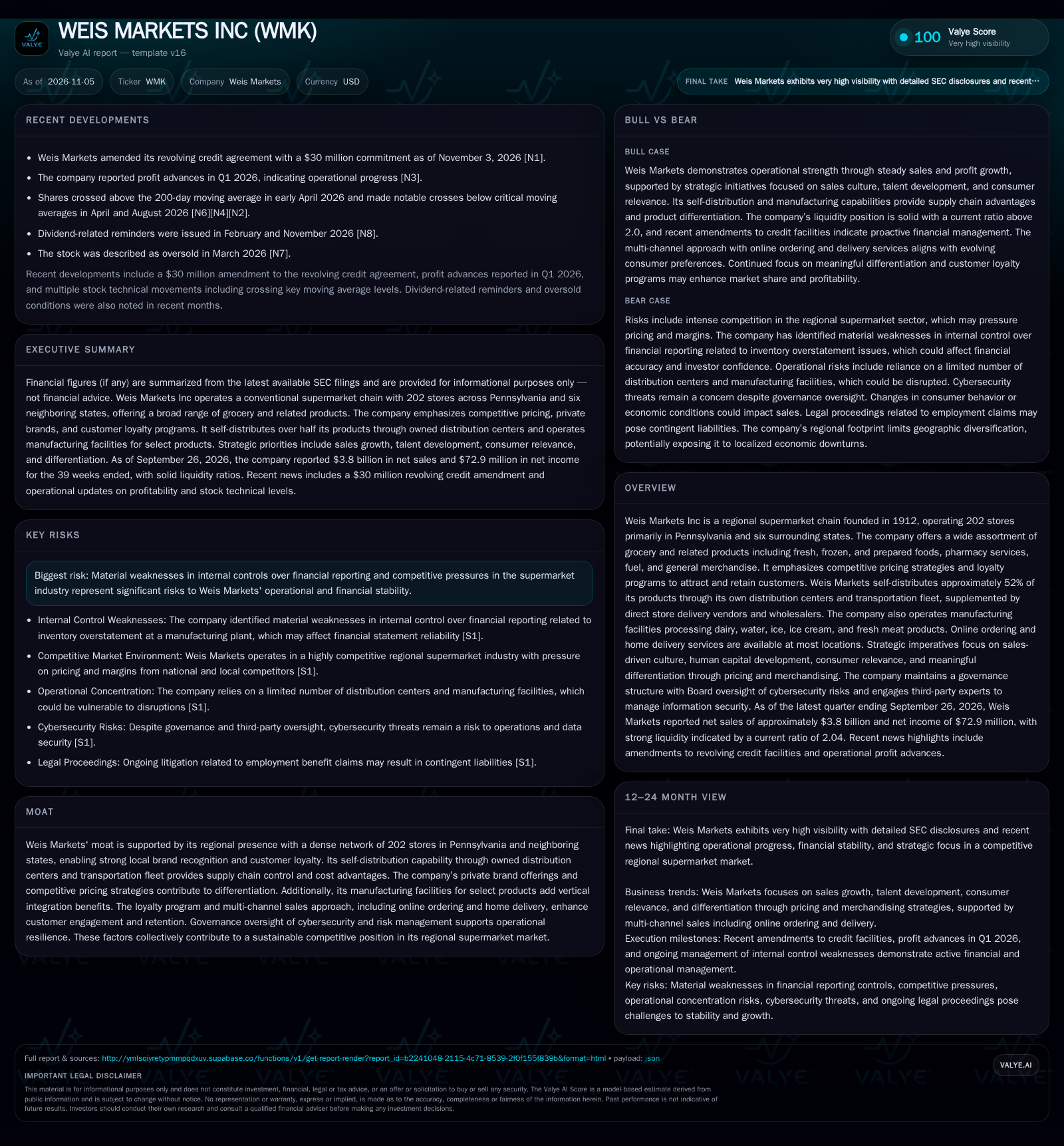
Weis Markets operates 202 stores across seven Mid-Atlantic states, generating $3.8 billion in net sales and $72.9 million in net income for the first 39 weeks of 2026 [S2]. Its model blends self-distribution, private label manufacturing, and multi-channel retailing, but faces intense competition, operational concentration, and recent material weaknesses in inventory controls [S1] [S2]. The company’s ability to sustain margin and relevance will depend on execution in loyalty, pricing, and omnichannel delivery.
Weis Markets stands as a classic example of a regionally scaled, vertically integrated supermarket operator, balancing the advantages of local density and supply chain control against the relentless pressures of grocery competition. With 202 stores across the Mid-Atlantic, $3.8 billion in recent net sales, and a blend of owned distribution, private label production, and omnichannel services, Weis is well-positioned to defend share in its core markets. Yet, with margin pressures, internal control weaknesses, and a limited geographic footprint, the company’s next chapter will be defined by its ability to execute on differentiation, cost discipline, and digital relevance.
A Snapshot of Weis Markets’ Operating and Financial Position
As of September 26, 2026, Weis Markets operated 202 stores across Pennsylvania and six adjacent states, supported by over 22,000 employees [S1]. For the first 39 weeks of 2026, the company reported net sales of approximately $3.8 billion and net income of $72.9 million, translating to $2.95 in basic and diluted EPS [S2]. The company held $126.3 million in cash and reported liquidity-ratio trends of 2.04 [S2].
Material weaknesses in internal controls over inventory at one manufacturing plant have been disclosed, raising questions about the reliability of reported figures and the potential for future restatements or operational scrutiny [S1].
Operationally, Weis continues to self-distribute roughly 52% of its products through its own distribution centers and transportation fleet, while also manufacturing select products such as dairy, ice, and fresh meat [S1]. The company reported cash and liquidity metrics for the period; these figures do not by themselves establish operating runway, investment capacity, financial flexibility, or financing capacity. [N1]
How Weis Markets’ Vertically Integrated Model Shapes Profitability
Weis Markets’ business model combines conventional supermarket retailing with a vertically integrated supply chain. The company’s self-distribution—covering about half of its product volume—reduces reliance on third-party wholesalers and can lower per-unit logistics costs in a dense regional footprint. Owning and operating two large distribution centers and manufacturing facilities (for milk, ice cream, water, and meat) enables some control over input costs, product freshness, and private label margins [S1].
Revenue is driven by a mix of national, regional, and private brands, with private label products potentially offering higher gross margins if volume and sourcing efficiencies are realized. However, the sector’s competitive intensity often translates into thin margins, as evidenced by net income of $72.9 million on $3.8 billion in sales—a net margin below 2% [S2].
Fixed costs are significant: labor for 22,000+ employees, facility operations, and logistics. The model’s operating leverage means that incremental sales growth can translate into higher margins if costs are held flat, but also that revenue declines or cost inflation (wages, energy, ingredients) can quickly erode profit. The company’s capital needs revolve around store maintenance and upgrades, supply chain investments, and digital platform enhancements, but are generally lower than those of national expansionary peers.
Multi-channel sales (online ordering via ‘Weis 2 Go Online’ and third-party delivery) offer incremental revenue opportunities but may dilute margins if fulfillment, picking, and delivery costs are not tightly controlled.
Defending Share in a Crowded Regional Grocery Landscape
Weis Markets’ primary competitive advantage lies in its regional density, enabling local brand recognition, frequent shopping trips, and cost-effective self-distribution. Its store network overlaps with a range of competitors: national chains (e.g., Walmart, Kroger, Target), regional supermarkets, discounters (Aldi, Lidl), club stores, and specialty grocers. The company’s focus on competitive pricing ('Everyday Lower Price', 'Low Price Guarantee'), loyalty programs, and private brands is essential in a segment where switching costs for consumers are low and price sensitivity is high [S1].
Self-distribution and selective vertical integration (manufacturing dairy, ice, and meat products) may provide some insulation from supply shocks and cost volatility, but these advantages are not unique and can be matched by larger, better-capitalized chains. Furthermore, Weis’ geographic concentration exposes it to regional economic downturns and limits the benefits of national advertising or supply chain scale.
The company’s online and delivery offerings are now table stakes rather than a differentiator, especially as third-party delivery partners make such services widely available. Weis’ ability to create meaningful differentiation will likely hinge on local merchandising, fresh/perishable execution, and the perceived value of its loyalty programs.
What Could Unlock Margin Expansion and Share Gains?
A favorable scenario for Weis Markets would see the company leveraging its self-distribution and manufacturing assets to drive higher private label penetration and more effective cost control, thereby expanding gross margins. If the company can deepen loyalty program engagement, tailor merchandising to local preferences, and execute on omnichannel convenience, it could capture incremental share from less-nimble regional rivals.
Confirmation would come from sustained, above-peer comp sales growth, rising private label penetration (if disclosed), and sequential improvement in gross and operating margin. Successful remediation of internal control weaknesses—evidenced by unqualified audit opinions and no further restatements—would restore investor confidence and reduce operational distraction.
Additional upside could stem from cost discipline in labor and supply chain, and from digital initiatives that increase basket size and order frequency in online channels without eroding margins.
The Most Likely Outcome: Stable But Pressured Regional Operator
A plausible middle path is that Weis Markets maintains its share in core markets, with modest top-line growth tracking local population and inflation. Gross margins remain under pressure from promotional activity and input cost inflation, but are partly offset by ongoing cost control and operational improvements.
The company successfully addresses its internal control issues, but these do not translate into outsized cost savings or revenue gains. Omnichannel and loyalty initiatives are necessary for customer retention but are largely defensive, preventing share loss rather than driving expansion.
Confirmation would come from steady comp-store sales, net income margins remaining in the low single digits, and no further material internal control findings. Falsification would be a marked deterioration in margin, persistent audit issues, or visible share loss to discounters or national chains.
Where the Model Breaks: Margin Squeeze, Execution Missteps, or Loss of Trust
A negative scenario would see Weis Markets’ already-thin margins further compressed by aggressive pricing from national chains and discounters, labor or input cost spikes, or a failure to contain fulfillment costs in the online channel. If internal control weaknesses recur or escalate, confidence in reported results could erode, increasing financing costs or limiting access to capital.
Operational risk is heightened by reliance on two distribution centers and manufacturing facilities; any disruption (from cyberattack, supply chain shock, or natural disaster) could create major inventory or sales shortfalls. Legal liabilities or regulatory scrutiny related to employment claims or inventory reporting could further undermine performance.
Confirmation would be a sharp drop in net income, negative comp sales, persistent material weakness disclosures, or adverse legal/regulatory developments.
Milestones That Will Test Weis Markets’ Differentiation and Margin Thesis
Gross and operating margin trends, especially relative to peer regional grocers and national chains, will indicate whether vertical integration and cost control are translating into durable profitability.
Comp-store sales growth and traffic/basket size trends, if disclosed, would clarify whether Weis is defending or gaining share in its core markets.
Private label sales penetration, if disclosed, would help assess the effectiveness of the company’s manufacturing and merchandising strategy.
Loyalty program engagement rates and redemption activity (if disclosed) would provide insight into customer stickiness and promotional ROI.
Resolution and remediation progress on internal control weaknesses—specifically, auditor commentary and absence of new material weaknesses—will be critical for investor trust.
Digital and omnichannel order growth, fulfillment cost per order, and customer satisfaction with online delivery would clarify whether digital is a profit lever or cost drag.
Updates on contingency liabilities or regulatory matters related to inventory controls or employment claims could materially alter the risk profile.
Disclaimer: This is research-only, informational analysis and not investment advice. It may include AI-generated interpretation and general industry context. Always verify important details using primary sources.

Comments