
Deluxe’s Payments Pivot: Integration, Print Headwinds, and the Economics of Modernization
Deluxe Corporation’s Q3 2026 results underscore a complex transition: growth in payments and data businesses—amplified by the Celero acquisition—offset by persistent Print segment declines and the costs of transformation. The company’s ability to leverage operational efficiencies, manage integration risks, and capture value in a rapidly evolving payments landscape will shape its next chapter.
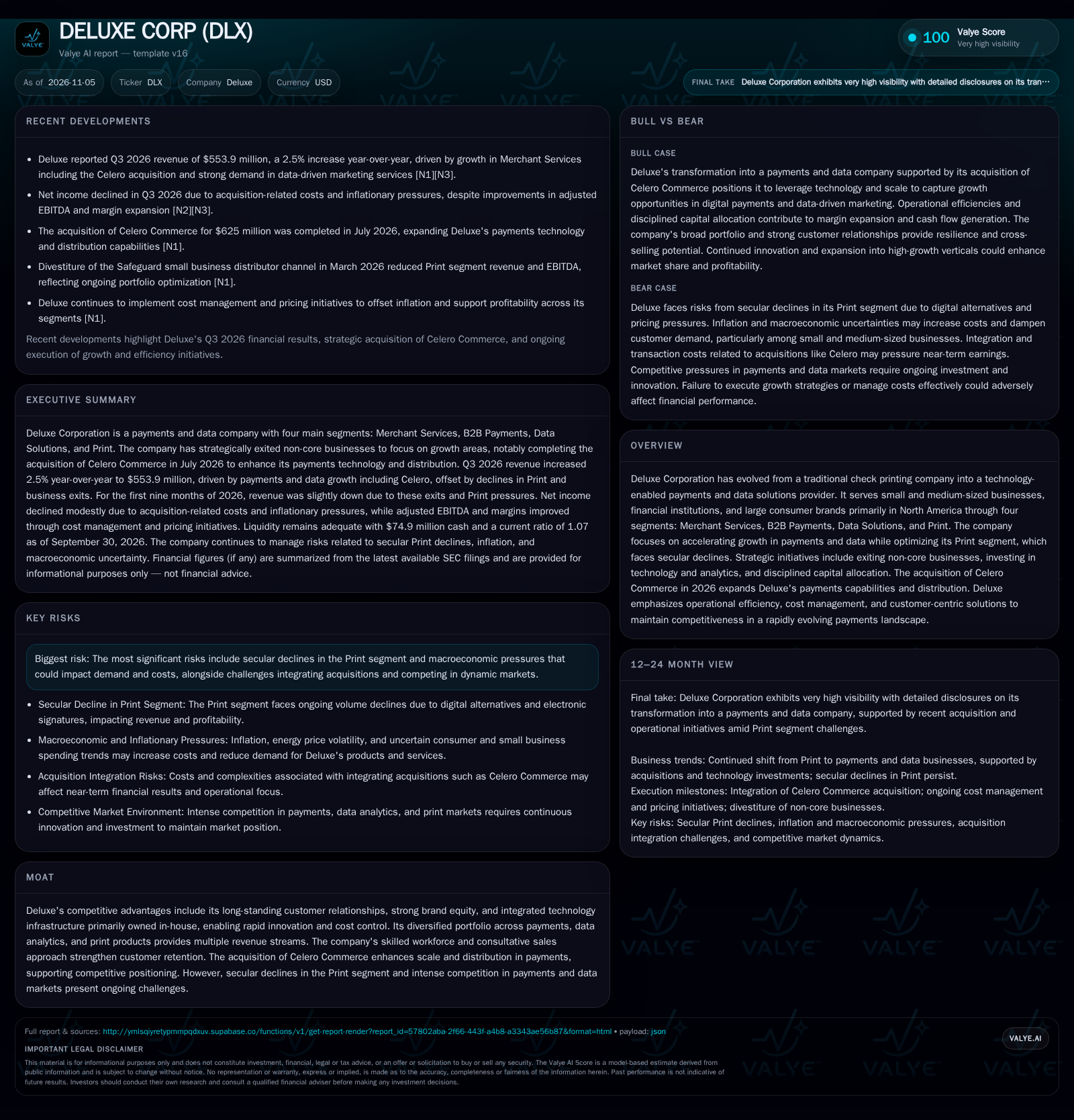
Deluxe’s shift from legacy print to digital payments and data is accelerating, with the $625 million Celero acquisition already contributing to Merchant Services growth in Q3 2026. While overall revenue edged up 2.5% year-over-year, Print segment declines and acquisition costs pressured net income. Margin improvements and robust free cash flow reflect successful cost management, but the long-term thesis hinges on integrating Celero, sustaining payments growth, and mitigating Print’s secular contraction. reported liquidity position, yet macroeconomic and competitive pressures persist. [S2] [N1] [N3]
Deluxe Corporation’s latest quarter illustrates both the promise and challenge of transformation. The company’s deliberate pivot toward payments and data—marked by the sizable Celero Commerce acquisition—has begun to show in segment growth and improved margins. Yet, the persistent decline of the Print segment and the upfront costs of reshaping the business model continue to weigh on reported net income. Deluxe’s future now depends on its ability to integrate new assets, extract synergies, and maintain momentum in higher-growth, higher-margin segments, all while managing legacy headwinds and a competitive, inflationary environment. [S2] [N1] [N3]
Celero Acquisition Accelerates Payments Growth Amid Print Decline
Deluxe’s acquisition of Celero Commerce for $625 million in July 2026 was a major strategic move to bolster its Merchant Services segment. Celero contributed $33.5 million to Q3 2026 revenue, helping to drive total revenue up 2.5% year-over-year to $553.9 million. This payments-driven growth was partially offset by ongoing declines in the Print segment and the effects of divesting non-core businesses. For the first nine months of 2026, revenue was slightly down compared to the prior year, reflecting these offsetting trends. Despite acquisition costs and Print pressures reducing net income by $2.2 million year-over-year, Deluxe improved its adjusted EBITDA margin to 22.2% and increased free cash flow to $134.9 million. The company reported a current ratio of 1.07 for the period. [S2] [N1] [N3]
How Deluxe’s Shifting Revenue Mix and Cost Structure Shape Profitability
Deluxe’s business model now hinges on a mix of transaction-driven revenues from payments, data analytics and marketing services, and legacy print products. Merchant Services and B2B Payments are characterized by high transaction volumes and recurring fee structures, which—if retention and volume growth are sustained—can drive operating leverage as scale increases. Data Solutions, with its cloud-based analytics and marketing offerings, likely enjoys relatively high gross margins due to software-driven economics and incremental cost efficiency. Print, by contrast, is capital-intensive, with secularly declining volumes and pricing pressure, leading to margin compression.
The Celero acquisition, funded by amended credit facilities, increases Deluxe’s exposure to payments technology and expands distribution to small and mid-sized businesses. If integration is executed well, Deluxe could benefit from cross-selling, improved unit economics, and a higher share of wallet within existing clients. However, acquisition-related amortization and integration expenses are weighing on net income in the near term. The company’s ability to generate $215.9 million in operating cash flow and $134.9 million in free cash flow for the first nine months of 2026 demonstrates that, despite headwinds, the shift toward higher-margin segments is supporting cash generation. Capital allocation is now focused on growth investments, debt reduction, and select shareholder returns, but future acquisition appetite may be constrained by leverage and integration bandwidth. [S2]
Navigating Competitive Pressures in Payments, Data, and Print
Deluxe competes against a spectrum of specialized payment processors, B2B fintechs, marketing analytics providers, and traditional print manufacturers. In payments, competition from both large incumbents and agile fintechs puts pressure on pricing, innovation, and customer acquisition costs. Deluxe’s advantage may lie in its long-standing customer relationships, integrated platforms, and consultative sales force, which could enable cross-selling and retention. The Data Solutions segment faces rivals with substantial technology and data science resources; the key will be leveraging Deluxe’s proprietary data and cloud infrastructure to deliver differentiated value.
Print remains a structurally challenged segment, with digital alternatives eroding demand for checks, forms, and paper-based products. Deluxe’s ability to extract cash from this legacy business and redeploy it to higher-growth areas is critical, but the risk of accelerated volume decline or customer attrition persists. The company’s diversified portfolio offers some resilience, but the competitive landscape across payments and data is dynamic and requires ongoing investment to maintain relevance.
Synergy Realization and Payments Scale Drive Earnings Reacceleration
If Deluxe successfully integrates Celero Commerce, realizes revenue and cost synergies, and achieves above-market growth in Merchant Services and B2B Payments, the company could see a durable expansion in EBITDA margins and free cash flow. Cross-selling payments and data solutions to an expanded SMB client base, combined with further technology modernization, would increase Deluxe’s share in high-margin, recurring-revenue businesses. Confirmation of this scenario would come from accelerating payments revenue growth, sustained improvement in adjusted EBITDA margins, and evidence of new customer wins or expanded wallet share among existing clients.
Falsification would be indicated by stalled payments growth, persistent integration costs without offsetting revenue gains, or a reversal in margin trends despite Print’s ongoing decline.
Transformation Progresses, But Print Drag and Integration Costs Temper Gains
The most plausible outcome is a continued gradual shift in revenue mix toward payments and data, with Print declines and integration expenses partially offsetting gains. Payments and Data Solutions will likely grow in the high single digits, while Print contracts at a mid-single-digit pace. Margin improvement is sustained by cost management and pricing actions, but net income remains under pressure as Deluxe absorbs amortization and integration costs from Celero.
This scenario would be confirmed by steady, if moderate, top-line growth, incremental EBITDA margin gains, and stable or slightly improving free cash flow, with Print declines not accelerating beyond current trends. Falsification would come from an unexpected acceleration in Print volume erosion, integration disruptions, or loss of payments market share.
Legacy Erosion or Integration Missteps Undermine Strategic Shift
The adverse scenario emerges if Print segment declines accelerate sharply, outpacing growth in payments and data, or if Celero integration proves more complex and costly than anticipated. Rising churn, customer attrition, or competitive losses in Merchant Services could erode Deluxe’s revenue base and margin profile. Inflationary pressures or macroeconomic shocks could further squeeze SMB and enterprise clients, reducing transaction volumes and marketing spend.
This scenario would be confirmed by declining or stagnant group revenues, EBITDA margin compression, negative free cash flow, or a need to draw more heavily on credit facilities to cover integration or restructuring costs. Persistent negative net income beyond the near term, or evidence of customer loss in core growth segments, would also signal downside realization.
Milestones That Will Define Deluxe’s Payments-Led Transformation
Quarterly revenue growth in Merchant Services and B2B Payments—if disclosed at a segment level—would help gauge the pace of payments-led transformation.
Adjusted EBITDA margin progression, particularly evidence of sustained improvement beyond Celero integration costs.
Print segment volume and revenue trends: a useful metric would be the rate of decline and any signs of stabilization or further acceleration downward.
Net customer additions or retention rates in payments and data businesses—if disclosed—would clarify Deluxe’s competitive position.
Acquisition integration updates, including achievement of synergy targets and realization of cross-selling opportunities.
Evidence of new product launches or enhanced technology offerings in payments and data, signaling continued innovation and market relevance.
Material changes in macroeconomic conditions—such as SMB spending or inflation—that could impact transaction volumes and demand for Deluxe’s services.
Disclaimer: This is research-only, informational analysis and not investment advice. It may include AI-generated interpretation and general industry context. Always verify important details using primary sources.

Comments