
Aspire Biopharma Advances Novel Sublingual Aspirin Toward FDA Filing Amid Early-Stage Development
Latest quarterly updates confirm Aspire’s progress on a high-dose sublingual aspirin candidate leveraging novel drug delivery technology with ongoing reliance on contract manufacturing.
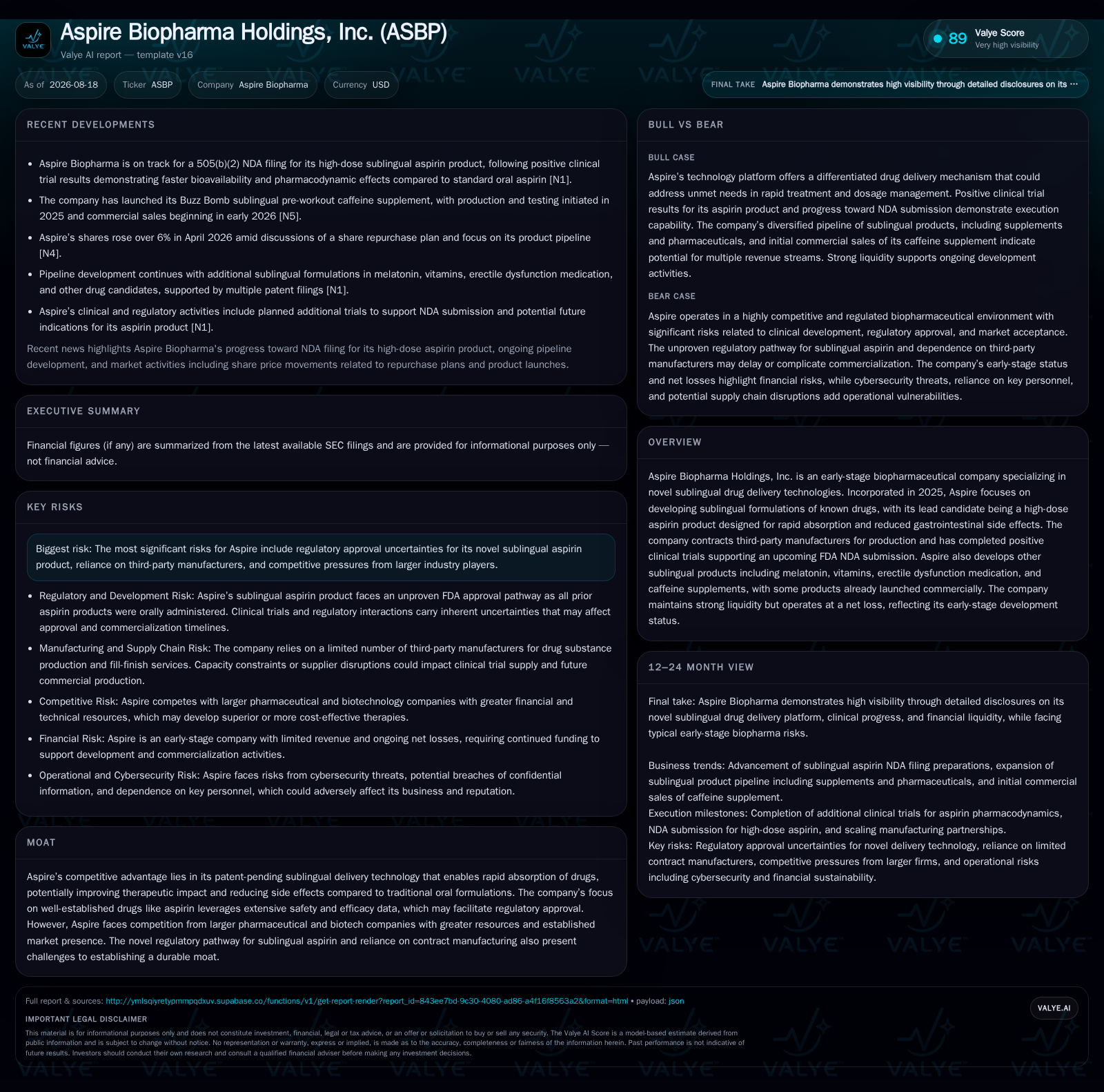
Aspire Biopharma Holdings, Inc. is an early-stage biopharmaceutical company focused on developing sublingual formulations of established drugs, led by a novel high-dose aspirin designed for rapid absorption and reduced gastrointestinal impact. The company reported continued clinical progress toward an anticipated NDA filing while maintaining partnerships with contract manufacturers such as Glatt and Microsize. Despite early-stage challenges including ongoing net losses and dependence on external manufacturing, Aspire’s patent-pending delivery platform offers differentiation that could address unmet needs in rapid analgesia and vascular protection. The company’s balance sheet at quarter-end shows a strong current ratio and cash position to support near-term development activities.
Recent Operating Update
Business Model Overview
Aspire operates primarily as a developer of novel sublingual drug delivery formulations for known pharmaceuticals and nutraceuticals. Its monetization strategy focuses on eventual direct commercial sales post-FDA approval alongside potential licensing deals featuring upfront payments, clinical milestone achievements, and royalties—although no active licenses or collaborations currently exist [S1]. The technology centers on a patent-pending sublingual platform enabling faster pharmacokinetics versus traditional oral forms, translating into potentially superior therapeutic profiles through enhanced drug absorption and tolerability.
Manufacturing is fully outsourced to specialized contract manufacturers compliant with current good manufacturing practices (cGMP). For instance, Glatt has been instrumental in producing clinical trial supplies of the lead aspirin product, with Microsize contracted recently for additional formulation manufacture [S1]. While these partnerships allow capital-efficient scale-up without internal facility investments, the company notes that existing third-party capacity may be inadequate for commercial demands without further agreements or scaling efforts.
Aspire also markets several nutraceutical products including sublingual melatonin, vitamins, caffeine supplements, and erectile dysfunction medications—providing early revenue streams albeit at relatively low levels ($63K revenue most recently) given the predominance of developmental activities [F1]. The company targets specialist physicians whose prescribing behaviors could accelerate adoption of its lead drug candidates upon approval, backed by plans to establish dedicated medical affairs teams in the United States [S1].
Industry Structure and Competitive Position
Aspire inhabits the upstream segment of the biopharmaceutical value chain focused on formulation innovation rather than original new chemical entities. This niche intersects domains typically populated by early-stage developers experimenting with alternative drug delivery methods (e.g., AcelRx Pharmaceuticals), contract development/manufacturing organizations (CDMOs) like Catalent serving similar innovators, and larger pharmaceutical companies deploying their own reformulated known drugs.
Its patent-pending sublingual technology provides a technically defensible moat by addressing well-known limitations of oral aspirin absorption—critical for indications demanding rapid onset or better safety profiles. However, market acceptance hinges heavily on successful FDA review given the novelty relative to legacy oral aspirin products.
Competition includes both large pharmas that might develop their own reformulations with broader marketing power—and established over-the-counter aspirin brands with entrenched physician/patient familiarity. Aspire’s need to educate prescribers about sublingual advantages can limit initial uptake while collaborating CMOs must effectively scale production quality without operational disruptions—challenges common for similarly sized biotechs transitioning from clinical-stage to commercialization.
Growth Drivers
The primary growth catalyst lies in imminent FDA NDA submission for the lead product following successful clinical trials evidencing rapid absorption kinetics and favorable safety outcomes compared to oral aspirin formulations [N1]. Regulatory approval would open pathways to direct sales revenue and licensing opportunities accelerating cash inflows beyond current nutraceutical sales.
Expansion of its pipeline through additional sublingual drugs could diversify revenue streams. Moreover, given evolving patient preferences for convenience and rapid onset medicines across various therapeutic areas, Aspire's innovative delivery platform addresses an industry trend likely to support broader application demand.
Strategic partnerships remain a critical lever enabling resources infusion via licensing or co-commercialization deals. Furthermore, improvements in formulation science may reduce R&D cycles or facilitate portfolio expansion enhancing competitive positioning.
Risks and Watchpoints
Regulatory uncertainty poses a prominent risk due to limited precedent for high-dose sublingual aspirin approval; existing approvals pertain exclusively to oral routes. Any unforeseen FDA concerns arising from this novel route could delay approvals or necessitate additional costly trials impacting timelines.
Reliance on third-party manufacturing creates operational exposure; production bottlenecks or failure to meet cGMP standards at partners like Glatt or Microsize could interrupt supply continuity essential for registration-enabling trials or commercial launch scalability.
Commercially, competing against incumbents with deep marketing infrastructures presents market share capture challenges. Physician adoption inertia towards new delivery modes also influences uptake speed despite pharmacological benefits.
From a financial standpoint, historical net losses reflect typical early-stage biopharma burn rates driven by R&D spend—necessitating continuous funding rounds. Failure to raise capital timely could force downsizing or delay progress [F1], [S1]. Intellectual property protection effectiveness directly affects competitive durability—any patent disputes or lapses would materially impair strategic advantage.
What to Watch Next
Near term milestones revolve around:
- Submission and acceptance of the FDA New Drug Application (NDA) for the high-dose sublingual aspirin,
- Continued scaling arrangements or contracts with CMOs ensuring commercial readiness,
- Expansion or clarification of licensing/collaboration initiatives providing non-dilutive capital,
- Progression in pipeline additions emphasizing formulation advancements for other approved drugs,
- Execution of commercialization infrastructure build-out targeting identified physician specialists,
- Monitoring cash runway metrics relative to operating expense trends post-August debt raise making evaluating financing sufficiency essential.
Any delays in these areas could influence timing of product revenue generation and overall valuation prospects.
Financial Profile Discussion
As of June 30, 2026, Aspire held approximately $12.2 million in cash and cash equivalents against modest total debt estimated near $1.3 million reflecting low leverage relative to liquidity [F1]. This results in an exceptionally healthy current ratio close to 8x—a strong buffer supporting operating expense coverage through upcoming phases including NDA review periods [F1].
Recent equity-linked debt financing arrangements provide additional working capital flexibility but emphasize continued reliance on external funding sources until meaningful product revenues materialize [S3], [S17], [S21]. Cost discipline alongside successful milestone achievement will be critical metrics gauging progress toward sustainable financial footing.
This analysis synthesizes recently filed SEC disclosures combined with industry-specific context relevant for early-stage biotherapeutic developers leveraging novel drug delivery technologies. It avoids speculative forecasts beyond disclosed information while situating Aspire Biopharma’s operational trajectory within sector norms involving regulatory milestones reliance, outsourced CMO dependencies, technology-driven differentiation opportunities, and typical financial burn characteristics inherent to innovative pharmaceutical startups.
Disclaimer: This is research-only, informational analysis and not investment advice. It may include AI-generated interpretation and general industry context. Always verify important details using primary sources.

Comments