
Assembly Biosciences Advances Clinical Pipeline with Gilead Collaboration Enhancing HPI Program Development
Assembly Biosciences progresses multiple antiviral therapeutic candidates, supported by a strategic license agreement with Gilead Sciences, while managing ongoing operating losses and capital allocation to sustain clinical advancement.
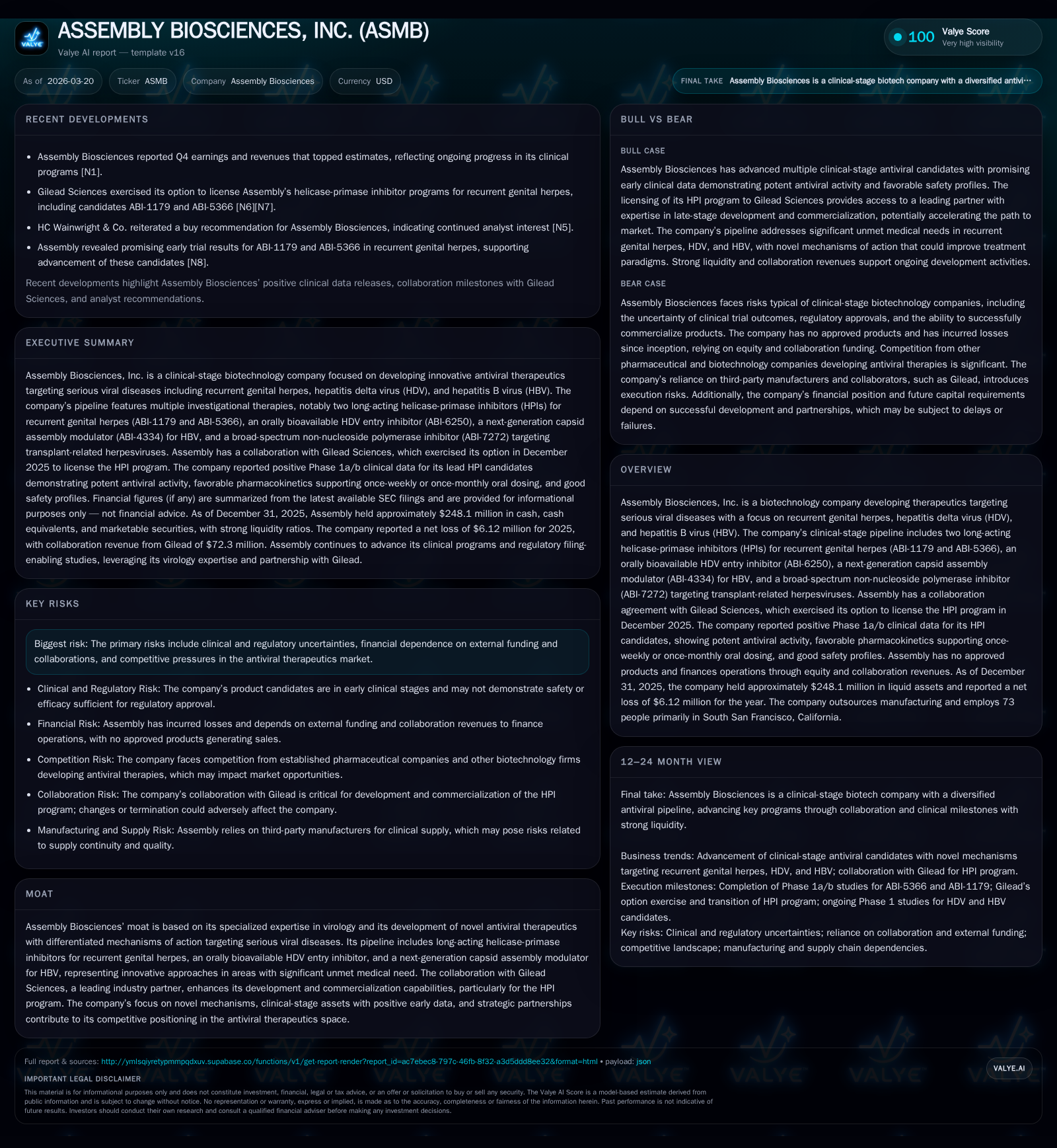
Assembly Biosciences is developing innovative antiviral therapies targeting recurrent genital herpes, hepatitis delta virus (HDV), hepatitis B virus (HBV), and transplant-related herpesviruses. Key clinical milestones in 2025 include positive Phase 1a/b results for long-acting helicase-primase inhibitors (HPIs) and the licensing of the HPI program to Gilead Sciences in December 2025. The company continues to invest heavily in R&D, reflected in ongoing operating losses and negative cash flow. With cash reserves supporting operations into 2028 and equity growth from recent financings, Assembly is positioned to advance late-stage trials, including Phase 2 initiation for its HDV candidate in late 2026 and regulatory filing-enabling studies for its broad-spectrum NNPI candidate.
Clinical Pipeline Progress and Strategic Collaboration
Assembly Biosciences focuses on innovative antiviral therapeutics addressing significant unmet medical needs across viral diseases. Its pipeline features two long-acting helicase-primase inhibitors (HPIs), ABI-1179 and ABI-5366, targeting recurrent genital herpes caused by HSV-1 and HSV-2. These HPIs inhibit the viral helicase-primase complex — a unique viral enzyme essential for DNA replication absent in humans — allowing immediate activity upon viral reactivation without requiring phosphorylation by viral thymidine kinase [S1][S2].
In 2025, Assembly reported positive Phase 1a interim results for ABI-1179 in February and favorable Phase 1b interim data from weekly and monthly dosing cohorts of ABI-5366 between August and December. These data indicate potent antiviral effects with pharmacokinetics supportive of once-weekly or once-monthly dosing regimens [S1].
Additional progress includes ABI-6250, an orally bioavailable HDV entry inhibitor that completed Phase 1a studies successfully, positioning it for expected Phase 2 initiation in late 2026 [S1][S2]. The next-generation HBV capsid assembly modulator ABI-4334 achieved positive topline Phase 1b results mid-year but is currently undergoing active partnering efforts to support further development due to the program's capital intensity [S1].
The broad-spectrum non-nucleoside polymerase inhibitor (NNPI) candidate ABI-7272 is advancing preclinically through regulatory filing enabling studies targeting transplant-associated herpesviruses after transitioning from prodrug ABI-7423 [S1][S2]. This diverse portfolio underscores Assembly’s expertise in antiviral drug development.
In December 2025, Gilead Sciences exercised its option to license Assembly’s HPI program encompassing ABI-1179 and ABI-5366. This collaboration transfers substantial late-stage development costs to Gilead while allowing Assembly potential profit-sharing contingent on opt-in decisions post-clinical plan review [S1][S3][N1]. This partnership provides validation of Assembly’s assets and leverages Gilead's resources for commercialization.
Financial Overview: Historical Performance Table
Assembly exhibits typical biotech financial characteristics marked by sustained operating losses amid heavy R&D investment. Key financial metrics up to fiscal year-end 2025 are summarized below [F1]:
Historical performance (annual)
| FY | Net ($mm) | CFO ($mm) | OpInc ($mm) | Capex ($) | Net YoY |
|---|---|---|---|---|---|
| 2025 | -6 | -41 | -12 | 66000 | +84.8% |
| 2024 | -40 | -51 | -45 | 28000 | +34.4% |
| 2023 | -61 | 23 | -65 | 255000 | +34.2% |
| 2022 | -93 | -84 | -94 | 102000 |
Source: SEC companyfacts cache [F1].
Capital returns and efficiency (annual)
| FY | FCF ($mm) | ROE% |
|---|---|---|
| 2025 | -41 | -3.0 |
| 2024 | -51 | -120.4 |
| 2023 | 22 | -149.0 |
| 2022 | -85 | -112.6 |
Source: SEC companyfacts cache [F1].
*Note: Latest available revenue figure is from FY2019.
The data show significant improvement in operating income and net losses between FY2024 and FY2025 reflecting cost management or reduced expenses as programs mature. Despite this progress net income remains negative consistent with the company’s developmental stage. Operating cash flow outflows remain material at approximately $41 million reflecting continued investment in clinical trials. Capital expenditures are minimal relative to overall spending emphasizing focus on research rather than fixed assets.
Liquidity remains strong with cash and equivalents around $58 million at end-FY25 alongside a current ratio above five indicating solid short-term financial stability [F1][S7]. Shareholders’ equity expanded substantially from roughly $33 million at end-FY24 to over $206 million at end-FY25 due to equity financings including private placements involving Gilead that support ongoing drug development [F1][S16].
Upcoming Clinical and Regulatory Milestones
Key near-term catalysts include:
- Initiation of Phase 2 trials for HDV entry inhibitor ABI-6250 expected in calendar Q4 of 2026 following completion of preparatory studies [S1][N1].
- Continuation of regulatory filing enabling preclinical studies for broad-spectrum NNPI candidate ABI-7272 targeting transplant-associated herpesviruses [S1].
- Active partnering efforts underway to advance HBV capsid assembly modulator ABI-4334 beyond Phase 1b readouts given its capital-intensive clinical pathway [S1].
Investors should monitor trial progress including enrollment rates and safety/efficacy outcomes particularly as registrational studies approach pivotal stages where viral load suppression durability will be critical endpoints. Engagements with regulatory agencies regarding study design acceptability remain important alongside manufacturing scale readiness.
Capital Allocation Strategy and Returns Overview
Assembly currently does not pay dividends or conduct share buybacks reflecting prioritization of reinvestment into pipeline advancement [F1]. The company’s capitalization profile is shaped by reliance on equity financings complemented by strategic collaborations such as its agreement with Gilead.
As of December 31, 2025:
- Cash plus marketable securities totaled approximately $248 million providing operational runway well into future years under current forecasts [S7][F1].
- Shareholders’ equity surged reflecting recent financings underpinning R&D investments critical for clinical progression [F1][S16].
- Return on equity remains negative roughly at -3%, typical for companies in pre-commercial stages investing heavily without product revenues yet realized [F1].
- Operating cash flow outflows nearing $41 million annually highlight ongoing capital consumption aligned with asset development phases.
This financial profile aligns closely with mid-to-late stage biotechs transitioning toward commercialization while balancing capital efficiency.
Risk Considerations Impacting Outlook
Assembly faces standard risks inherent to biotech innovation compounded by antiviral-specific challenges:
- Clinical trial outcomes remain uncertain particularly given complexities of latent/reactivating viral infections targeted by HPIs or chronic hepatotropic viruses requiring validated surrogate biomarkers [S4][S5].
- Regulatory landscapes continue evolving necessitating adaptable study designs which may extend timelines or increase costs [S14][S18].
- Dependency on external funding sources including equity markets and collaborations introduces volatility risks affecting resource availability for trials [S7][S11].
- Healthcare policy reforms focused on drug pricing negotiation may constrain pricing power post-launch impacting commercial viability despite unmet medical need claims [S6][S9][S17].
Institutional investors typically weigh these factors against scientific innovation depth when valuing emerging antivirals addressing indications like genital herpes or hepatitis delta.
Mechanistic Innovation: Differentiated Antiviral Approaches
Assembly’s candidates utilize distinctive mechanisms:
HPIs target the HSV helicase-primase complex permitting immediate antiviral action post-reactivation unlike nucleoside analogs dependent on viral kinase activation steps. This may reduce resistance emergence risks while extended dosing regimens enhance adherence potential [S1].
HBV capsid assembly modulators like ABI-4334 disrupt multiple replication cycle points including nucleocapsid formation crucial for viral genome packaging offering prospects toward functional cure strategies beyond viral suppression.
Broad-spectrum NNPIs aim at transplant-associated herpesviruses addressing immunocompromised populations through oral formulations pending successful regulatory clearance.
In summary: Assembly Biosciences combines mechanistic novelty with pragmatic delivery advantages which if confirmed in pivotal trials could translate into clinically meaningful improvements over existing therapies.
Disclaimer: This report synthesizes publicly available information as of early 2026 without offering investment advice or recommendations regarding Assembly Biosciences securities.
Disclaimer: This is research-only, informational analysis and not investment advice. It may include AI-generated interpretation and general industry context. Always verify important details using primary sources.

Comments