
Strive, Inc.'s Transition to Public Bitcoin Treasury Asset Management Challenges Profitability and Risk Profile
Strive, Inc. leverages an innovative structured finance model focused on bitcoin-based capital allocation while integrating a healthcare technology segment to diversify revenue streams.
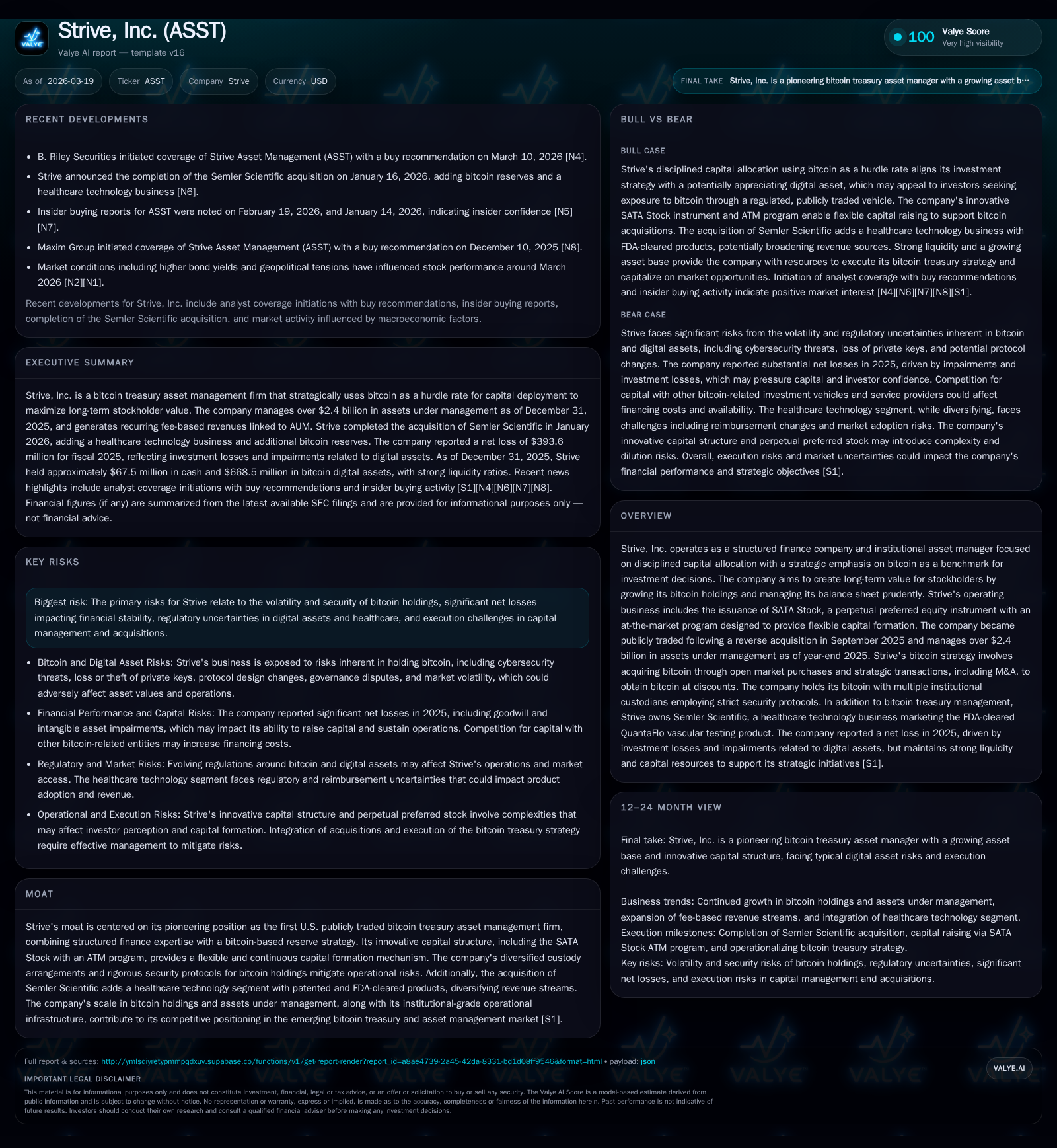
Strive, Inc., newly public as of September 2025 following a reverse acquisition and pioneering the U.S. publicly traded bitcoin treasury asset management space, manages over $2.4 billion in assets with a distinctive strategy centered on bitcoin as its performance benchmark. Despite marked revenue growth from prior years, the company faces substantial operating losses totaling over $241 million in 2025, driven partly by goodwill impairments related to acquisitions and ongoing operational scaling costs. Its capital structure innovations, including the issuance of perpetual preferred equity (SATA Stock) with ATM programs for flexible funding, position it uniquely in capital markets, though regulatory and market risk remain key challenges due to bitcoin volatility and healthcare compliance exposure. Operating cash flows remain negative amid heavy investing and financing activities aimed at increasing bitcoin holdings and expanding business lines.
Company Overview and Historical Growth
Strive, Inc. (Nasdaq: ASST) positions itself at the intersection of traditional institutional finance and emerging digital asset management by centering its capital allocation philosophy on bitcoin as a performance benchmark [S1]. This strategic adoption dictates that all capital deployment decisions meet or exceed bitcoin’s appreciation potential rather than fiat benchmarks — setting higher accountability thresholds given bitcoin’s historical volatility yet anticipated long-term value retention.
The company transitioned into the public markets via a reverse acquisition completed on September 12, 2025 [S1], becoming the first U.S.-listed entity explicitly dedicated to bitcoin treasury asset management. This move facilitated rapid scale: Strive reported managing over $2.4 billion of assets under management (AUM) by December 31, 2025 [S1]. These AUM underpin fee revenues tied to investment advisory services and fund management activities.
Revenues remained modest historically—$633K in fiscal year 2024—but show marked acceleration compared to previous years ($277K in ’23; $343K in ’22) [F1]. The sharp jump aligns with organizational transformations around the reverse merger and broadening of services consistent with institutional-grade asset management platforms.
Historical performance (annual)
| FY | Rev ($) | Net ($mm) | CFO ($mm) | OpInc ($mm) | Rev YoY | Net YoY |
|---|---|---|---|---|---|---|
| 2025 | -394 | -25 | -241 | -6055.8% | ||
| 2024 | 633489 | -6 | -5 | -6 | +128.7% | -29.7% |
| 2023 | 277038 | -5 | -4 | -5 | -19.3% | -664.2% |
| 2022 | 343106 | -1 | -1 | -1 |
Source: SEC companyfacts cache [F1].
Capital returns and efficiency (annual)
| FY | FCF ($mm) | ROE% |
|---|---|---|
| 2025 | -25 | -67.6 |
| 2024 | -5 | -229.5 |
| 2023 | -4 | -168.7 |
| 2022 | -419.6 |
Source: SEC companyfacts cache [F1].
Note: Operating income and net income for FY2025 reflect substantial impairment charges mostly linked to goodwill from recent acquisitions.
Profitability Challenges and Capital Allocation
The widening net losses (-$394M in ‘25 vs. -$6.4M in ‘24) predominantly stem from non-cash goodwill impairments associated with Strive’s merger-related purchase accounting [F1][S1]. The acquisition of Semler Scientific contributes materially here — bringing not only a healthcare tech footprint but also legacy regulatory challenges [S1][S7]. This step diversifies revenue potential beyond pure digital asset custody fees but introduces complexities associated with FDA regulations and healthcare fraud risk exposures that have entailed settlements including a $29.8 million payment resolving False Claims Act allegations [S7][S15].
Cash flow-wise Strive ended ’25 with negative operating cash flow (-$25M) underscoring ongoing operating expenses exceeding current revenues as the business scales post-acquisition [F1][S18]. Capex remains modest ($12K), typical for asset managers focused on balance sheet investments over physical infrastructure.
Capital raising efforts were aggressive — PIPE transactions closed around the time of listing raised gross proceeds exceeding $749 million facilitating both operational funding and substantial bitcoin purchase capacity [S16][S19]. Concurrently Strive issued SATA Stock — a novel perpetual preferred equity security allowing flexible capital deployment via ATM offerings — with initial aggregate proceeds near $148 million post-IPO pricing [S19][S20]. A parallel Class A common stock ATM program permits up to $450 million issuance capacity [S19]. Despite authorizing a sizeable share repurchase program ($500 million), no repurchases occurred through end-2025 evidencing a capital preservation or growth intent at this stage [S6][S19].
Operating Model: Bitcoin Treasury Strategy
Central to Strive's differentiated moat is its pioneering stance as an institutional manager employing structured finance techniques oriented around bitcoin reserves [S1]. Unlike passive holders or exchange-traded product sponsors who simply track bitcoin prices, Strive maintains an active treasury strategy:
- Periodic open-market purchases using available cash,
- Strategic acquisitions including mergers (e.g., Semler Scientific deal providing discounted bitcoins),
- Employing multiple geographically dispersed custodians with institution-grade security protocols to mitigate operational risks.
As of mid-March 2026 Strive reported holding approximately 13,628 bitcoins – representing its core reserve base measured against which investment returns are judged [S20]. This sizable stake supports fee structures linked to AUM growth but exposes the firm materially to cryptocurrency market swings and evolving regulatory scrutiny inherent in virtual currency ecosystems.
Semler Scientific Acquisition: Healthcare Tech Diversification
In January 2026 Strive finalized merging Semler Scientific into its wholly owned subsidiary structure adding both existing bitcoin reserves for its treasury pool and an operational business targeting chronic disease diagnostics via patented medical devices such as QuantaFlo — a non-invasive tool measuring peripheral arterial blood flow aiding PAD diagnosis [S1][S7].
While this enhances revenue diversification potential beyond volatile crypto markets through technology product sales and healthcare service contracts that generate recurring revenues with expected margin benefits over time [N4], it concurrently increases regulatory compliance obligations:
- Semler faces FDA oversight including ongoing clearance efforts for expanded device labeling,
- Corporate Integrity Agreements imposed post-settlement require stringent sales practice monitoring,
- Exposure to anti-kickback regulations and False Claims Act liabilities present ongoing legal risks.
These entail heightened legal diligence burdens alongside potential financial contingencies that could weigh on near-term earnings volatility [S15].
Liquidity Position and Capital Structure Strengths
Despite significant net losses noted above Strive’s balance sheet exhibits robust liquidity positioning delivering strategic operational flexibility. At December 31st 2025 total liquidity – comprising cash & equivalents plus short-term investments plus fair-value marked digital assets – totaled approximately $67.5 million in cash & equivalents alone versus notably low current liabilities (~$10.8 million), yielding a conservative current ratio near 6.7x indicative of ample near-term cash buffer [F1][S13][S23].
Operating leases represent manageable commitments (~$5.4 million undiscounted), partially subleased mitigating net cash impact [S18], while the absence of long-term debt preserves unencumbered balance sheet status seeding optionality.
Capital gains realization is not prioritized given stated intent to hold bitcoin reserves indefinitely barring tactical liquidity needs supporting working capital requirements [S16]. Forward liquidity relies heavily on continued equity capital raises through proven ATM facilities alongside prudent balance sheet stewardship.
Considerations on Returns and Market Potential
Strive projects operating results within an astute range between minor single-digit million dollar losses or profits for its asset management segment starting fiscal year 2026 reflecting scaling cost absorption balanced against increasing fee income potential from growing AUM base complemented by biotech-derived recurring revenues [N4][S1].
However key performance milestones rest critically upon:
- Stable or appreciating bitcoin prices preserving reserve value,
- Successful execution of acquisition integration particularly Semler’s portfolio,
- Regulatory navigation minimizing fines or costly settlements,
- Ability to modulate capital structure dynamically via SATA Stock ATM issuances balancing dilution against funding needs.
Given tensions between large impairments impacting earnings quality versus nascent fee growth streams this phase remains transformational yet financially delicate.
Risks Summary
Major risk vectors identified by management include cryptocurrency price volatility which historically can exhibit extreme fluctuations impacting portfolio valuations; security vulnerabilities despite multi-custodian approaches; continued uncertainties surrounding federal and state regulatory frameworks governing digital assets; healthcare regulatory compliance complexity enhanced by recent settlement terms paired with ongoing litigation exposure involving Semler Scientific legacy matters ; execution risks around sustaining disciplined capital allocation amid rapid business evolution; and macroeconomic impacts influencing cost of capital availability or investor sentiment towards disruptive structured finance models [N2].
Conclusion: Strategic Innovation with Execution Challenges Ahead
Strive embodies an innovative overlay blending structured finance techniques and cutting-edge digital asset adoption through its unprecedented launch as a public bitcoin treasury asset manager combined with diversification into regulated healthcare technology solutions. Although top-line growth is emergent accompanied by promising scale in digital asset holdings surpassing billions under management alongside sophisticated capital markets strategies—these are overshadowed presently by significant accruals impairing operating profitability requiring cautious attention.
Investors should monitor upcoming quarterly disclosures for clear signals regarding trajectory toward sustained profitability combined with risk management efficacy across volatile cryptocurrency environments and complex regulatory landscapes.
This report is prepared for informational purposes only based on currently available data without any form of investment advice or recommendation.
Disclaimer: This is research-only, informational analysis and not investment advice. It may include AI-generated interpretation and general industry context. Always verify important details using primary sources.

Comments