
ATN International's 2025 Turnaround Supported by Tower Divestiture and Regulatory Challenges
Despite flat revenues and a net loss in 2025, ATN International’s significant tower portfolio sale and infrastructure moat underpin its outlook amid regulatory headwinds.
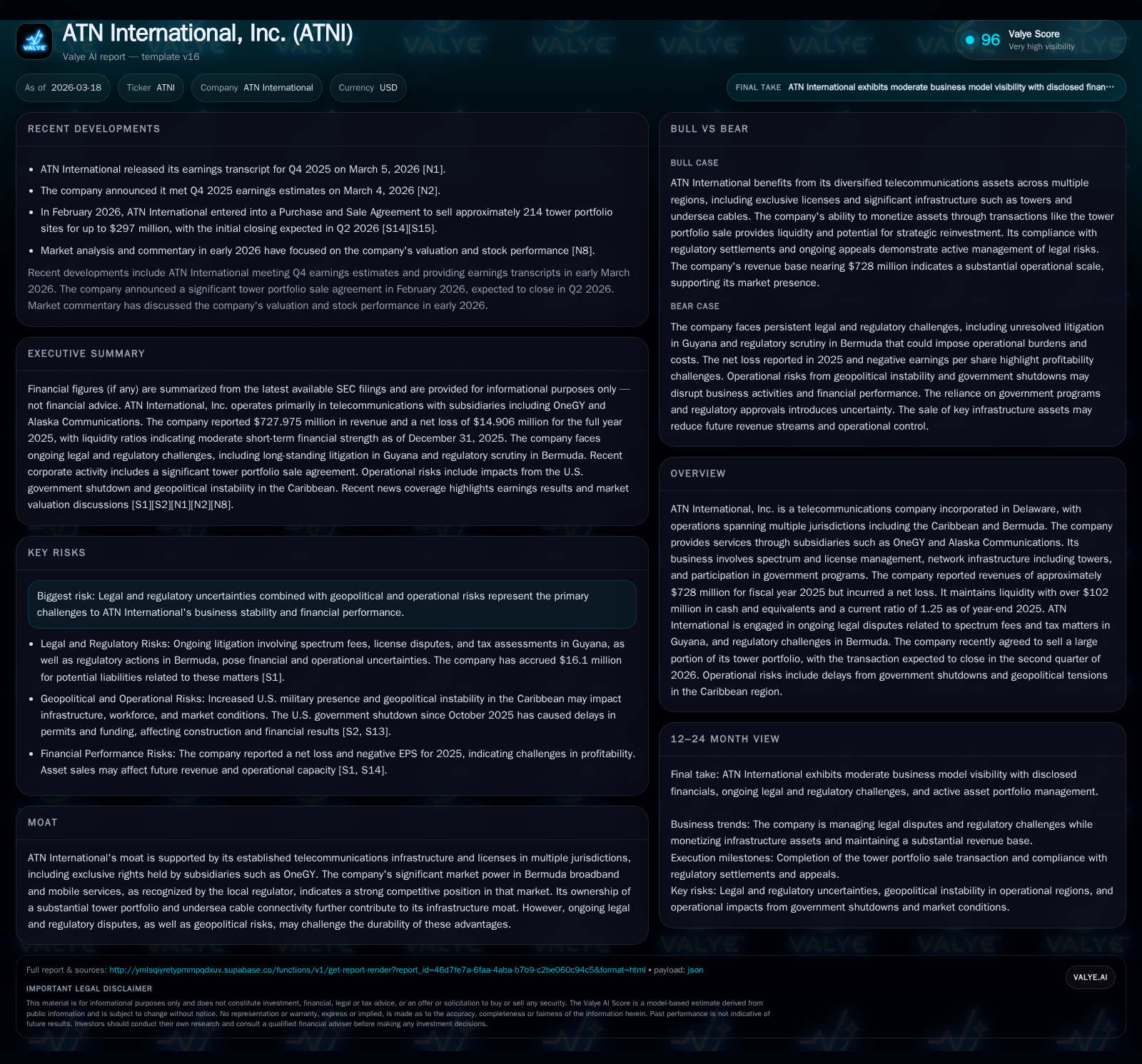
ATN International navigated a challenging 2025 marked by stable revenues near $728 million but a net loss of $14.9 million, stemming from legal disputes and operational pressures in key regions like Guyana and Bermuda. The company’s operating income improved sharply due to better cost management. A pivotal catalyst is the recent agreement to sell the majority of its tower portfolio for up to $297 million, expected to close in mid-2026, which should free capital and streamline operations. However, ongoing regulatory disputes and geopolitical risks in its Caribbean markets remain substantial uncertainties that could temper growth and returns.
Historical Performance
ATN International has exhibited revenue stability over recent years with revenue moving from $726M in 2022 to a peak of $762M in 2023 before easing back near $728M in 2025 [F1]. This essentially flat topline masks an operational reset; most notable is the swing from a minor operating loss of approximately -$0.8M in 2024 to a $28.4M operating profit in the latest fiscal year—an improvement over prior years reinforced by effective cost controls and operational streamlining.
Net income paints a different picture, with the company incurring a loss of about $14.9M in 2025 after consecutive profitable years previously. This negative bottom line reflects accumulated charges related to legal contests including settlements like the $6.3 million FCC compliance agreement payment connected with its Alaska Communications subsidiary, and accrued liabilities linked to ongoing disputes primarily centered on spectrum fees and tax assessments primarily involving OneGY in Guyana [F1][S4][S6].
Capex trended downward significantly, from over $168M in 2022 to roughly $90M in 2025, indicative of a reduced investment cycle probably connected with planned asset divestitures including its tower portfolio sale [F1][S16]. Operating cash flow increased steadily throughout this period reaching approximately $134M last year, highlighting strong cash generation despite profitability challenges.
Historical performance (annual)
| FY | Rev ($mm) | CFO ($mm) | OpInc ($mm) | Capex ($mm) | Rev YoY |
|---|---|---|---|---|---|
| 2025 | 728 | 134 | 28 | 90 | -0.2% |
| 2024 | 729 | 128 | -1 | 110 | -4.3% |
| 2023 | 762 | 112 | 13 | 163 | +5.0% |
| 2022 | 726 | 103 | 8 | 168 |
Source: SEC companyfacts cache [F1].
Capital returns and efficiency (annual)
| FY | Div ($mm) | Buybacks ($mm) | FCF ($mm) |
|---|---|---|---|
| 2025 | 16 | 10 | 44 |
| 2024 | 15 | 10 | 18 |
| 2023 | 13 | 15 | -52 |
| 2022 | 11 | 1 | -65 |
Source: SEC companyfacts cache [F1].
Note: Net income figures for FY24–22 were not provided explicitly; only FY25 net income is available.
Forward Growth Prospects
Growth drivers are anchored chiefly on infrastructure ownership across multiple sparsely served geographies including the Caribbean islands and Alaska through subsidiaries such as OneGY and Alaska Communications [N1][S7]. The company benefits from exclusive spectrum rights granted to OneGY in Guyana, assets critical for broadband penetration within underserved markets that typically see long-term demand growth due to connectivity needs.
Importantly, ATN’s substantial holdings of communication towers plus undersea cables constitute significant physical moats that support recurring revenue streams via leasing arrangements with mobile network operators and other telecom providers [S16][S23]. The recent announcement agreeing to sell approximately nearly all of these towers for up to $297 million reflects a pivot towards asset monetization intended to enhance balance sheet flexibility without sacrificing operational footprint thanks to leaseback agreements ensuring continued site access post-sale.
While this reduces capital intensity moving forward, it also shifts certain risks onto third-party infrastructure managers.
Regulatory interactions represent a material constraint: ongoing litigation stemming from how spectrum fees are calculated and tax disputes specifically related to Guyanese operations cast uncertainty on future cost structures and profitability margins [S1][S4][S6]. The Bermuda market adds complexity where ATN was declared as having significant market power subjecting it to regulatory price caps and wholesale obligations—currently under appeal—with potential operational costs if these rulings are upheld [S5].
Furthermore, geopolitical risk heightened by increased U.S. military presence in the Caribbean could disrupt operations or impact infrastructure security given the regional footprint extending well beyond conventional telecom exposures [S2].
Upcoming Milestones & Monitoring Points
- Closing of the tower portfolio sale expected around Q2 2026 remains paramount; final purchase price subject to adjustments based on closing conditions [S16][S23].
- Resolution over spectrum fee methodology in Guyana litigation could remove substantial accounting uncertainties; timing remains indeterminate as appeals continue since suit filings over a decade ago [S1][S6].
- Outcome of Bermuda Supreme Court review regarding imposed ex-ante regulatory remedies is another critical determinant that could influence pricing strategy going forward [S5].
- Compliance under FCC agreements following settlement payments signals risk mitigation but ongoing oversight measures persist especially for Alaska Communications' Rural Health Care program participation [S4].
- Impact from extended U.S. government shutdowns affects permitting timelines essential for network expansions or repairs mainly subjecting capital projects schedules at risk until normal government operation resumes fully [S2].
Capital Allocation & Returns Context
ATN reported approximately $44 million free cash flow (operating cash flow minus capex) for FY25 evidencing sound cash-generative ability despite headline losses ([F1]). Cash balances exceed $102 million providing liquidity cushion while the current ratio stands at a healthy ~1.25 indicating short-term solvency strength.
Dividends paid reached approximately $15.7 million indicating steady shareholder returns supported firmly by operating cash flows rather than net profits given the reported net loss last year [F1][S17][S19]. Share repurchases appear modest historically around or below $10 million annually reflecting cautious capital deployment likely balanced against funding requirements for litigation exposures and tower sale-related transaction costs.
Equity base declined somewhat alongside net losses trailing off from near half a billion dollars into mid-$444 million by end-2025 possibly compounded by accrued liabilities related to lawsuits and settlements [F1]. Return on equity based on trailing values was negative approximately -3.4% reflecting profitability challenges typical in companies grappling simultaneously with growth investments and legal/regulatory headwinds.
Industry & Strategic Analysis
ATN’s geographic footprint across emerging telecom markets poses both opportunity and complexity uncommon among domestically focused peers; their large-scale infrastructure assets command considerable entry barriers locally but require navigating multifaceted regulatory landscapes which raise compliance costs.
The decision to monetize core tangible infrastructure while retaining operational control via leases aligns with trends seen globally among telecom operators seeking capital-efficient models amid competitive pressure from wireless internet service providers (WISPs) expanding fixed wireless access technologies.
Connectivity demand continues growing strongly worldwide but within niches such as Caribbean island nations or rural American states served by ATN operations can be highly sensitive to macroeconomic instability as governments fluctuate policies or budget priorities impacting subsidies or licensing regimes.
Reliance on indirect spectrum fee negotiations highlights vulnerabilities: unlike markets with transparent auction-based spectrum pricing mechanisms, ATN contends with administrative processes prone to reinterpretations prolonging dispute resolution substantially.
This pattern necessitates conservative financial provisioning as seen through recognized accruals totaling about $16 million covering potential adverse rulings—a prudent approach given historical volatility.
Conclusion
ATN International presents a nuanced profile characterized by asset-backed stability interwoven with complex jurisdictional risks manifesting as persistent litigation exposure impacting earnings variability. Strong operating cash flows combined with strategic monetization efforts position the company for enhanced financial flexibility providing buffer amid legal uncertainties. Investors monitoring upcoming closure of its major tower portfolio transaction alongside key judiciary outcomes—especially relating to spectrum fees—should gain clearer visibility into sustainable earnings capacity. Despite these headwinds, ATN's entrenched market positions offer enduring moats essential for long-run viability within fragmented telecommunications landscapes uncommon among larger diversified players.
Disclaimer: This analysis is informational only and does not constitute investment advice or recommendations regarding securities of ATN International, Inc.
Disclaimer: This is research-only, informational analysis and not investment advice. It may include AI-generated interpretation and general industry context. Always verify important details using primary sources.

Comments